
Tree Insect and Pest Pressure in North Texas
Professional Tree Pest Identification and Plant Healthcare for the DFW Metroplex
Trees across North Texas and the DFW Metroplex face constant pressure from insects and other plant pests that can weaken trees, damage foliage, disrupt vascular systems, and in severe cases cause tree mortality. Proper identification of pest pressure is one of the most critical steps in protecting valuable shade trees, ornamental plantings, and landscape investments.
At Truly Arbor Care, our plant healthcare programs are built on science-based diagnostics and professional arboriculture standards. Our ISA Certified Arborists follow ANSI A300 tree care standards and TCIA plant healthcare protocols to properly identify insect infestations and recommend targeted treatment strategies.
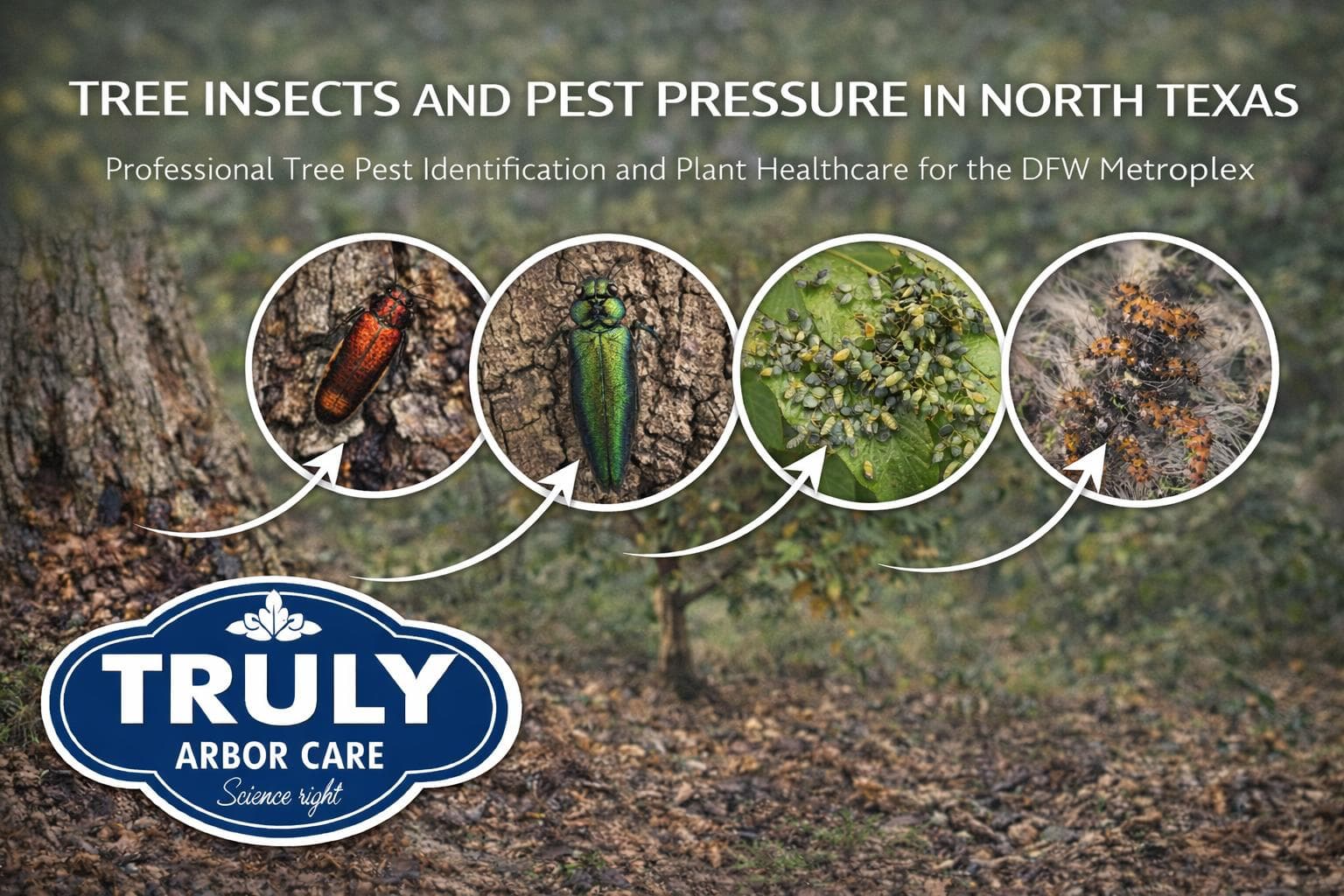
This pest identification library provides a comprehensive guide to the most common insects and pest pressures affecting trees and shrubs throughout North Texas. Each pest listed within this section includes scientific background, host species, damage symptoms, environmental triggers, and professional plant healthcare treatment options.
Correct pest identification combined with early intervention often allows arborists to stop infestations before they spread and cause permanent damage to the tree.
⸻
Why Proper Pest Identification Matters
Many tree pests produce damage symptoms that can easily be mistaken for disease or environmental stress. Leaf discoloration, canopy thinning, branch dieback, and bark damage may result from insects feeding on leaves, boring into stems, or attacking root systems.
Without proper identification, treatments may fail to address the underlying problem.
ISA Certified Arborists are trained to diagnose pest pressure through careful evaluation of:
- Host tree species
- Feeding patterns
- Seasonal pest cycles
- Environmental stress conditions
- Scientific research from institutions such as Texas A&M AgriLife Extension
Accurate identification allows arborists to apply targeted Integrated Pest Management (IPM) strategies that protect trees while minimizing unnecessary pesticide use.
⸻
Common Tree Pests Affecting North Texas Landscapes
The warm climate and long growing season across North Texas create favorable conditions for many insect pests. Trees in the DFW Metroplex may experience pressure from a wide variety of insects that feed on leaves, bark, roots, and vascular tissues.
Common insect groups affecting trees in North Texas include:
- Borers and wood-boring insects
- Sap-feeding insects such as aphids, scale insects, and lace bugs
- Leaf-feeding caterpillars and defoliators
- Gall-forming insects
- Beetles that attack stressed trees
- Mites that damage foliage
Each insect group causes different types of damage and requires different treatment approaches.
Some pests primarily affect aesthetics, while others may severely weaken trees and create structural hazards.
⸻
Environmental Stress and Pest Outbreaks
Most severe insect infestations occur when trees are already under environmental stress.
Common stress factors affecting trees throughout the DFW Metroplex include:
- Drought conditions
- Extreme summer heat
- Soil compaction
- Construction damage to root systems
- Poor soil drainage
- Improper watering practices
When trees become stressed, their natural defense mechanisms weaken. This allows opportunistic insect pests to colonize the tree more easily.
Texas A&M research consistently shows that maintaining tree health is one of the most effective ways to reduce pest outbreaks.
⸻
Integrated Pest Management (IPM) for Tree Health
Modern arboriculture uses an approach known as Integrated Pest Management (IPM) to manage insect populations.
IPM focuses on:
- Monitoring pest populations
- Identifying pest thresholds
- Using targeted treatments only when necessary
- Promoting tree health to resist pests naturally
Professional plant healthcare programs may include:
- Seasonal pest monitoring
- Systemic insecticide treatments when appropriate
- Biological pest control strategies
- Soil health improvement programs
- Preventive treatments during high-risk seasons
By using IPM strategies, arborists can control insect populations while protecting beneficial insects and maintaining ecological balance.
⸻
The Importance of Soil Health and Root Aeration
Healthy soil conditions play a critical role in preventing insect infestations.
Trees growing in compacted or oxygen-deprived soils often experience reduced root function, making them more vulnerable to pest pressure.
Professional plant healthcare programs often include:
- Soil testing
- Root zone aeration
- Organic soil amendments
- Mycorrhizal inoculation
- Mulching to protect root systems
Proper root oxygenation allows trees to develop strong root systems capable of supporting healthy canopy growth and natural pest resistance.
⸻
Water Management and Tree Health
Improper watering practices can contribute significantly to pest outbreaks.
Trees experiencing water stress may become vulnerable to insect colonization.
Proper irrigation practices include:
- Deep watering to encourage root development
- Avoiding frequent shallow watering
- Preventing prolonged soil saturation
- Adjusting irrigation during drought conditions
ISA Certified Arborists evaluate irrigation practices during tree health inspections and provide recommendations that support healthy root systems.
⸻
Preventing Pest Damage Through Plant Healthcare
The most effective strategy for protecting trees from insects is proactive plant healthcare.
Instead of waiting for infestations to become severe, professional plant healthcare programs focus on prevention and early detection.
These programs may include:
- Annual tree health inspections
- Preventative pest treatments
- Nutrient management programs
- Root health monitoring
- Seasonal pest monitoring
When pests are detected early, treatment options are often simpler and more effective.
⸻
Protecting Trees Across North Texas and the DFW Metroplex
Trees are a vital part of the urban ecosystem throughout North Texas. They provide shade, improve air quality, reduce heat, and enhance property value.
Protecting these trees requires proactive plant healthcare and professional pest monitoring.
Routine inspections by an ISA Certified Arborist ensure trees are maintained according to ANSI A300 standards and modern arboricultural science. Early detection of pest pressure allows property owners to protect valuable landscape trees and prevent serious damage.
Primary Insect Categories Affecting North Texas Trees
Insect pests in the DFW region generally fall into three biological categories:
- Sap-feeding insects
- Wood-boring insects
- Defoliating insects
Each group affects tree physiology differently and requires specific diagnostic consideration.
⸻
Sap-Feeding Insects
Sap-feeding insects such as aphids, scale insects, and lace bugs extract fluids from foliage and stems. Feeding damage reduces photosynthetic efficiency and may lead to chlorosis, leaf distortion, and premature leaf drop.
Heavy infestations can produce honeydew accumulation, encouraging secondary fungal growth such as sooty mold. While often considered cosmetic, repeated infestations may reduce long-term vigor.
⸻
Wood-Boring Insects
Wood-boring insects, including longhorned beetles, bark beetles, and invasive species such as Emerald Ash Borer, penetrate beneath the bark and feed within the cambial region.
Larval galleries disrupt phloem transport and can lead to progressive canopy dieback. Native borers frequently colonize stressed trees, while invasive borers may attack otherwise healthy hosts.
Structural weakening becomes a concern as vascular disruption advances.
⸻
Defoliating Insects
Defoliators such as webworms and caterpillars consume leaf tissue, reducing carbohydrate production. Most healthy trees can tolerate moderate defoliation; however, repeated seasonal defoliation combined with drought stress may accelerate decline.
Monitoring outbreak cycles is essential to determine whether intervention is biologically justified.
⸻
Environmental Factors Driving Pest Pressure in DFW
Several regional factors increase insect susceptibility:
- Alkaline clay soils limiting nutrient uptake
- Prolonged summer heat stress
- Root zone compaction
- Construction-related disturbance
- Improper canopy pruning
Texas A&M research consistently demonstrates that stress reduction improves natural defense response and reduces infestation severity.
⸻
Integrated Pest Management Approach
Truly Arbor Care follows science-based Integrated Pest Management principles consistent with ISA best practices and ANSI A300 Part 10 Plant Health Care standards.
Professional management includes:
- Accurate species identification
- Lifecycle timing evaluation
- Host vitality assessment
- Economic and structural impact threshold determination
- Targeted treatment only when biologically justified
- Ongoing monitoring
Preventative chemical application without confirmed need is discouraged under modern arboricultural standards.
⸻
Structural and Risk Considerations
Certain insect infestations, particularly wood-boring species, may contribute to structural instability over time. As vascular tissues are compromised, secondary decay organisms may accelerate weakening.
ISA Tree Risk Assessment principles are applied when evaluating advanced infestation cases near structures or pedestrian areas.
⸻
Professional Insect Evaluation in North Texas
As ISA Certified Arborists serving the Dallas–Fort Worth region, Truly Arbor Care evaluates insect pressure within the broader context of soil health, root vitality, canopy structure, and long-term preservation feasibility.
Below is a comprehensive resource library of common insect pests affecting North Texas trees. Each condition links to a detailed page outlining insect biology, symptoms, lifecycle timing, treatment thresholds, and management strategies.
- AMBROSIA BEETLE
(Scholyinae: Xyleborini)
- BAGWORM
(Thyridopteryx ephemeraeformis)
- BLACK TURPENTINE BEETLE
(Dendroctonus terebrans)
- BLACK TWIG BORER
(Xylosandrus compactus)
- BUCK MOTH
(Hemileuca maia)
- CARPENTERWORM
(Prionoxystus robiniae)
- CATALPA SPHINX
(Ceratomia catalpae)
- CHALCID WASP
(Eurytomida spp)
- COTTONWOOD BORER
(Plectrodera scalator)
- COTTONWOOD LEAF BEETLE
(Chrysomela scripta)
- COTTONWOOD TWIG BORER
(Gypsonoma haimbachiana)
- CRAPE MYRTLE BARK SCALE
(Eriococcus lagerstroemiae)
- CYNIPID WASP
(Cynipidae)
- DOGWOOD BORER
(Synanthedon scitula)
- EASTERN TENT CATERPILLAR
(Malacosoma americanum)
- ELM LEAF BEETLE
(Pyrrhalta luteola)
- ELM SPANWORM
(Ennomos subsignarius)
- EMERALD ASH BORER
(Agrilus plannipennis)
- EUONYMUS SCALE
(Unaspis euonymii)
- FALL WEBWORM
(Hyphantria cunea)
- FIVE-SPINED ENGRAVER BEETLE
(Ips grandicollis)
- FOREST TENT CATERPILLAR
(Malacosoma disstria)
- FOUR-SPINED ENGRAVER BEETLE
(Ips avulsus)
- GREENSTRIPED MAPLEWORM
(Dryocampa rubicunda)
- JAPANESE BEETLE
(Popillia japonica)
- LARGER ELM LEAF BEETLE
(Monocesta coryli)
- LECANIUM SCALE
(Coccus hesperidium)
- LESSER PEACHTREE BORER
(Synanthedon pictipes)
- LINDEN LOOPER
(Erannis tilaria)
- LOCUST LEAFMINER
(Odontota dorsalis)
- OAK LEAFROLLER
(Archips semiferana)
- OAK SKELETONIZER
(Bucculatrix ainsliella)
- ORANGESTRIPED OAKWORM
(Anisota senatoria)
- PEACHTREE BORER
(Synanthedon exitiosa)
- PINE TIP MOTH
(Rhyacionia spp)
- PINKSTRIPED OAKWORM
(Anisota virginiensis)
- REDHEADED ASH BORER
(Neoclytus acuminatus)
- SIX-SPINED ENGRAVER BEETLE
(Ips calligaphus)
- SOAPBERRY BORER
(Agrilus prionurus)
- SOLITARY OAK LEAFMINER
(Cameraria hamadyadella)
- SOUTHERN PINE BEETLE
(Dendroctonus frontalis)
- SOUTHERN PINE SAWYER
(Monochamus titillator)
- SPIDER MITES
(Tetranynchus urticae)
- SPINY OAKWORM
(Anisota stigma)
- SPRING CANKERWORM
(Paleacrita vernata)
- TWIG GIRDLER
(Oncideres pustulatus)
- VARIABLE OAKLEAF CATERPILLAR
(Heterocampa manteo)
- WALNUT CATERPILLAR
(Datana integerrima)