
Tree Disease Pressure in North Texas
Professional Tree Disease Identification and Plant Healthcare for the DFW Metroplex
Trees across North Texas and the DFW Metroplex face a wide range of environmental stresses, pathogens, and insect pressures that can threaten their health and structural stability. Proper identification of tree diseases is one of the most important steps in protecting valuable shade trees, ornamental plantings, and landscape investments.
At Truly Arbor Care, our plant healthcare programs are built around science-based diagnostics, modern arboricultural standards, and proven research from institutions such as Texas A&M AgriLife Extension. Our ISA Certified Arborists follow ANSI A300 tree care standards and TCIA plant healthcare protocols to accurately diagnose tree diseases and recommend effective treatment strategies.
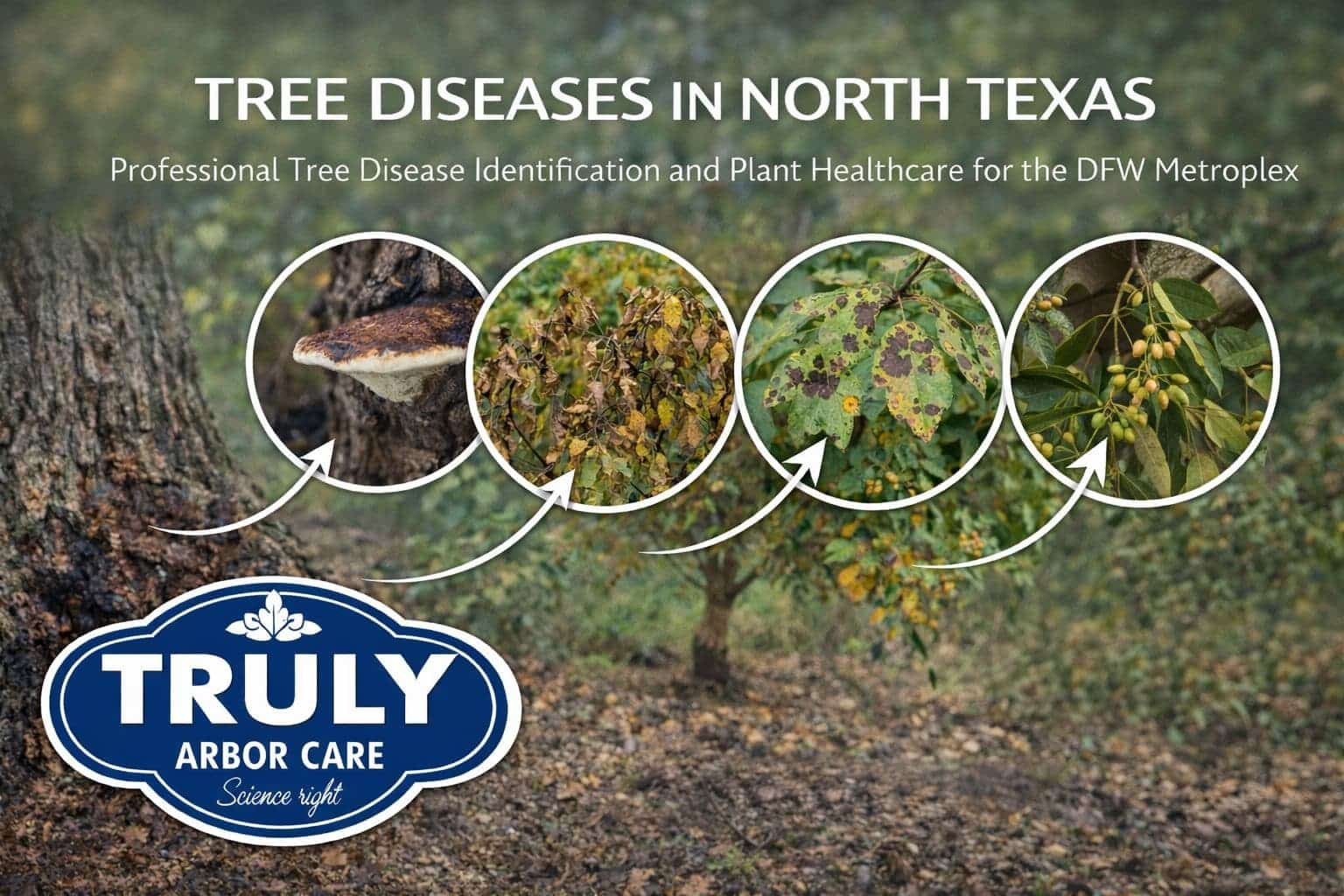
This tree disease library provides a comprehensive guide to many of the most common fungal, bacterial, and environmental diseases affecting trees and shrubs across North Texas. Each disease listed below includes scientific background, symptoms, host species, environmental triggers, and professional plant healthcare management strategies.
Correct diagnosis and early intervention can often prevent serious decline and help property owners save trees that might otherwise be lost.
Why Proper Tree Disease Identification Matters
Many tree diseases produce symptoms that look similar to one another. Leaf discoloration, branch dieback, canopy thinning, and root decline may result from fungal pathogens, bacterial infections, soil problems, drought stress, or insect activity.
Without proper diagnosis, treatments may be ineffective or even harmful.
ISA Certified Arborists are trained to identify plant diseases through careful observation of symptoms, host species susceptibility, environmental conditions, and plant pathology research. In some cases, laboratory analysis may also be required to confirm the presence of specific pathogens.
Early disease detection allows arborists to intervene before the problem spreads throughout the tree or landscape.
When tree diseases are identified early, plant healthcare treatments may include:
- Targeted fungicide applications
- Bacterial suppression treatments
- Soil improvement programs
- Root health restoration
- Pruning of infected plant material
- Long-term plant healthcare monitoring
The goal is always to preserve the health and longevity of trees whenever possible.
Common Tree Diseases Affecting North Texas Landscapes
The North Texas climate presents a unique combination of environmental challenges. High summer temperatures, periodic drought conditions, heavy clay soils, and fluctuating rainfall patterns can create stress conditions that allow pathogens to invade trees.
The disease library on this page includes many of the most common plant health issues affecting trees and shrubs throughout the DFW Metroplex.
These include:
- Root diseases such as Armillaria root rot, Phytophthora root rot, and Texas cotton root rot.
- Canker diseases such as Botryosphaeria canker, Hypoxylon canker, Seiridium canker, and Phomopsis canker.
- Leaf diseases including anthracnose, leaf spot diseases, powdery mildew, and oak leaf blister.
- Vascular diseases such as oak wilt and bacterial leaf scorch.
- Rust diseases including cedar hawthorn rust and fusiform rust.
- Parasitic plants such as mistletoe and epiphytes like ball moss.
Each disease listed below includes a dedicated page with detailed scientific information and diagnostic guidance.
Environmental Stress and Tree Disease in the DFW Metroplex
Many tree diseases are not caused by pathogens alone. Environmental stress is often the underlying factor that allows disease organisms to infect trees.
Common environmental stress factors affecting trees across North Texas include:
- Prolonged drought conditions
- High summer temperatures
- Soil compaction from construction or foot traffic
- Poor soil drainage
- Improper irrigation practices
- Root disturbance during landscaping or development
When trees become stressed, their natural defense systems weaken. Opportunistic fungi and bacteria may then colonize bark, roots, or vascular tissues.
Understanding the relationship between environmental stress and plant disease is essential for effective plant healthcare.
The Importance of Soil Science and Root Health
Healthy soil conditions are the foundation of long-term tree health. The majority of tree diseases affecting landscapes in North Texas are closely tied to root stress and poor soil conditions.
Proper soil science plays a critical role in preventing disease outbreaks.
Professional plant healthcare programs often include:
- Soil testing to evaluate pH and nutrient levels
- Root zone aeration to reduce compaction
- Organic soil amendments to improve microbial activity
- Mycorrhizal inoculation to support root health
- Mulching practices that protect the root flare
Root aeration and oxygenation are particularly important in the clay soils commonly found throughout the DFW Metroplex. Compacted soils reduce oxygen availability and restrict root growth, making trees more susceptible to disease.
By improving soil conditions, arborists can strengthen the tree’s natural defense mechanisms and reduce disease pressure.
Proper Water Management for Tree Health
Water management is another key factor in preventing tree disease.
Both overwatering and underwatering can stress trees and create favorable conditions for pathogens.
Proper irrigation practices include:
- Deep watering to encourage strong root development
- Avoiding frequent shallow watering
- Preventing prolonged soil saturation
- Monitoring irrigation during drought periods
Root diseases such as Phytophthora root rot and Texas cotton root rot are often associated with poor water management and soil drainage problems.
ISA Certified Arborists evaluate irrigation practices as part of a comprehensive plant healthcare program.
Plant Healthcare Programs That Protect Trees
Proactive plant healthcare is the most effective strategy for preventing serious tree disease outbreaks.
Instead of waiting for symptoms to become severe, plant healthcare programs focus on early detection and preventive care.
Professional programs may include:
- Seasonal disease monitoring
- Preventative fungicide treatments
- Insect management programs
- Soil health improvement
- Root zone aeration
- Structural pruning according to ANSI A300 standards
By monitoring trees regularly, arborists can identify early warning signs before disease spreads throughout the canopy.
This approach helps property owners protect valuable landscape trees and avoid costly removals.
When to Have Your Trees Evaluated
Trees often show subtle signs of stress long before serious disease symptoms appear.
Property owners across North Texas should consider professional tree evaluations when they notice:
- Canopy thinning
- Premature leaf drop
- Unusual leaf discoloration
- Branch dieback
- Fungal growth on bark or roots
- Changes in growth patterns
Having trees evaluated by an ISA Certified Arborist allows for early diagnosis and targeted treatment recommendations.
In many cases, early intervention can prevent long-term damage and preserve the tree.
Protecting the Urban Forest of North Texas
Trees are a critical part of the urban ecosystem across North Texas and the DFW Metroplex. They provide shade, improve air quality, reduce urban heat, and increase property value.
Protecting these trees requires a proactive approach to plant healthcare and disease management.
By following ISA arboriculture standards, TCIA plant healthcare guidelines, and research from Texas A&M AgriLife Extension, professional arborists can provide science-based solutions that help preserve tree health for generations.
If you suspect your trees may be affected by disease, early evaluation by an ISA Certified Arborist can make the difference between saving a tree and losing it.
Understanding Disease Development in DFW Landscapes
Common disease categories affecting trees in the Dallas–Fort Worth region include:
- Vascular wilt pathogens
- Foliar fungal diseases
- Root decay organisms
- Canker pathogens
- Bacterial leaf disorders
Disease pressure often begins internally within the vascular system before visible canopy symptoms appear. Early diagnosis improves preservation success and reduces structural risk.
Why Early Identification Matters
Many symptoms such as thinning canopy, chlorosis, premature leaf drop, or dieback may resemble nutrient deficiency or drought stress. Proper identification requires host species confirmation, symptom pattern analysis, and site evaluation consistent with ISA diagnostic principles.
Below is a comprehensive list of common tree diseases impacting North Texas landscapes. Each condition links to a detailed research-based page outlining biology, spread, treatment thresholds, and management strategies.
- ANNOSUM ROOT ROT
(Heterobasidion annosum)
- ANTHRACNOSE (ASH)
(Discula fraxinus)
- ANTHRACNOSE (ELM)
(Stegophora ulmea)
- ANTHRACNOSE (OAK)
(Discula quercina)
- ANTHRACNOSE (SYCAMORE)
(Discula platani)
- ARMILLARIA ROOT ROT
(Armillaria spp.)
- BACTERIAL LEAF SCORCH
(Xylella fastidiosa subsp. Multiplex)
- BALL MOSS
(Tilandsia recurvata)
- BOTRYOSPHAERIA CANKER
(Botryosphaeria spp)
- BOTRYOSPHAERIA CANKER (JUNIPER)
(Botryosphaeria stevensii)
- CEDAR HAWTHORN RUST
(Gymnosporangium juniperi-virginiana)
- COTTON (TEXAS) ROOT ROT
(Phymatotrichopsis omnivora)
- CROWN GALL
(Agrobacterium tumefeciens)
- DOTHISTROMA NEEDLE BLIGHT
(Dothistroma spp)
- DUTCH ELM DISEASE
(Ophiostoma novo ulmi)
- ENDOTHIA CANKER
(Endothia gyrosa)
- ENTOMOSPORIUM LEAF SPOT
(Entomosporium spp)
- FIREBLIGHT
(Erwinia amylovora)
- FUSIFORM RUST
(Cronartium fusiforme)
- HYPOXYLON CANKER
(Hypoxylon tinctor)
- HYPOXYLON CANKER (OAK)
(Biscogniauxia atropunctata)
- LEAF SPOTS (MAPLE-SYCAMORE)
(Rhytisma acerinum)
- LEAF SPOTS (OAK)
(Tubakia quercina)
- LEAFY MISTLETOE
(Phoradendron tomentosum)
- OAK LEAF BLISTER
(Taphrina caerulescens)
- OAK WILT
(Bretziella fagacearum)
- PHOMOPSIS CANKER
(Phomopsis spp.)
- PHOMOPSIS TIP BLIGHT
(Phomopsis juniperovora)
- PHYTOPHTHORA ROOT ROT
(Phytophthora spp.)
- POST OAK DECLINE
(Multiple agents)
- POWDERY MILDEW
(Oidium sp.)
- SERIDIUM CANKER
(Seridium spp.)
- SPHAEROPSIS TIP BLIGHT
(Sphaeropsis sapinea)
- STRUCTURAL ROOT ROT
(Ganoderma sp.)