
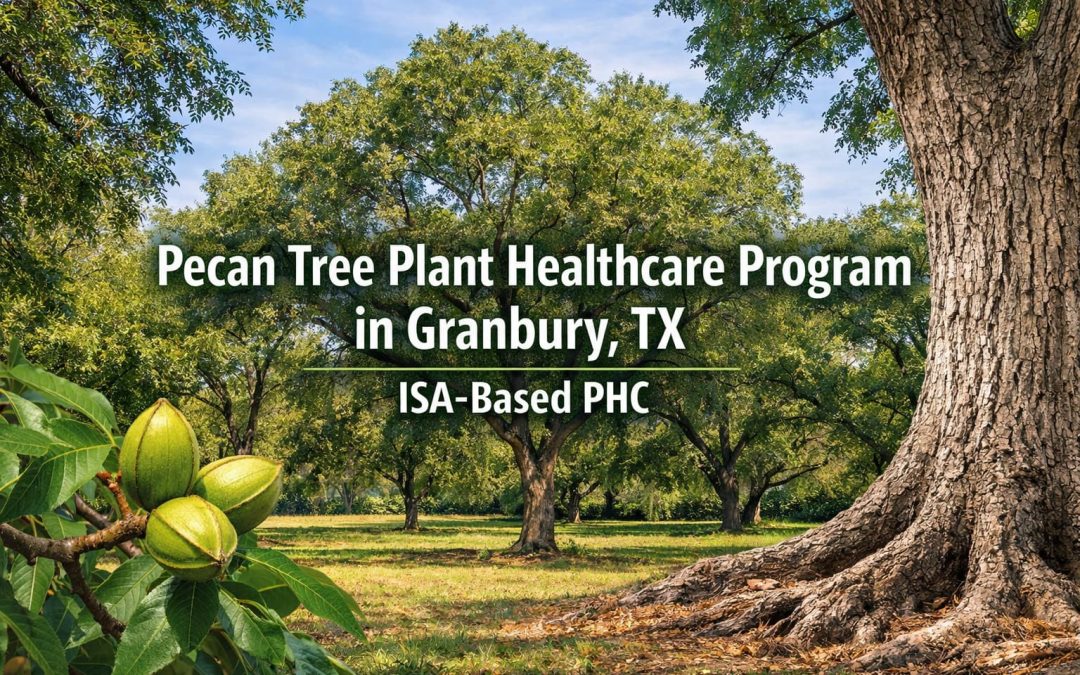
Understanding Pecan Tree Stress in Granbury, Texas
Plant healthcare (PHC) program for pecan trees in Granbury, Texas. If you own pecan trees in Granbury, Texas, you have likely noticed periods of thinning canopy, scattered deadwood, leaf discoloration, or branch breakage after storms. These symptoms are common in Carya illinoinensis growing in North Central Texas landscapes.
Granbury sits within a challenging, growing environment. Heavy clay soils, prolonged summer heat, irregular rainfall patterns, and seasonal insect pressure all interact with pecan physiology. Over time, these stressors can reduce root efficiency, limit nutrient uptake, and weaken branch structure.
The purpose of a Plant Healthcare (PHC) program is not to “force growth” or cosmetically thicken a canopy. It is to:
- Improve root-zone function
- Support carbohydrate production and storage
- Reduce structural risk through standards-based pruning
- Monitor and manage pest pressure conservatively
- Maintain long-term tree stability
This program follows ISA, ANSI A300, TCIA, ASCA, and Texas A&M AgriLife Extension principles and is rooted in tree biology rather than reactionary treatment.
Diagnostic Assessment
Pecan trees in Granbury commonly exhibit stress patterns that are environmental rather than pathogen-specific.
Observed and regionally consistent patterns include:
- Upper-crown thinning
- Deadwood accumulation
- Uneven scaffold loading
- Leaf scorch during late summer
- Sap-feeding insect presence
- Stress-associated foliar fungal symptoms
It is important to clarify: visual symptoms alone do not confirm a specific pathogen. Many foliar issues in pecans are stress-amplified responses rather than primary disease drivers.
Tree Biology Context
Trees operate on stored carbohydrate reserves. When soil oxygen is limited or drought cycles interrupt water uptake, fine root function declines. Reduced root efficiency limits:
- Micronutrient uptake
- Chlorophyll production
- Enzymatic processes
- Energy storage
As outlined in the ISA-aligned Tree Biology & CODIT framework , stress reduces carbohydrate reserves, weakening defense responses and increasing susceptibility to opportunistic insects.
Most insects observed in stressed pecans are secondary exploiters. Effective management prioritizes stress reduction before chemical intervention, consistent with PHC protocols .
Soil & Root-Zone Context
Granbury’s soils are predominantly clay-based with variable compaction. Clay soils present three primary biological limitations:
- Reduced oxygen diffusion
- Restricted fine root regeneration
- Limited pore space for microbial activity
Fine absorbing roots are responsible for water and nutrient uptake. When oxygen is limited, these roots decline, and canopy thinning often follows.
Compacted clay soils reduce:
- Cation exchange efficiency
- Root hair development
- Microbial symbiosis
- Carbohydrate feedback loops
Deep root zone support and soil-based micronutrient correction are intended to improve root function—not stimulate excessive top growth.
Per ISA and TCIA PHC guidance , root-zone health drives canopy performance. Treatments are most effective when aligned with tree physiology and seasonal timing.
Basal/Structural Observations
Mature pecans are physiologically predisposed to breakage due to:
- Long scaffold architecture
- Wide branch angles
- Heavy end-weight
- Rapid growth under favorable moisture
When pruning wounds occur, trees do not “heal.” They compartmentalize.
According to the CODIT model (Compartmentalization of Decay in Trees), described in ISA biology guidance :
- Wall 1 limits vertical decay spread
- Wall 2 limits inward spread
- Wall 3 limits lateral spread
- Wall 4 forms new barrier tissue after injury
Improper cuts (flush cuts, oversized reductions) expand decay columns and weaken long-term structure.
ANSI A300 performance standards emphasize preserving the branch collar and avoiding excessive live tissue removal . Structural pruning must reduce risk without impairing biological defense capability.
Distinguishing historic defects from active progression requires professional inspection. Ground-based observations have inherent limitations, particularly in upper canopy unions.
Risk Perspective (TRAQ-Aligned)
Tree risk is not defined by the presence of defects alone.
Risk evaluation considers three factors:
- Likelihood of failure
- Likelihood of impact
- Consequences of failure
This framework aligns with ISA TRAQ-style logic .
Pecan trees near:
- Homes
- Barns
- Driveways
- High-traffic areas
represent elevated target zones. Codominant stems, excessive end-weight, and prior breakage increase likelihood of failure under wind load.
It is critical to state:
Risk can be reduced but not eliminated.
Even with proper pruning and monitoring, trees remain living organisms subject to unpredictable environmental forces.
Advanced assessment (aerial inspection or additional diagnostic tools) may be required to fully evaluate upper-crown unions and internal decay.
Plant Healthcare Interpretation
PHC is a proactive system, not a reactive spray program.
Per ISA- and TCIA-aligned Plant Healthcare protocols :
- Stress is the primary driver of decline
- Most pests are secondary agents
- Soil function precedes canopy response
- Over-treatment creates dependency and unintended stress
Primary Stressors in Granbury Pecan Trees
- Clay soil compaction
- Inconsistent irrigation patterns
- Heat stress
- Nutrient imbalance (particularly micronutrients)
- Mechanical storm damage
Secondary Agents
- Aphids and sap-feeding insects
- Stress-associated foliar fungal diseases
- Opportunistic borers in declining wood
Systemic treatments may be appropriate only when pest thresholds exceed acceptable levels. Chemical intervention without addressing root stress often fails to provide durable improvement.
Professional Recommendations
- ANSI A300 Structural Pruning
- Crown cleaning to remove dead, broken, or declining limbs
- Selective reduction of excessive end-weight
- Preservation of branch collar integrity
- Avoid topping, lion-tailing, or excessive thinning
- Soil & Micronutrient Program
- Soil-applied micronutrient complex addressing common pecan deficiencies
- Humic substances to improve cation exchange
- Seaweed-derived carbon inputs to support stress tolerance
- Root stimulators to encourage fine root regeneration
- Deep Root Zone Application
- Placement of nutrients within active absorption zones
- Oxygenation benefit from injection process
- Integrated Pest Monitoring
- Seasonal inspection for aphids, foliar stress, and borer indicators
- Threshold-based intervention only
- Avoid calendar-based pesticide dependency
- Seasonal Evaluation
- Monitor shoot elongation
- Assess canopy density
- Evaluate leaf color and chlorophyll response
- Reassess structural condition after pruning
- Target-Based Risk Assessment
- Evaluate trees near structures separately
- Consider aerial inspection where codominant unions exist
- Use pruning and support systems judiciously
- Avoid Harmful Practices
- No topping
- No excessive canopy removal
- No high-nitrogen spike fertilization
- No flush cuts
Key Takeaway for Homeowners
Thinning pecan canopies in Granbury are often a soil and stress story—not an immediate death sentence.
When roots struggle, canopies respond.
Plant Healthcare focuses on:
- Supporting root function
- Conserving carbohydrate reserves
- Reducing structural load
- Monitoring pests conservatively
- Improving resilience over time
Healthy soil and proper pruning extend the functional lifespan of mature pecans more effectively than reactive treatments.
Improvements occur gradually across seasons, not overnight.
Standards & Framework Alignment
This PHC program aligns with:
- ISA tree biology principles and CODIT defense theory
- ANSI A300 performance-based pruning standards
- TRAQ-style tree risk logic
- TCIA Plant Healthcare framework
Mandatory Professional Disclaimers
- Ground-based inspections have inherent limitations.
- Internal decay, upper-canopy unions, and root defects may not be fully visible without advanced assessment.
- Pest presence does not confirm causation without laboratory testing.
- Treatments reduce stress and risk but do not guarantee prevention of failure.
- Tree risk can be reduced but not eliminated.
- PHC does not reverse advanced structural decay or restore postmortem trees.
- For general tree-care best practices, homeowners can also reference guidance from the Texas A&M Forest Service, https://tfsweb.tamu.edu/trees/, a trusted authority on Texas tree health.
If you’d like to speak to an arborist, please call us at 817-697-2884 or visit our website https://www.trulyarborcare.com/contact-us/ to schedule a consultation. Serving Granbury, Texas, and the DFW Metroplex area.
In this video, ISA Certified Arborist Josh Friar explains the Plant Healthcare (PHC) strategy for mature pecan trees (Carya illinoinensis) in Granbury, Texas, where heavy clay soils, prolonged summer heat, inconsistent moisture cycles, and seasonal insect pressure commonly drive canopy thinning and structural stress. The focus is on how soil compaction, oxygen limitation, carbohydrate storage, and pruning practices influence long-term pecan vigor and failure potential. Many decline patterns in North Central Texas are stress-related, not pathogen-confirmed diagnoses. Understanding that distinction changes how trees are managed.