
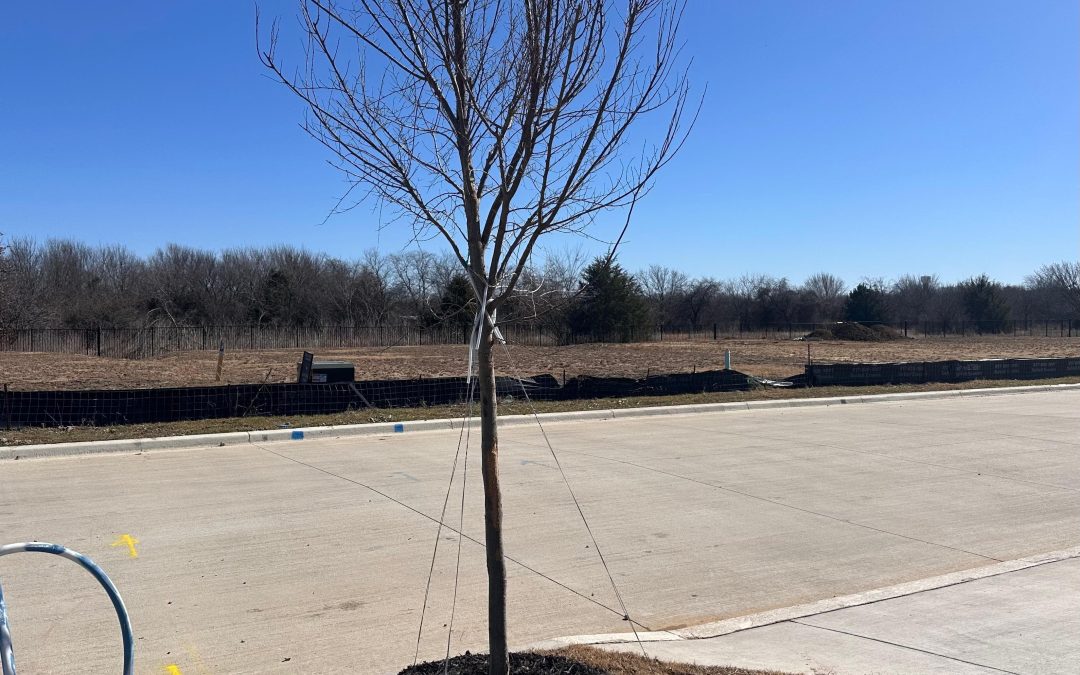
Early Establishment Concerns in Newly Planted Trees
Mexican Sycamore Plant Healthcare Program for Clay Soils in Fort Worth, TX. A newly planted Mexican sycamore can be a beautiful and appropriate shade tree for North Texas, but its long-term success depends far more on what is happening below ground than what is visible in the canopy during the first few years. In clay-dominated soils such as those common throughout Fort Worth, establishment failures are rarely immediate or dramatic. Instead, decline often develops slowly, beginning at the root collar and root system and only later expressing in reduced growth, thinning canopy, or structural weakness.
Homeowners commonly notice mulch piled against the trunk, a tree that appears “set too deep,” or irrigation schedules designed more for turf than for woody plants. While these practices are well-intentioned, they can significantly interfere with oxygen exchange, root development, and the tree’s natural defense systems. This Plant Healthcare (PHC) program is designed to support proper establishment, reduce avoidable stress, and align early care with how trees actually function biologically.
Diagnostic Assessment
Plant Healthcare Interpretation. From a diagnostic perspective, the primary concerns for newly planted trees in heavy clay soils are root system function and oxygen availability, not pests or disease. Mexican sycamore is moderately tolerant of a range of soil textures, but it is not tolerant of chronic hypoxia at the root collar or within the upper root zone.
Common establishment risks observed in North Texas landscapes include:
- Root flare burial (“telephone pole effect”)
- Excessive mulch accumulation against the trunk
- Overwatering in slow-draining clay soils
- Lack of structural root expansion into surrounding soil
These factors do not cause immediate mortality. Instead, they reduce carbohydrate efficiency, limit fine root regeneration, and compromise the tree’s ability to compartmentalize stress and minor injury over time. As outlined in ISA-aligned tree biology frameworks, stress accumulation precedes most decline events, while pests and decay organisms typically arrive later as secondary agents, not primary causes.
No pathogen diagnosis is appropriate or defensible at this stage. The focus remains on correcting site-related stressors that influence long-term physiology.
Soil & Root-Zone Context
Clay soils present a unique challenge because they hold water tightly while simultaneously restricting oxygen diffusion. When soils remain saturated for extended periods, fine absorbing roots decline, even though the soil may appear “moist enough” or even ideal from a turf perspective.
Key biological considerations include:
- Oxygen availability: Roots require oxygen for respiration. Saturated clay soils restrict gas exchange.
- Moisture cycling: Trees benefit from wet–dry cycles that encourage deeper root growth and soil pore re-oxygenation.
- Carbohydrate implications: Reduced root function limits nutrient uptake and weakens carbohydrate storage, which is essential for growth, defense, and wound response.
Deep, infrequent irrigation is therefore not a convenience recommendation—it is a physiological requirement. Daily or shallow watering encourages surface rooting and prolongs hypoxic conditions, increasing the likelihood of girdling roots and basal dysfunction later in the tree’s life.
Basal / Structural Observations
At the base of any newly planted tree, the root flare serves as the transition zone between stem tissue and root tissue. This zone is not designed to be buried. When soil or mulch is piled against the trunk, moisture is retained where bark is not adapted for constant contact, increasing the risk of basal decay and impaired compartmentalization.
It is critical to distinguish between:
- Historic planting errors (such as initial depth)
- Active biological response (such as adventitious rooting or bark deterioration)
Trees do not “heal” buried tissue. Instead, they attempt to compartmentalize stress, often unsuccessfully when exposure conditions remain unchanged. Early correction dramatically improves long-term outcomes and reduces structural and decay risks that otherwise emerge years later.
Risk Perspective (TRAQ-Aligned)
From a Tree Risk Assessment Qualification (TRAQ) logic standpoint, newly planted trees generally represent low immediate risk, but future risk is dynamic and influenced by early establishment practices.
Key considerations include:
- Likelihood of failure: Currently low, but increases over time if root systems are compromised.
- Target presence: Residential landscapes inherently include structures, pedestrian areas, and vehicles.
- Risk trajectory: Improper planting and irrigation practices increase future likelihood of basal or root-plate failure.
Risk is not static. Early intervention does not eliminate risk but meaningfully reduces the probability of future structural issues developing in high-target environments.
Plant Healthcare Interpretation
Plant Healthcare is not a product-driven program; it is a decision framework centered on stress reduction and biological support. For newly planted Mexican sycamore in clay soil, the primary stressors are mechanical and environmental, not nutritional excess or pest pressure.
Primary Stressors
- Improper planting depth
- Oxygen-limited soils
- Excessive or poorly timed irrigation
Secondary Agents
- Opportunistic decay organisms
- Girdling root development
- Stress-related canopy stagnation
PHC inputs such as micronutrients are considered supportive tools, not corrective solutions. They are only appropriate once foundational issues—grade, mulch, and irrigation—are addressed.
Professional Recommendations
- Root Collar & Grade Correction
Expose the root flare to finished grade. Remove excess soil and mulch from the trunk base to restore normal gas exchange and bark function. - Mulching (Correct Method)
Apply organic mulch 2–3 inches deep in a flat or donut-shaped ring. Maintain 3–6 inches of clearance from the trunk. Avoid mulch mounding. - Irrigation Guidance (Clay Soils)
Implement deep, infrequent watering. Allow soil moisture to decline between irrigation events to promote oxygen exchange and deeper rooting. Adjust frequency based on rainfall and temperature. - Structural Pruning (If Needed)
Limit pruning to dead, damaged, or defective branches only. Preserve canopy mass during establishment in accordance with ANSI A300 intent. - Plant Healthcare Input
If establishment stress is evident, apply a micronutrient complex in March 2026 to support leaf function and carbohydrate production. Avoid routine fertilization without demonstrated need. - Monitoring Schedule
Conduct a June 2026 evaluation to assess shoot extension, canopy density, root flare exposure, moisture stress indicators, and early signs of girdling roots or basal dysfunction.
Key Takeaway for Homeowners
Most long-term tree problems begin quietly, below ground. By focusing on soil conditions, root flare exposure, and biologically appropriate irrigation, homeowners can prevent many of the decline patterns commonly attributed—incorrectly—to pests or “bad trees.” Early, conservative corrections yield outsized benefits over the life of the tree.
Standards & Framework Alignment
This PHC program aligns with:
- ISA tree biology principles and Best Management Practices
- ANSI A300 pruning intent and limitations
- TRAQ risk assessment logic emphasizing probability and targets
- TCIA Plant Healthcare frameworks prioritizing stress reduction
- For general tree-care best practices, homeowners can also reference guidance from the Texas A&M Forest Service, https://tfsweb.tamu.edu/trees/, a trusted authority on Texas tree health.
Mandatory Disclaimer
This assessment is based on ground-level observations and known site conditions. Subsurface conditions, internal decay, and future environmental factors cannot be fully predicted. Tree risk can be reduced but not eliminated. No guarantees are implied, and no pathogen diagnosis is made without laboratory confirmation.
Truly Arbor Care
If you’d like to speak to an arborist, please call us at 817-697-2884 or visit our website https://www.trulyarborcare.com/contact-us/ to schedule a consultation. Serving Fort Worth, Texas and the DFW Metroplex area.
In this video, ISA Certified Arborist Josh Friar explains the most common establishment risks facing newly planted Mexican sycamore (Platanus mexicana) in Fort Worth, Texas, clay soils, including root flare burial, excessive mulch, and overwatering. These issues are among the leading causes of long-term decline, basal decay, girdling roots, and structural instability in urban landscapes.