
Variable Oakleaf Caterpillar in North Texas
Heterocampa manteo | Late Season Oak Defoliator in North Texas
The Variable Oakleaf Caterpillar, Heterocampa manteo, is a native hardwood defoliator found throughout Texas. According to Texas A&M AgriLife Extension and Texas A&M Forest Service publications, this species feeds primarily on oak foliage and may cause noticeable late-season canopy thinning when populations increase.
In North Texas, Variable Oakleaf Caterpillar activity is most commonly observed from mid to late summer, particularly during extended periods of heat that accelerate larval development.
ISA Certified Arborist Evaluation and Texas A&M Research Context in North Texas
As ISA Certified Arborists serving North Texas, Truly Arbor Care evaluates Variable Oakleaf Caterpillar infestations using science-based plant health care standards aligned with Texas A&M AgriLife Extension research guidance.
Texas A&M documentation notes that late-season defoliation can be confused with drought stress, spider mite injury, or fungal leaf disorders. Accurate identification is critical before treatment decisions are made.
Professional evaluation in North Texas includes assessing percentage of canopy loss, host species, environmental stress levels, and overall tree vigor prior to recommending intervention.
—
Identification and Morphology
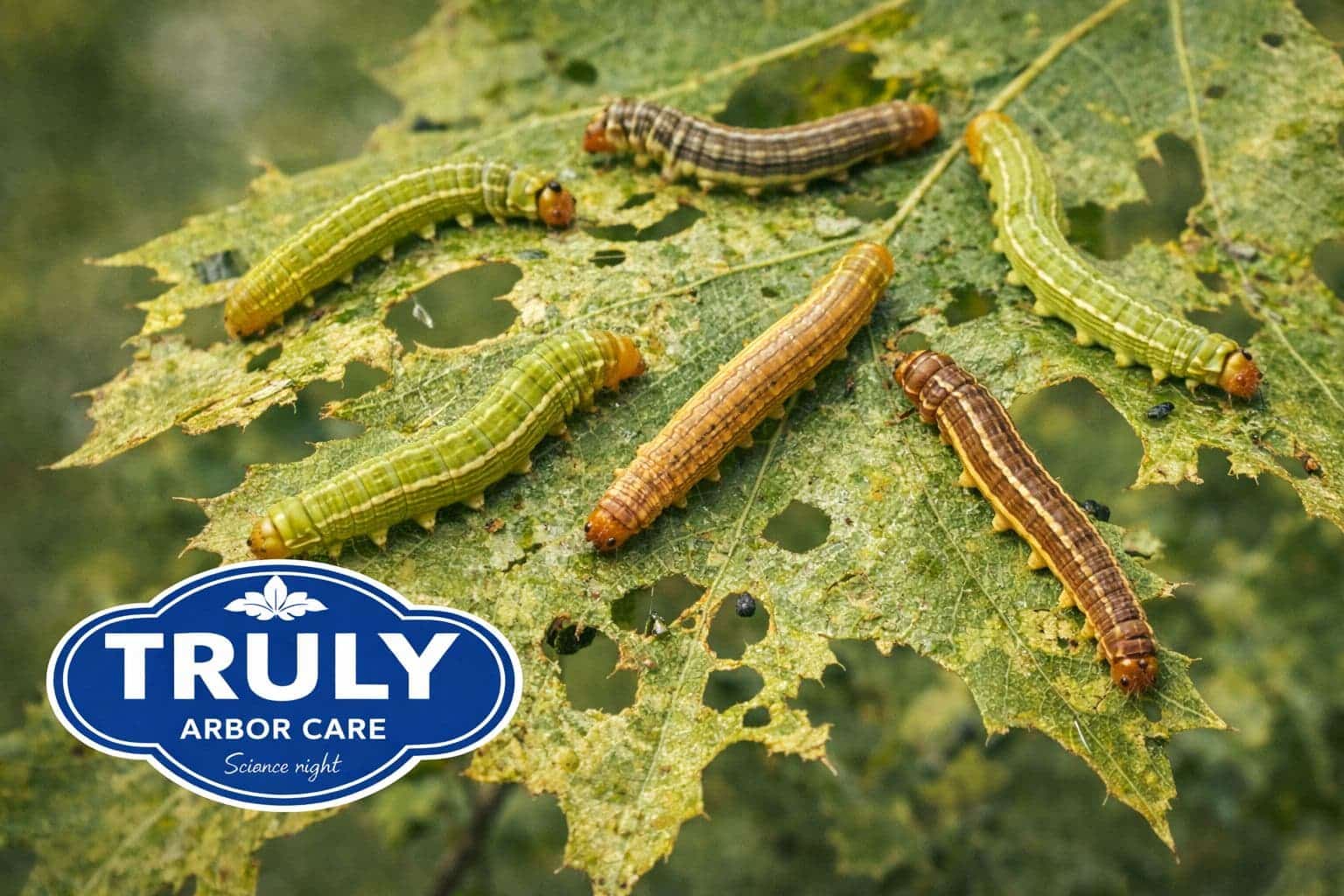
Variable Oakleaf Caterpillar larvae display notable color variation, which gives the species its name.
Key identifying characteristics include:
- Smooth-bodied larvae without prominent spines
- Color ranging from green to yellow-green to brown
- Distinct pale longitudinal striping along the body
- Small rounded head capsule
- Approximately 1.25 to 1.5 inches in length at maturity
Unlike heavily spined species such as spiny oakworm, Heterocampa manteo larvae have a smoother profile and subtler markings.
—
Distinguishing Characteristics
In North Texas landscapes, Variable Oakleaf Caterpillar damage presents as:
- Irregular chewing of leaf margins
- Partial defoliation of upper canopy
- Presence of multiple larvae feeding simultaneously
- Late summer canopy thinning
Damage differs from skeletonizing insects, as these caterpillars consume large portions of leaf tissue rather than leaving only veins.
—
Host Trees in North Texas
Variable Oakleaf Caterpillar primarily affects:
- Live oak
- Red oak
- Shumard oak
- Post oak
Texas A&M indicates that healthy, established oaks in North Texas typically tolerate single-season defoliation without long-term decline.
Trees experiencing drought stress, soil compaction, or root disturbance may show greater sensitivity to repeated defoliation events.
—
Life Cycle in North Texas
The life cycle of Heterocampa manteo follows a seasonal pattern in North Texas:
- Eggs deposited on oak foliage in summer
- Larvae feed through mid to late summer
- Pupation occurs in soil
- Adults emerge later in season
Warm North Texas summers may accelerate larval feeding rates and shorten development time.
—
Impact on Tree Health in North Texas
According to Texas A&M AgriLife Extension, late-season defoliation from Variable Oakleaf Caterpillar rarely causes mortality in mature trees.
Potential impacts include:
- Reduced photosynthetic capacity
- Temporary canopy thinning
- Increased environmental stress
- Greater vulnerability if drought conditions persist
In North Texas, maintaining irrigation and reducing compaction stress supports canopy recovery.
—
Environmental Stress and Susceptibility
Trees in North Texas are more vulnerable when subjected to:
- Prolonged drought
- High heat exposure
- Compacted soils
- Construction-related root disturbance
Texas A&M emphasizes that environmental stress plays a major role in determining whether defoliation results in measurable decline.
—
Management and Professional Guidance in North Texas
Texas A&M AgriLife Extension recommends integrated pest management strategies including:
- Monitoring population density
- Assessing percentage of canopy loss
- Encouraging natural predators
- Threshold-based intervention when necessary
ANSI A300 Plant Health Care standards emphasize stress reduction and informed treatment rather than automatic chemical application.
In North Texas, professional evaluation ensures management decisions are aligned with actual tree condition and infestation severity.
—
Professional Assessment in North Texas
As ISA Certified Arborists serving North Texas, Truly Arbor Care evaluates Variable Oakleaf Caterpillar activity within a comprehensive plant health framework, including canopy inspection, soil condition review, irrigation assessment, and long-term oak vitality planning.
For more information, check out the Texas A&M article on Variable Oakleaf Caterpillar here.