
Twig Girdler in North Texas
Oncideres pustulatus | Structural Twig Damage in North Texas Landscapes
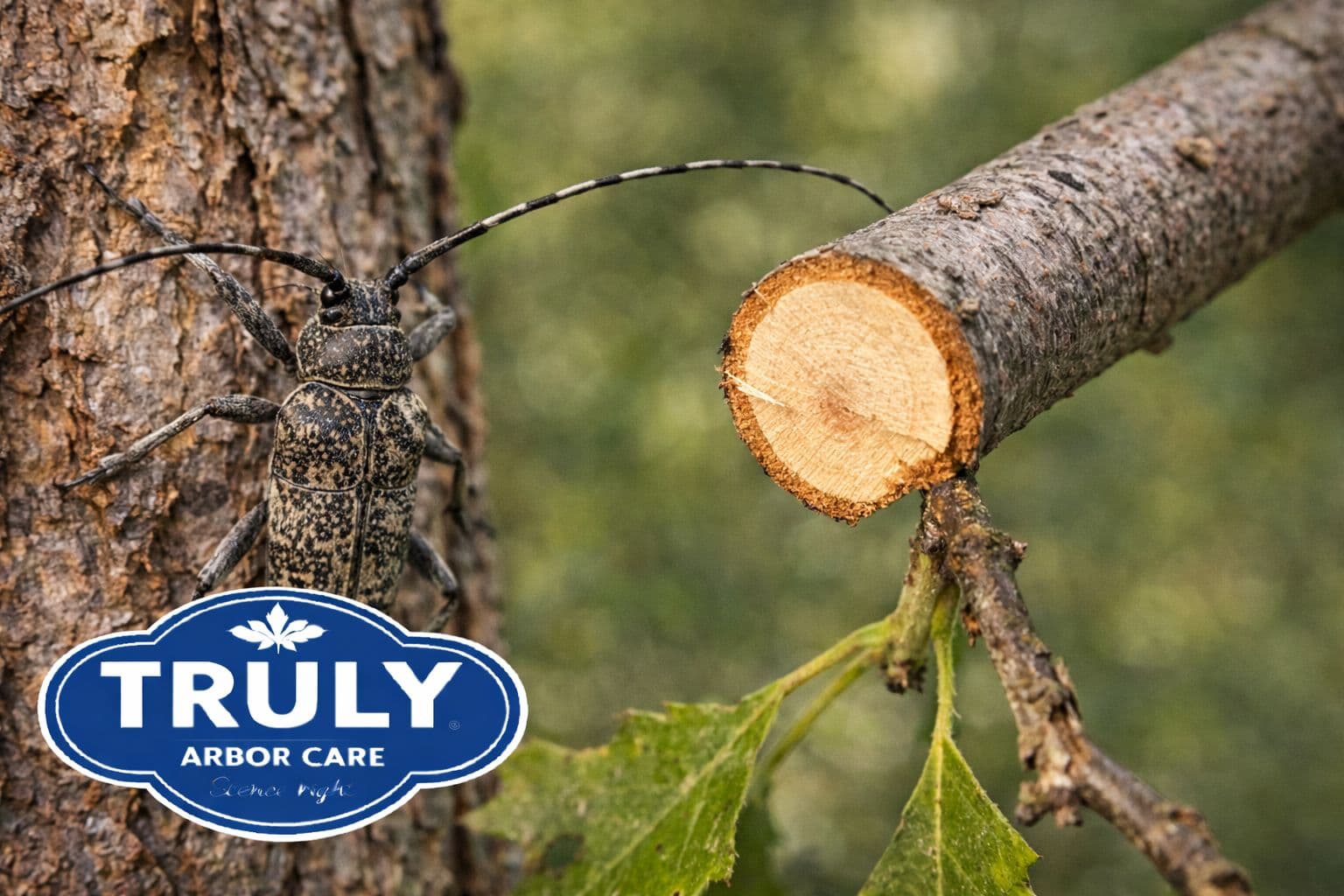
Twig girdler, Oncideres pustulatus, is a longhorn beetle species found throughout Texas. According to Texas A&M AgriLife Extension and Texas A&M Forest Service publications, twig girdlers are known for their distinctive behavior of chewing completely around small branches, causing them to break and fall.
In North Texas, twig girdler activity is most commonly observed in late summer through fall, when freshly cut twigs begin accumulating beneath affected trees.
ISA Certified Arborist Evaluation and Texas A&M Research Context in North Texas
As ISA Certified Arborists serving North Texas, Truly Arbor Care evaluates twig girdler activity using science-based plant health care standards aligned with Texas A&M AgriLife Extension research guidance.
Texas A&M documentation emphasizes that twig drop caused by girdling beetles can be confused with storm breakage, squirrel damage, or drought-related dieback. Accurate diagnosis is essential before management decisions are made.
Professional assessment in North Texas includes evaluating twig diameter, cut pattern consistency, species affected, and overall canopy health.
—
Identification and Morphology
Twig girdler adults are longhorn beetles belonging to the Cerambycidae family.
Key identifying characteristics include:
- Elongated, cylindrical body
- Gray to mottled brown coloration
- Extremely long antennae, often equal to or longer than body length
- Approximately ½ to ¾ inch in length
The defining feature of twig girdler damage is not just the beetle itself, but the characteristic smooth, circular girdling cut around small branches.
—
Distinguishing Characteristics
In North Texas landscapes, twig girdler damage presents as:
- Clean, uniform cuts encircling small twigs
- Fallen branch tips beneath canopy
- Leaves remaining attached to fallen twigs
- Damage typically on twigs ¼ to ½ inch in diameter
Unlike wind breakage, girdled twigs show a deliberate, evenly chewed ring near the break point.
—
Host Trees in North Texas
Twig girdlers affect a wide range of hardwood species, including:
- Oak
- Pecan
- Elm
- Hackberry
- Persimmon
Texas A&M notes that while damage may appear dramatic, mature trees in North Texas typically tolerate twig girdler activity without long-term decline.
Young trees or recently stressed trees may show more noticeable canopy thinning.
—
Life Cycle in North Texas
The life cycle of Oncideres pustulatus follows a predictable seasonal pattern:
- Female girdles small branches
- Eggs are deposited in the cut twig
- Larvae develop within fallen wood
- Pupation occurs inside twig
- Adults emerge the following season
In North Texas, most girdling occurs during late summer and early fall.
—
Impact on Tree Health in North Texas
According to Texas A&M AgriLife Extension, twig girdler damage is primarily structural rather than systemic.
Potential impacts include:
- Temporary canopy thinning
- Increased debris beneath trees
- Minor reduction in photosynthetic area
Healthy, established trees in North Texas typically recover without intervention.
However, repeated annual activity combined with environmental stress may reduce canopy density.
—
Environmental Stress and Susceptibility
Trees in North Texas may experience greater visible impact when subjected to:
- Drought conditions
- Soil compaction
- Root disturbance
- Poor irrigation practices
Texas A&M emphasizes that maintaining overall tree vigor reduces susceptibility to cumulative stress.
—
Management and Professional Guidance in North Texas
Texas A&M AgriLife Extension recommends management strategies including:
- Collecting and removing fallen girdled twigs
- Monitoring tree vigor
- Avoiding unnecessary chemical treatment
- Supporting tree health through irrigation and soil management
ANSI A300 Plant Health Care standards emphasize cultural management and stress reduction rather than routine pesticide application.
In North Texas, professional evaluation ensures that treatment decisions are based on actual structural risk rather than cosmetic concern.
—
Professional Assessment in North Texas
As ISA Certified Arborists serving North Texas, Truly Arbor Care evaluates twig girdler activity within a comprehensive plant health framework, including canopy structure analysis, soil condition assessment, irrigation review, and long-term tree vitality planning.
For more information, check out the Texas A&M article on Twig girdler here.