
Southern Pine Beetle in North Texas
Dendroctonus frontalis | Aggressive Pine Mortality Risk in the DFW Metroplex
The southern pine beetle, Dendroctonus frontalis, is one of the most destructive bark beetles affecting pine species in the southeastern United States. According to Texas A&M Forest Service and Texas A&M AgriLife Extension publications, this insect is considered a primary pest capable of killing healthy pine trees under favorable outbreak conditions.
In North Texas and across the DFW Metroplex, southern pine beetle activity is closely monitored due to its ability to cause rapid mortality in ornamental and forest pine stands.
ISA Certified Arborist Evaluation and Texas A&M Research Context
As ISA Certified Arborists serving North Texas, Truly Arbor Care evaluates southern pine beetle activity using science-based diagnostic standards aligned with Texas A&M Forest Service research. Accurate identification is critical because early-stage infestations may resemble damage from other Ips species or drought stress.
Texas A&M documentation emphasizes that southern pine beetle differs from secondary bark beetles because it can successfully attack and overcome the defenses of otherwise healthy pine trees during outbreak conditions.
⸻
Identification and Morphology
Adult southern pine beetles are small, cylindrical insects measuring approximately 2 to 4 mm in length. They are dark reddish-brown to nearly black.
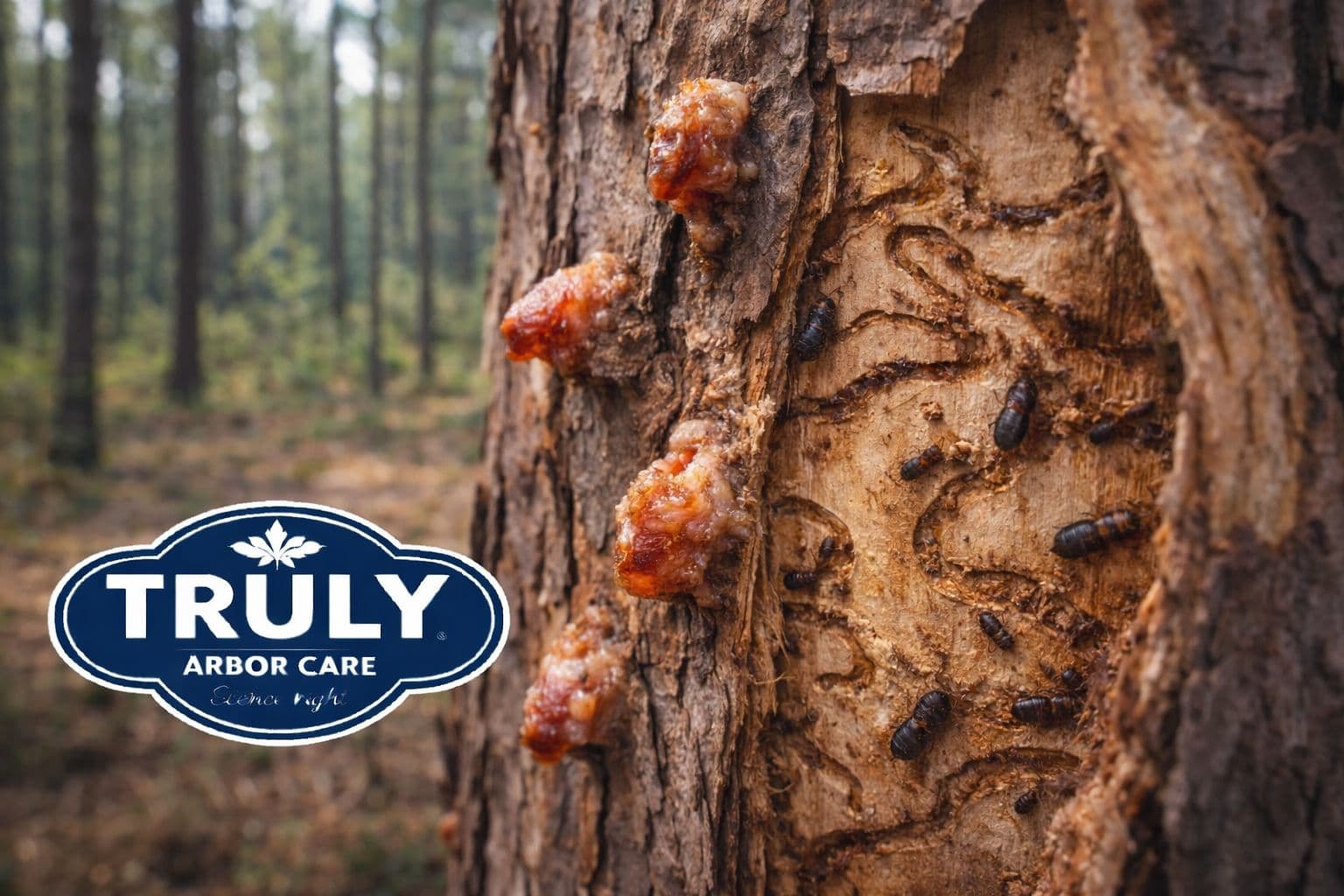
Larvae are white, legless grubs that feed within the phloem beneath the bark.
Unlike Ips species, Dendroctonus frontalis creates S-shaped or winding galleries beneath the bark.
⸻
Distinguishing Characteristics
Key identifying features include:
- Reddish pitch tubes scattered along the trunk
- Rapid needle discoloration progressing from green to yellow to red
- Bark flaking
- S-shaped galleries beneath bark
- Tree mortality occurring in clusters
Texas A&M Forest Service notes that infestations often expand outward in a “spot” pattern, affecting adjacent trees.
⸻
Host Trees in North Texas
Primary hosts include:
- Loblolly pine
- Shortleaf pine
- Slash pine
- Other southern pine species
Texas A&M documentation indicates that outbreaks are often associated with dense stands, drought stress, and environmental triggers.
In the DFW Metroplex, ornamental pines planted in close proximity may be vulnerable when stress conditions align.
⸻
Life Cycle in Texas
Southern pine beetles may produce multiple generations per year under favorable conditions.
- Adults bore through bark and construct galleries
- Eggs are laid in phloem
- Larvae feed and develop beneath bark
- Pupation occurs within tree
- Adults emerge and attack nearby trees
Warm North Texas temperatures may accelerate life cycles.
⸻
Impact on Tree Health
Southern pine beetle can cause:
- Rapid canopy discoloration
- Complete tree mortality
- Structural weakening
- Spread to adjacent trees
Texas A&M Forest Service classifies this species as one of the most economically significant pine pests in Texas.
Unlike secondary bark beetles, southern pine beetle may successfully overwhelm resin defenses in healthy trees during outbreak cycles.
⸻
Environmental Stress and Susceptibility
Contributing factors include:
- Prolonged drought
- Overcrowded pine plantings
- Compacted soils
- Storm damage
North Texas drought conditions may increase vulnerability in ornamental pine plantings.
⸻
Management and Professional Guidance in North Texas
Texas A&M recommends rapid response when southern pine beetle is confirmed.
Management strategies may include:
- Removal of infested trees
- Preventative treatment of adjacent high-value trees
- Monitoring surrounding pines
- Reducing stand density where applicable
ANSI A300 Plant Health Care standards emphasize prompt evaluation and decisive intervention for high-risk infestations.
⸻
Professional Assessment in the DFW Metroplex
As ISA Certified Arborists serving North Texas and the DFW Metroplex, Truly Arbor Care evaluates southern pine beetle infestations within a comprehensive plant health and structural risk framework to prevent spread and reduce mortality.
For more information, check out the Texas A&M article on the southern pine beetle here.