
Redheaded Ash Borer in North Texas
Neoclytus acuminatus
Hardwood Stress and Secondary Wood-Boring Risk in the DFW Metroplex
The redheaded ash borer, Neoclytus acuminatus, is a native longhorned beetle found throughout Texas, including North Texas and the DFW Metroplex. According to Texas A&M Forest Service and Texas A&M AgriLife Extension publications, this species is generally considered a secondary pest that primarily colonizes stressed, recently cut, or weakened hardwood trees.
While commonly associated with ash species, redheaded ash borers also attack a wide range of hardwoods. In the DFW Metroplex, infestations are often linked to drought stress, construction injury, and declining urban trees.
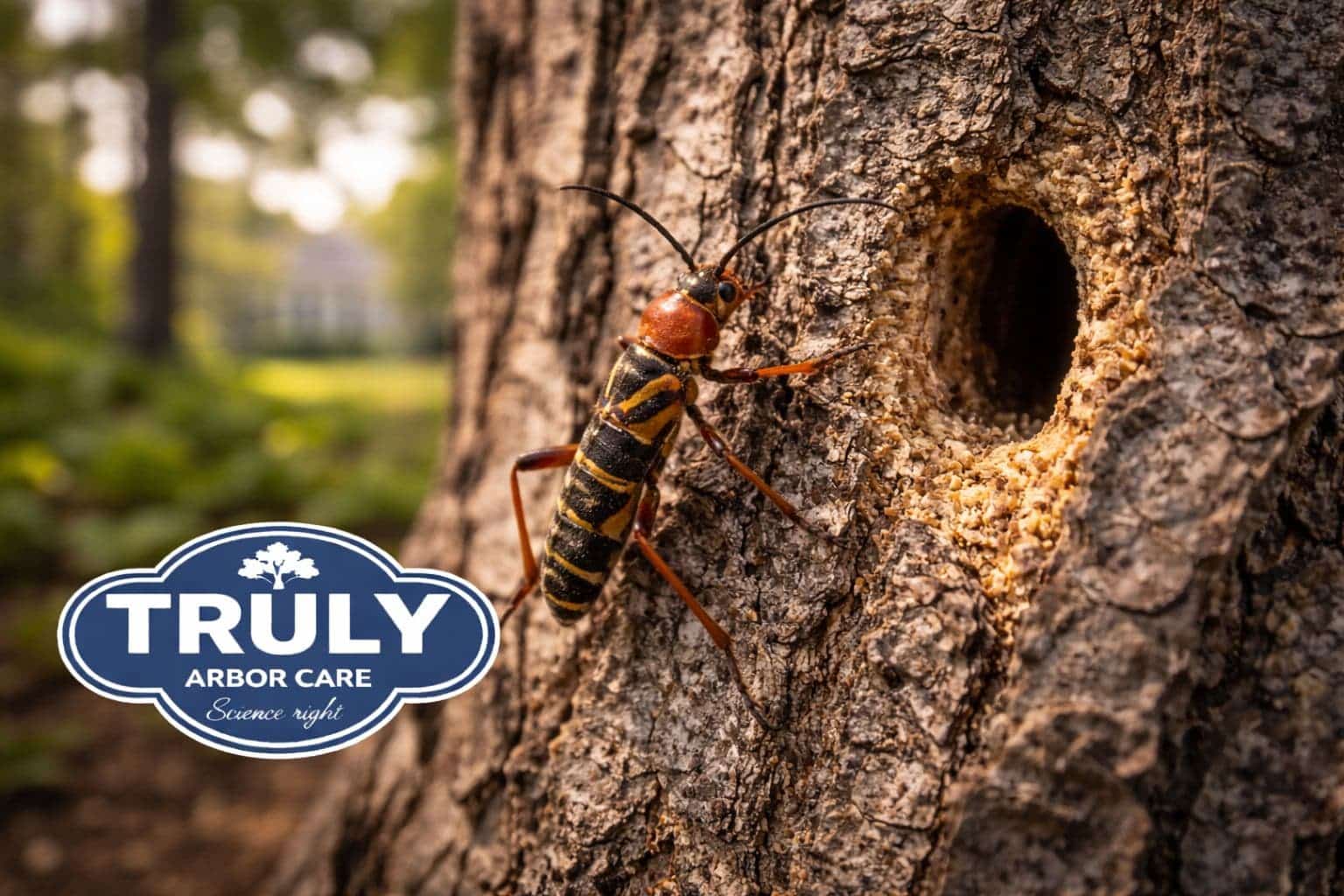
Identification and Morphology
Adult redheaded ash borers are slender, longhorned beetles measuring approximately 1/2 to 3/4 inch in length. They are characterized by:
- Reddish head and thorax
- Yellowish wing covers with dark zigzag or banded markings
- Long antennae typical of Cerambycidae
The larval stage is responsible for structural damage. Larvae are cream-colored, cylindrical, and legless, boring into sapwood and heartwood.
⸻
Distinguishing Characteristics
Key identifying features include:
- Oval exit holes in hardwood trunks or limbs
- Fine sawdust (frass) at base of tree
- Presence in recently cut or stressed wood
- Visible adult beetles on bark surfaces
Unlike emerald ash borer, which produces D-shaped exit holes, redheaded ash borer exit holes are more oval.
⸻
Host Range in Texas
Although commonly associated with ash, redheaded ash borer has a broad host range including:
- Ash
- Oak
- Elm
- Hickory
- Maple
- Other hardwood species
Texas A&M Forest Service documentation indicates that infestations are most common in stressed or freshly cut hardwood material.
In North Texas urban landscapes, trees weakened by prolonged drought or root disturbance are more susceptible.
⸻
Life Cycle in Texas
In Texas, redheaded ash borer typically produces one generation per year.
- Adults emerge in spring to early summer
- Eggs are laid in bark crevices
- Larvae bore into wood and feed for several months
- Pupation occurs within the wood
- Adults emerge through oval exit holes
Infestations often become noticeable after adult emergence.
⸻
Impact on Tree Health
Redheaded ash borer is generally considered a secondary pest. Texas A&M research indicates that healthy trees are rarely killed solely by this species.
However, larvae boring within sapwood and heartwood can:
- Reduce structural integrity
- Accelerate decline in already stressed trees
- Increase risk of limb failure
In the DFW Metroplex, the primary concern is structural weakening in drought-stressed urban hardwoods.
⸻
Environmental Stress and Susceptibility
Trees experiencing:
- Drought stress
- Construction injury
- Compacted soils
- Storm damage
are more likely to attract egg-laying adults.
Maintaining proper tree vigor reduces colonization risk.
⸻
Management and Professional Evaluation in North Texas
Texas A&M AgriLife Extension emphasizes prevention through stress reduction and proper tree care.
Management practices may include:
- Removing severely infested wood
- Improving irrigation during drought
- Avoiding trunk injury
- Monitoring high-value hardwood trees
Chemical treatment is rarely warranted for secondary borers unless specific high-value preservation strategies are being implemented.
ANSI A300 Plant Health Care standards emphasize maintaining tree health and evaluating structural risk.
⸻
Professional Assessment in the DFW Metroplex
As ISA Certified Arborists serving North Texas, Truly Arbor Care evaluates redheaded ash borer infestations within a comprehensive plant health and structural risk framework to determine whether intervention is necessary.