
Orangestriped Oakworm in North Texas
Anisota senatoria | Oak Defoliation Risk in the DFW Metroplex
The orangestriped oakworm, Anisota senatoria, is a native defoliating caterpillar that feeds primarily on oak species throughout Texas. According to Texas A&M AgriLife Extension and Texas A&M Forest Service publications, this species can cause periodic late-summer defoliation in both native and ornamental oak trees.
In North Texas and across the DFW Metroplex, orangestriped oakworm infestations are most commonly observed in mid to late summer when large groups of caterpillars feed openly on oak foliage.
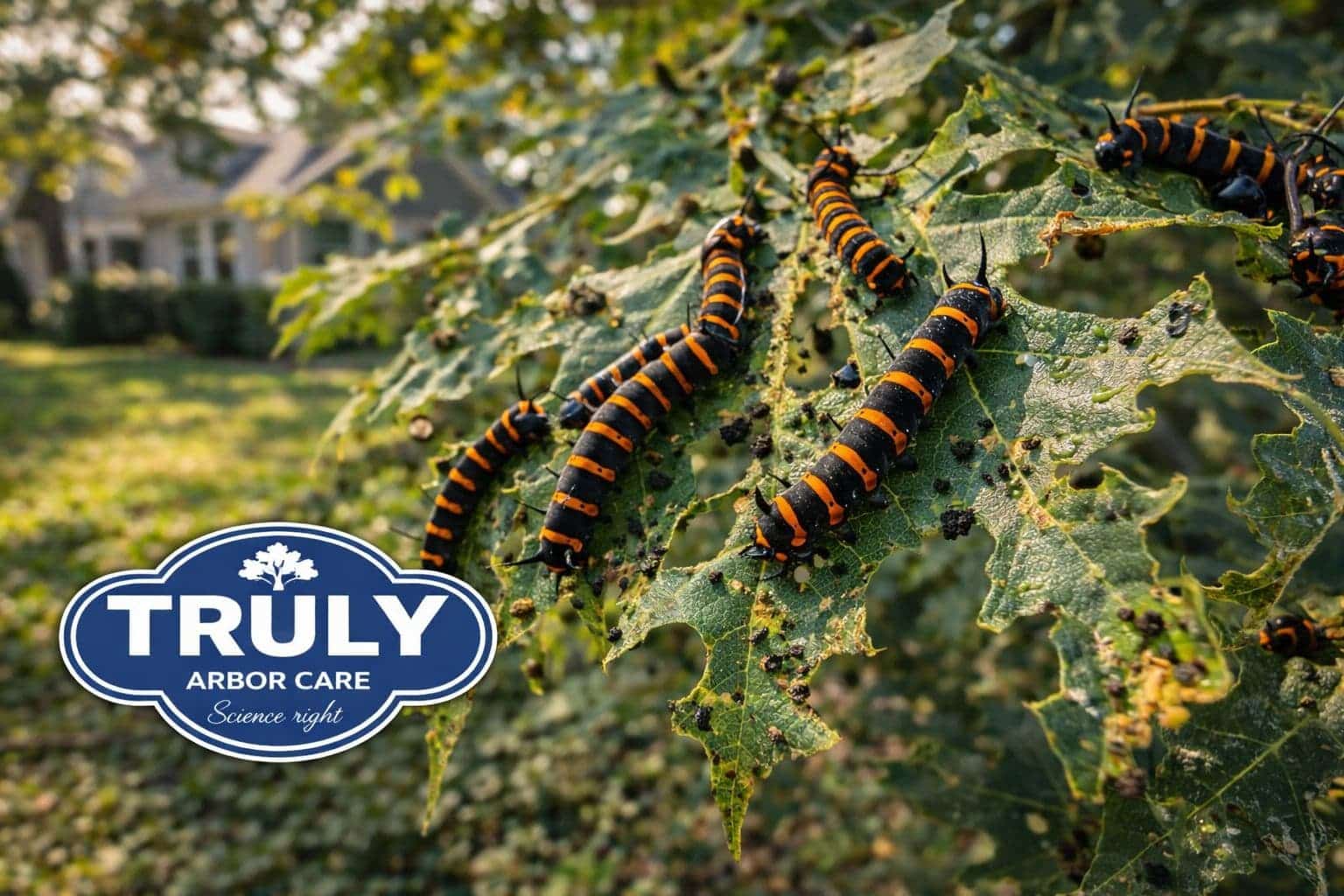
Identification and Morphology
Adult orangestriped oakworm moths are medium-sized and brownish in color. The larvae are more commonly observed than adults.
Caterpillars are dark with distinct orange longitudinal stripes running the length of the body. Mature larvae may reach up to 2 inches in length and are often seen feeding in groups.
Unlike forest tent caterpillars, orangestriped oakworm larvae do not construct tents or webs.
⸻
Distinguishing Characteristics
Key identifying features include:
- Dark caterpillars with bright orange stripes
- Group feeding behavior
- Rapid leaf consumption in late summer
- Visible frass accumulation beneath canopy
Heavy infestations may result in noticeable canopy thinning.
⸻
Host Trees in Texas
Primary hosts include:
- Red oak species
- Water oak
- Live oak
- Other ornamental oak varieties
Texas A&M documentation notes that red oak species are particularly susceptible during outbreak periods.
In the DFW Metroplex, mature landscape oaks may experience aesthetic damage when populations surge.
⸻
Life Cycle in Texas
Orangestriped oakworm typically produces one generation per year in Texas.
- Adults lay eggs on the undersides of oak leaves
- Eggs hatch in mid to late summer
- Larvae feed intensively before pupating in soil
- Adults emerge later in the season
Feeding generally occurs after much of the season’s growth has already developed.
⸻
Impact on Tree Health
Late-season defoliation is typically more aesthetic than lethal. Texas A&M AgriLife notes that healthy oak trees usually recover following a single defoliation event.
However, repeated defoliation combined with drought stress in North Texas may reduce carbohydrate reserves and overall vigor.
In the DFW Metroplex, aesthetic concerns and homeowner alarm are the most common issues.
⸻
Environmental Stress Considerations
Trees experiencing:
- Prolonged summer drought
- Soil compaction
- Root disturbance
- High urban heat exposure
may recover more slowly from defoliation.
Maintaining soil health and irrigation consistency improves resilience.
⸻
Management and Professional Evaluation
Texas A&M AgriLife Extension recommends treatment only when defoliation becomes severe or when repeated outbreaks occur.
Management options may include:
- Monitoring larval development
- Mechanical removal when feasible
- Targeted insecticide application during early larval stages
ANSI A300 Plant Health Care standards emphasize preservation of tree vigor rather than routine preventative spraying.
⸻
Professional Assessment in North Texas
As ISA Certified Arborists serving North Texas and the DFW Metroplex, Truly Arbor Care evaluates orangestriped oakworm infestations within a comprehensive plant health framework.
Monitoring is recommended when multiple stressors are present.
For more information, check out the Texas A&M article on Orangestriped Oakworm here.