
Japanese Beetle in North Texasapanese Beetle in North Texas
Popillia japonica | Broadleaf Defoliation Risk in the DFW Metroplex
The Japanese beetle, Popillia japonica, is an invasive scarab beetle established in parts of Texas and monitored closely by Texas A&M AgriLife Extension and Texas A&M Forest Service. While more historically concentrated in eastern states, populations have been detected in portions of Texas, and movement through nursery stock remains a concern.
In North Texas and across the DFW Metroplex, Japanese beetles are considered a potential high-impact defoliator due to their broad host range and aggressive feeding behavior.
ISA Certified Arborist Evaluation and Texas A&M Research Context
As ISA Certified Arborists serving North Texas, Truly Arbor Care evaluates Japanese beetle infestations using science-based plant health care standards aligned with Texas A&M research. Proper identification is critical because damage may resemble that caused by native leaf beetles or caterpillars.
Texas A&M guidance emphasizes early detection, monitoring, and coordinated management due to the beetle’s potential for rapid population expansion.
⸻
Identification and Morphology
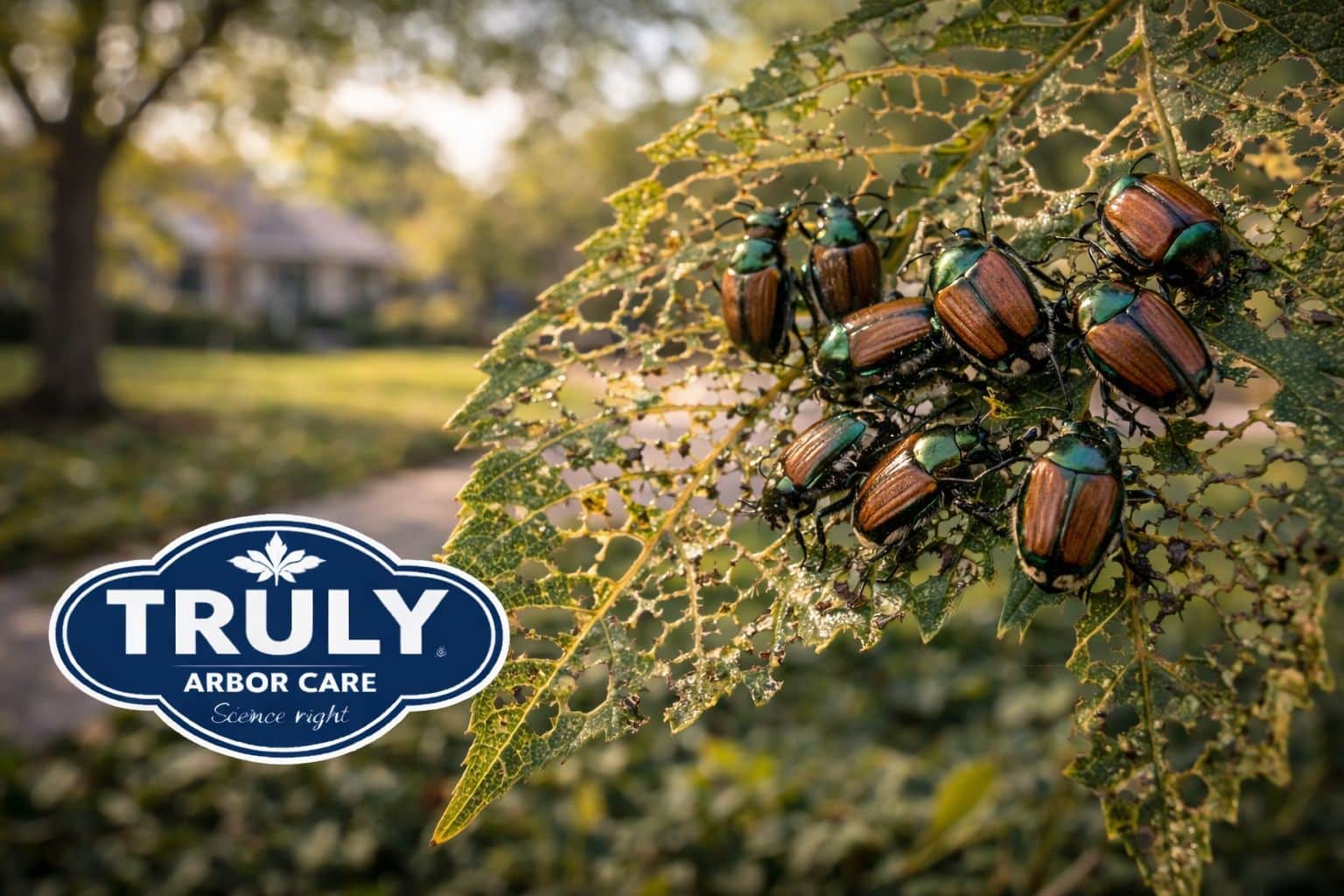
Adult Japanese beetles are approximately 3/8 to 1/2 inch in length and are easily identified by:
- Metallic green head and thorax
- Copper-brown wing covers
- Small white tufts of hair along the sides of the abdomen
Larvae are white C-shaped grubs that develop in soil and feed on turfgrass roots.
⸻
Distinguishing Characteristics
Key identifying features include:
- Skeletonized leaf surfaces
- Lace-like feeding damage between leaf veins
- Group feeding behavior on foliage
- White C-shaped grubs in soil
Unlike many native beetles, Japanese beetles often feed in large clusters.
⸻
Host Trees and Plants in North Texas
Japanese beetles have an extremely broad host range including:
- Elm
- Maple
- Crape myrtle
- Rose
- Fruit trees
- Many ornamental shrubs
Texas A&M notes that this wide host range increases the potential for landscape impact.
In the DFW Metroplex, ornamental plantings and residential landscapes are most vulnerable.
⸻
Life Cycle in Texas
Japanese beetles typically produce one generation per year.
- Adults emerge in early summer
- Females lay eggs in turfgrass
- Larvae feed on roots during late summer
- Grubs overwinter in soil
- Pupation occurs in spring
Warm North Texas conditions may influence development timing.
⸻
Impact on Tree and Turf Health
Adult feeding may result in:
- Severe leaf skeletonization
- Reduced photosynthesis
- Aesthetic decline
- Increased stress during drought
Larval feeding on turf roots may result in:
- Brown patches
- Turf thinning
- Increased vulnerability to secondary damage
Texas A&M AgriLife emphasizes that combined turf and tree damage can affect overall landscape health.
⸻
Environmental Stress and Susceptibility
Trees and turf experiencing:
- Drought stress
- Compacted soils
- Improper irrigation
- Nutrient imbalance
may suffer more severe damage.
Maintaining landscape vigor reduces impact severity.
⸻
Management and Professional Guidance in North Texas
Texas A&M recommends integrated pest management strategies including:
- Monitoring adult emergence
- Targeted insecticide applications when populations exceed thresholds
- Turf management for grub control
- Maintaining overall plant health
ANSI A300 Plant Health Care standards emphasize threshold-based treatment rather than routine preventative spraying.
⸻
Professional Assessment in the DFW Metroplex
As ISA Certified Arborists serving North Texas and the DFW Metroplex, Truly Arbor Care evaluates Japanese beetle infestations within a comprehensive plant health framework, considering both tree canopy impact and turf health.
For more information, check out the Texas A&M article on Japanese beetles here.