
Greenstriped Mapleworm in North Texas
Dryocampa rubicunda | Maple Defoliation in the DFW Metroplex
The greenstriped mapleworm, Dryocampa rubicunda, is a native defoliating caterpillar found throughout Texas and the southeastern United States. According to Texas A&M AgriLife Extension and Texas A&M Forest Service publications, this species feeds primarily on maple foliage and may cause noticeable defoliation during outbreak cycles.
In North Texas and across the DFW Metroplex, infestations are typically observed in mid to late summer when larvae feed openly on maple leaves.
ISA Certified Arborist Evaluation and Texas A&M Research Context
As ISA Certified Arborists serving North Texas, Truly Arbor Care evaluates greenstriped mapleworm infestations using science-based plant health care standards aligned with Texas A&M research. Accurate identification is essential because defoliation patterns may resemble drought stress or other foliar diseases.
Texas A&M guidance indicates that most established trees tolerate limited defoliation, but repeated heavy feeding combined with environmental stress may reduce vigor.
⸻
Identification and Morphology
Adult greenstriped mapleworm moths are pink and yellow in coloration and are often referred to as rosy maple moths.
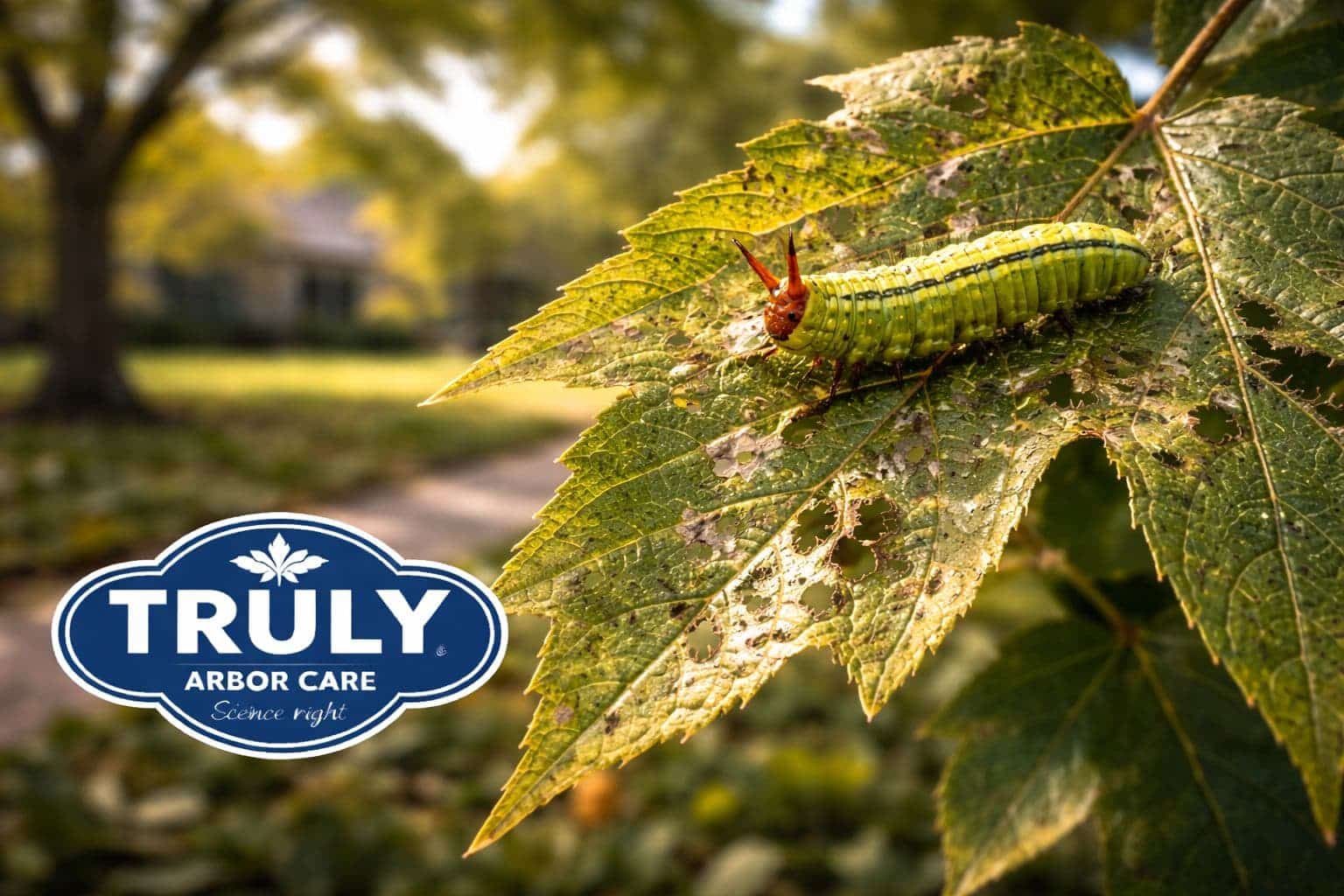
The larval stage is more commonly observed. Caterpillars are bright green with longitudinal yellow or pale stripes running along the body. Mature larvae may reach approximately 1.5 inches in length and possess short, dark horns near the head.
⸻
Distinguishing Characteristics
Key identifying features include:
- Bright green body with yellow striping
- Small dark horns near head
- Group feeding behavior
- Heavy frass accumulation beneath canopy
Unlike tent caterpillars, greenstriped mapleworms do not construct silk tents.
⸻
Host Trees in North Texas
Primary hosts include:
- Red maple
- Silver maple
- Sugar maple (less common in Texas)
- Other ornamental maple varieties
Texas A&M Forest Service documentation notes that young trees and ornamental plantings may show more visible impact.
In the DFW Metroplex, landscape maples in residential neighborhoods are most frequently affected.
⸻
Life Cycle in Texas
Greenstriped mapleworms typically produce one generation per year in Texas.
- Adults lay eggs on leaf undersides
- Larvae hatch and feed intensively
- Pupation occurs in soil
- Adults emerge later in the season
Feeding generally peaks in summer.
⸻
Impact on Tree Health
Defoliation may result in:
- Thinned canopy
- Reduced growth rate
- Aesthetic decline
- Increased stress during drought
Texas A&M AgriLife notes that while single defoliation events are rarely fatal, repeated outbreaks in combination with North Texas drought stress may reduce stored carbohydrate reserves.
⸻
Environmental Stress and Susceptibility
Trees experiencing:
- Drought
- Soil compaction
- Root disturbance
- Urban heat stress
may recover more slowly from defoliation.
Maintaining irrigation consistency and soil health improves resilience in the DFW Metroplex climate.
⸻
Management and Professional Guidance in North Texas
Texas A&M recommends monitoring larval populations before implementing treatment.
Management strategies may include:
- Mechanical removal when feasible
- Targeted insecticide applications during early larval stages
- Supporting overall tree vigor
ANSI A300 Plant Health Care standards emphasize integrated pest management and environmental stress reduction.
⸻
Professional Assessment in the DFW Metroplex
As ISA Certified Arborists serving North Texas and the DFW Metroplex, Truly Arbor Care evaluates greenstriped mapleworm infestations within a comprehensive plant health framework to determine appropriate intervention.
For more information, check out the Texas A&M article on Greenstriped Mapleworm here.