
Emerald Ash Borer in North Texas
Early Detection and Science-Based Management | Truly Arbor Care
Emerald Ash Borer (Agrilus planipennis) is an invasive wood-boring beetle that has been confirmed in multiple North Texas counties. According to Texas A&M Forest Service, this pest poses a severe threat to all native ash species (Fraxinus spp.), including green ash, white ash, and Texas ash commonly planted throughout the Dallas–Fort Worth region.
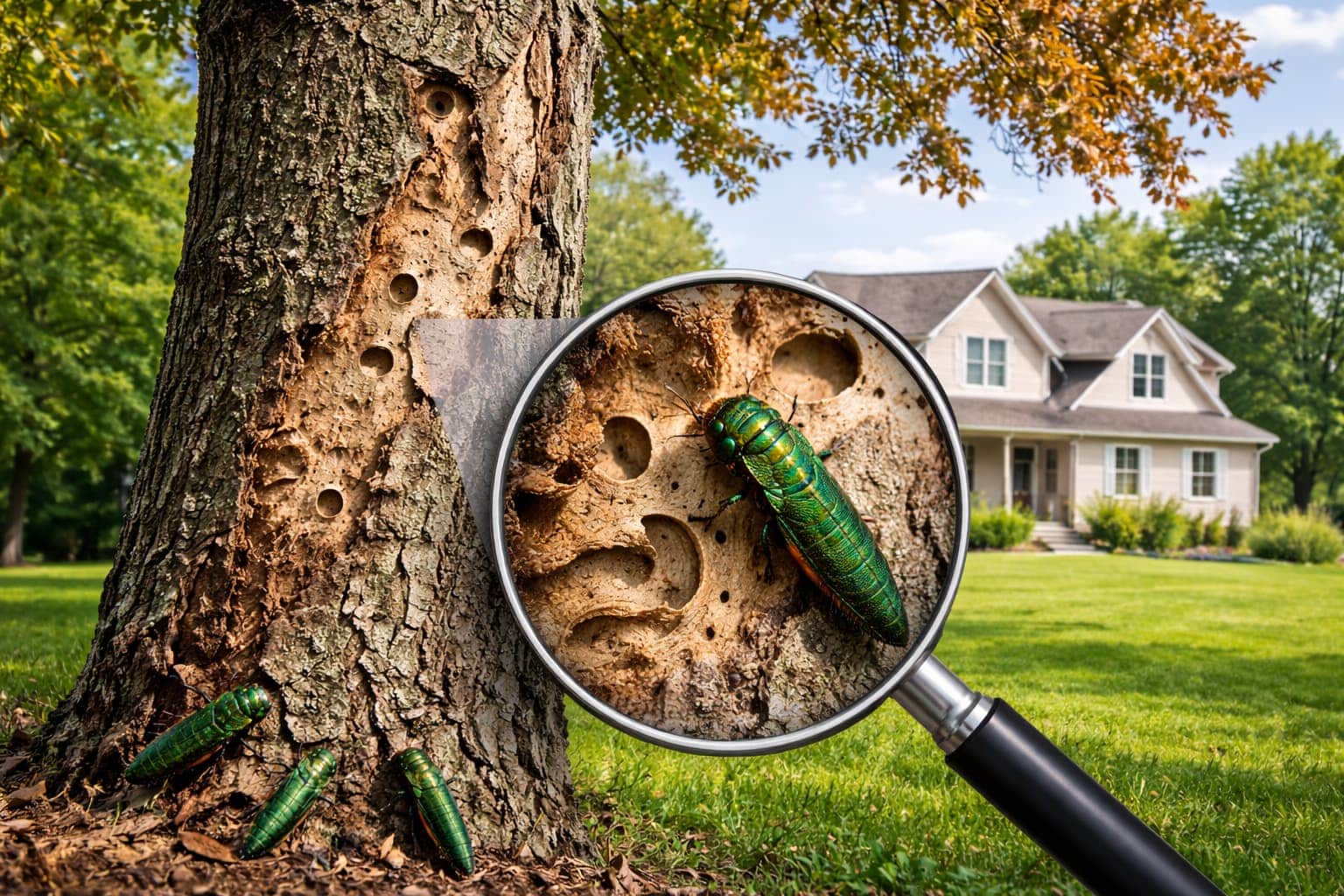
EAB larvae feed beneath the bark within the phloem and outer xylem, disrupting the tree’s vascular system and preventing normal water and nutrient transport. Untreated infestations typically result in tree mortality within two to four years of initial colonization.
Biology and Spread in the DFW Region
Texas A&M Forest Service reports that adult beetles emerge in late spring through early summer. After mating, females deposit eggs within bark crevices. Upon hatching, larvae tunnel into the cambial region, creating serpentine galleries that girdle the tree.
Primary indicators include:
- Canopy thinning beginning in upper crown
- Epicormic sprouting along trunk
- D-shaped adult exit holes
- Vertical bark splitting
- Increased woodpecker activity
Emerald Ash Borer spreads both naturally through adult flight and artificially through movement of infested firewood or untreated ash material.
⸻
Why Ash Trees Decline Rapidly
Unlike many native borers that attack already stressed trees, Emerald Ash Borer aggressively colonizes healthy ash trees. The feeding galleries interrupt phloem transport, triggering progressive canopy dieback.
As vascular disruption intensifies, the tree cannot transport carbohydrates or water efficiently, leading to rapid structural weakening and eventual failure risk.
ISA and university research emphasize that early detection significantly improves preservation success rates.
⸻
Treatment Options Consistent with ISA and Texas A&M Guidance
Texas A&M Forest Service and ISA recommendations indicate that systemic insecticide treatments can be effective when applied proactively or during early infestation stages.
Treatment options may include:
- Trunk injection using emamectin benzoate products
- Soil-applied systemic insecticides, when appropriate
- Ongoing monitoring and retreatment intervals
Treatment is most successful when canopy decline is less than approximately 30 percent.
Trees with advanced canopy loss often have reduced recovery potential and may require risk assessment for removal.
All applications must follow label directions and align with ANSI A300 Part 10 Plant Health Care standards.
⸻
Risk Assessment and Ash Tree Preservation in Granbury and DFW
Ash trees located near structures, roadways, or pedestrian areas require careful evaluation as decline progresses. As larvae compromise vascular integrity, secondary wood decay organisms may accelerate structural failure.
As ISA Certified Arborists and Tree Risk Assessment Qualified professionals, Truly Arbor Care evaluates:
- Crown condition
- Structural stability
- Proximity to targets
- Preservation feasibility
We prioritize early intervention and preservation when biologically justified.
⸻
Protecting North Texas Ash Trees
Emerald Ash Borer is not a seasonal nuisance; it is a lethal invasive species. Preventative treatment before visible canopy decline provides the highest probability of long-term survival.
If you have ash trees in Granbury, Fort Worth, or surrounding North Texas communities, early evaluation is critical.
For more information, check out the Texas A&M article on Emerald Ash Borer here.