
Eastern Tent Caterpillar in North Texas
Malacosoma americanum | Early Spring Defoliation in the DFW Metroplex
The eastern tent caterpillar, Malacosoma americanum, is a native defoliating insect found throughout Texas and much of the eastern United States. According to Texas A&M AgriLife Extension and Texas A&M Forest Service publications, this species is most active in early spring when larvae feed on emerging foliage of host trees.
In North Texas and across the DFW Metroplex, infestations are commonly observed in ornamental and native hardwoods during the early growing season.
ISA Certified Arborist Evaluation and Texas A&M Research Context
As ISA Certified Arborists serving North Texas, Truly Arbor Care evaluates eastern tent caterpillar infestations using science-based plant health care standards aligned with Texas A&M research. Accurate identification is critical because eastern tent caterpillars are often confused with forest tent caterpillars, which differ in web-building behavior.
Texas A&M guidance emphasizes that most healthy trees tolerate limited early-season defoliation without long-term injury.
⸻
Identification and Morphology
Adult eastern tent caterpillar moths are reddish-brown with pale diagonal lines across the forewings. Adults are active primarily at night.
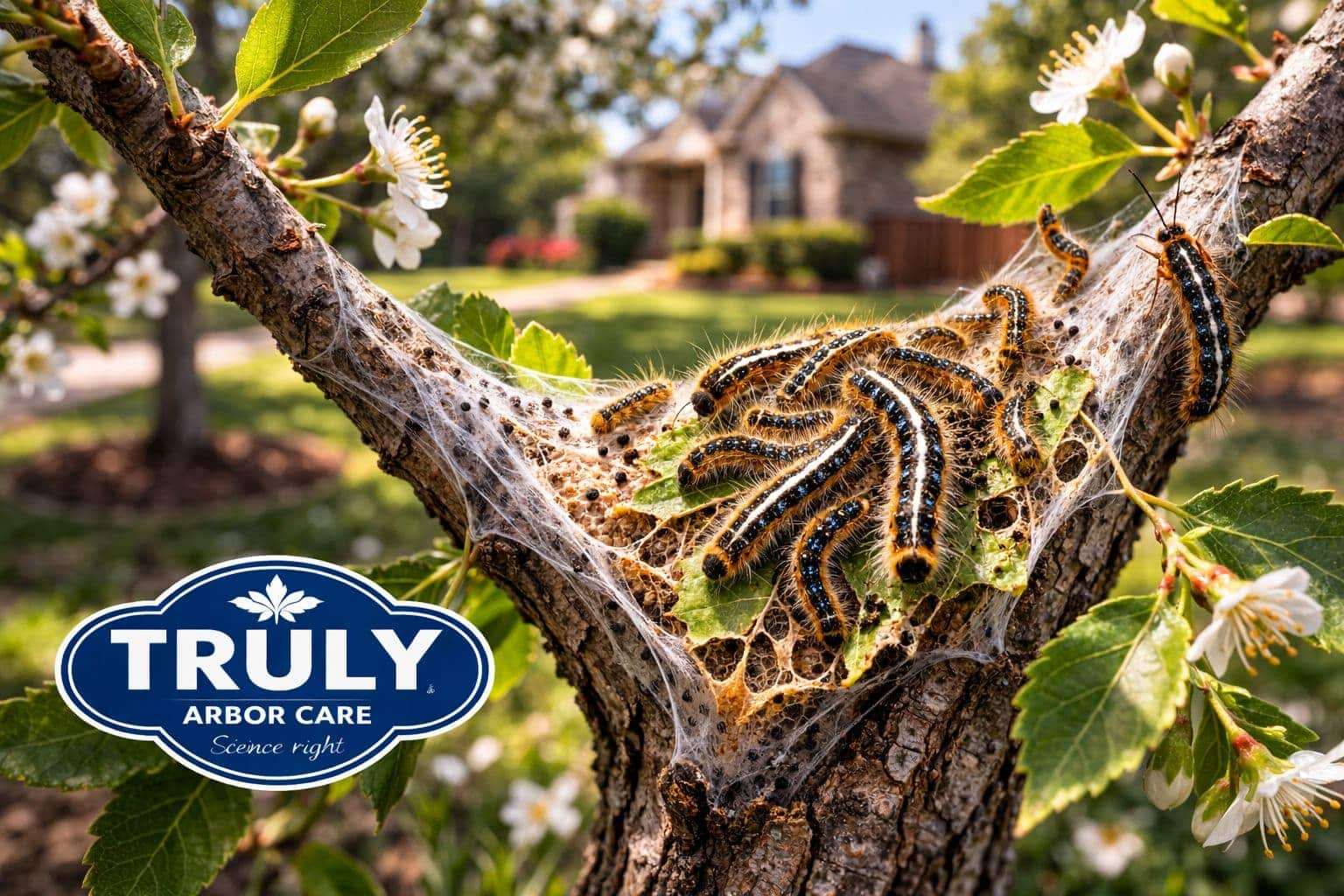
Larvae are dark with a solid white stripe running down the center of the back and blue markings along the sides. Caterpillars are typically observed feeding in groups.
⸻
Distinguishing Characteristics
Key identifying features include:
- * Large silk tents constructed in branch crotches
* Group feeding behavior
* White dorsal stripe on larvae
* Early spring defoliation
Unlike forest tent caterpillars, eastern tent caterpillars build prominent silk tents in tree forks.
⸻
Host Trees in North Texas
Primary hosts include:
- * Wild cherry
* Plum
* Crabapple
* Other Prunus species
Texas A&M Forest Service notes that infestations are most common on trees in the rose family.
In the DFW Metroplex, ornamental fruit trees and native cherries are most frequently affected.
⸻
Life Cycle in Texas
Eastern tent caterpillars produce one generation per year.
- Eggs overwinter in dark bands encircling twigs
- Larvae hatch in early spring
- Silk tents are constructed shortly after emergence
- Feeding continues for several weeks
- Pupation occurs in silken cocoons
- Adults emerge in late spring
Defoliation occurs during early leaf expansion.
⸻
Impact on Tree Health
Early-season defoliation may appear severe, but Texas A&M AgriLife indicates that established trees typically refoliate and recover without long-term injury.
However, repeated defoliation combined with drought stress in North Texas may reduce tree vigor over time.
In the DFW Metroplex, aesthetic concerns and web removal are the most common management issues.
⸻
Environmental Stress and Susceptibility
Trees experiencing:
- Drought stress
- Poor soil conditions
- Compacted root zones
may show slower recovery after defoliation.
Maintaining tree health supports resilience.
⸻
Management and Professional Evaluation in North Texas
Texas A&M recommends management only when infestations are heavy or when aesthetic concerns justify intervention.
Management strategies may include:
- Mechanical removal of tents
- Pruning small infested branches
- Targeted insecticide application during early larval stages
ANSI A300 Plant Health Care standards emphasize preserving tree vigor and evaluating environmental stress factors.
⸻
Professional Assessment in the DFW Metroplex
As ISA Certified Arborists serving North Texas and the DFW Metroplex, Truly Arbor Care evaluates eastern tent caterpillar infestations within a comprehensive plant health and structural framework.
For more information, check out the Texas A&M article on eastern tent caterpillar here.