
Crape Myrtle Bark Scale in North Texas
Eriococcus lagerstroemiae | Sooty Mold and Bark Infestation in the DFW Metroplex
Crape myrtle bark scale, Eriococcus lagerstroemiae, is an invasive scale insect first confirmed in Texas in the early 2000s and now widely distributed across North Texas and the DFW Metroplex. According to Texas A&M AgriLife Extension and Texas A&M Forest Service publications, this pest is considered one of the most significant threats to crape myrtle health and ornamental value in urban landscapes.
Unlike most scale insects that primarily infest leaves, crape myrtle bark scale colonizes stems and trunks.
ISA Certified Arborist Evaluation and Texas A&M Research Context
As ISA Certified Arborists serving North Texas, Truly Arbor Care evaluates crape myrtle bark scale infestations using science-based plant health care standards aligned with Texas A&M research. Accurate identification is critical because this pest is often confused with common white aphids or other scale insects.
Texas A&M AgriLife emphasizes that early detection and integrated management significantly improve long-term control outcomes.
⸻
Identification and Morphology
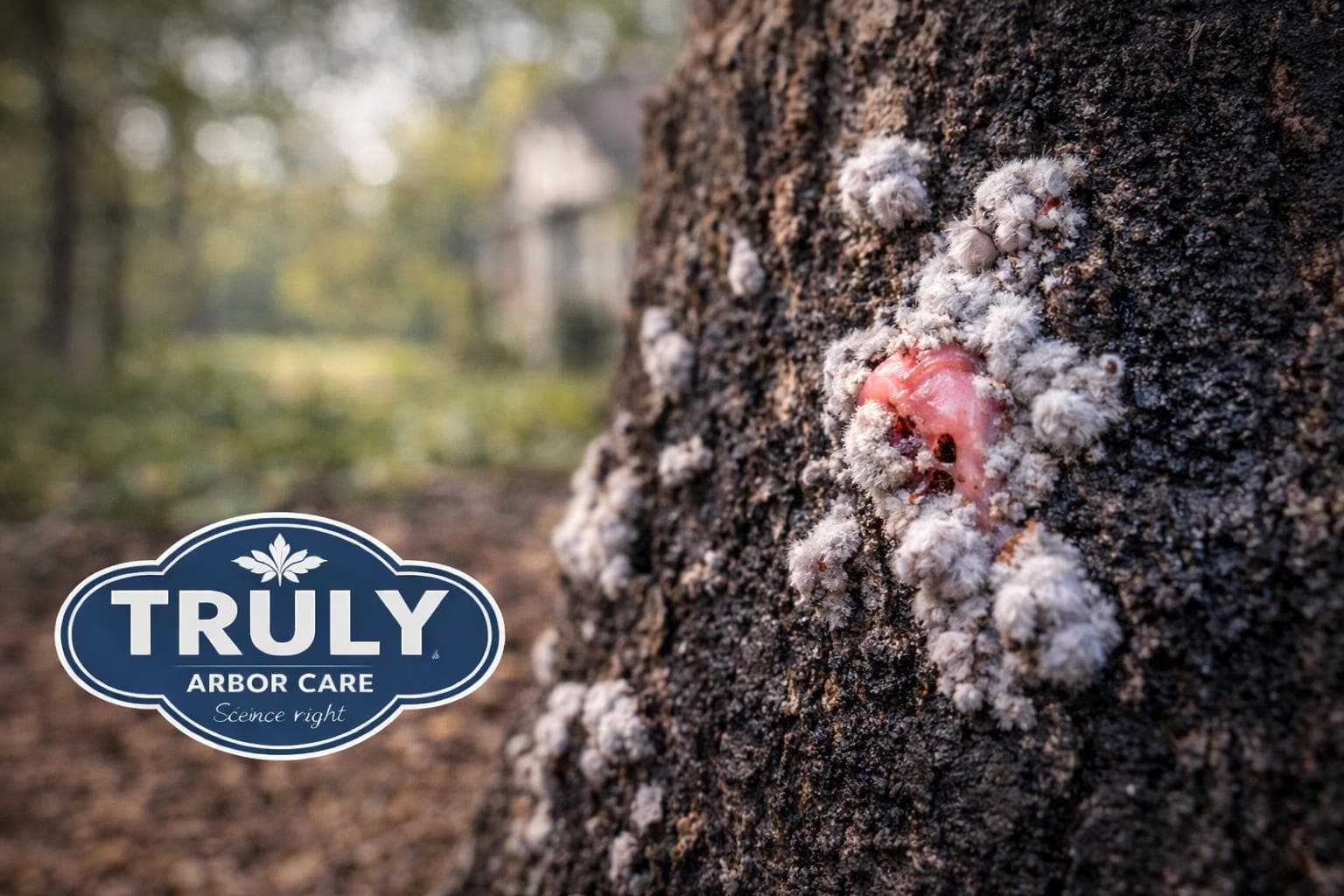
Adult female scales appear as white to gray felt-like masses attached to bark. When crushed, they often exude a pink fluid, which is a key diagnostic feature.
Males are small and less noticeable. Immature crawler stages are tiny and mobile before settling on bark surfaces.
Heavy infestations may cover branches and trunks with white clusters.
⸻
Distinguishing Characteristics
Key identifying features include:
- White cottony scale clusters on bark
- Pink fluid when crushed
- Black sooty mold growing on bark
- Sticky honeydew residue
- Heavy ant activity
Sooty mold develops on honeydew excreted by feeding scales and may blacken the trunk surface.
⸻
Host Trees in North Texas
Primary host:
- Crape myrtle (Lagerstroemia species)
Texas A&M documentation notes that while crape myrtle bark scale primarily affects Lagerstroemia, it may occasionally be observed on related ornamental species.
In the DFW Metroplex, infestation rates are highest in densely planted urban landscapes.
⸻
Life Cycle in Texas
Crape myrtle bark scale may produce multiple overlapping generations per year in Texas.
- Crawlers emerge and disperse to new feeding sites
- Immatures settle on bark and begin feeding
- Females develop protective waxy coverings
- Honeydew excretion increases as populations build
Warm North Texas temperatures support continuous activity during growing season.
⸻
Impact on Tree Health
While crape myrtle bark scale rarely kills established trees, heavy infestations can cause:
- Reduced vigor
- Branch dieback
- Decline in flowering
- Significant aesthetic damage
Texas A&M AgriLife notes that honeydew accumulation promotes sooty mold growth, which interferes with photosynthesis and ornamental appearance.
In the DFW Metroplex, aesthetic decline is often the primary concern.
⸻
Environmental Stress and Susceptibility
Trees experiencing:
- Drought stress
- Improper pruning
- Nutrient imbalance
- Compacted soils
may experience more severe infestations.
Maintaining tree health improves tolerance and recovery.
⸻
Management and Professional Guidance in North Texas
Texas A&M AgriLife recommends integrated pest management strategies including:
- Monitoring crawler stages
- Horticultural oil applications
- Systemic insecticide treatments when warranted
- Pruning heavily infested branches
ANSI A300 Plant Health Care standards emphasize combining chemical management with environmental stress reduction.
⸻
Professional Assessment in the DFW Metroplex
As ISA Certified Arborists serving North Texas and the DFW Metroplex, Truly Arbor Care evaluates crape myrtle bark scale infestations within a comprehensive plant health framework to determine appropriate long-term management strategies.
For more information, check out the Texas A&M article on Crape myrtle bark scale here.