
Carpenterworm in North Texas
Prionoxystus robiniae | Wood-Boring Moth Impact on Hardwood Trees
The carpenterworm, Prionoxystus robiniae, is a native wood-boring moth whose larvae tunnel into the heartwood of hardwood trees. According to Texas A&M AgriLife Extension and Texas A&M Forest Service, carpenterworms are most commonly associated with stressed or mature hardwood trees in urban and forested environments.
In North Texas, prolonged drought, soil compaction, construction injury, and aging tree structure increase susceptibility to infestation.
Unlike bark beetles that colonize phloem tissue, carpenterworm larvae bore deep into the sapwood and heartwood, creating structural galleries that weaken trunk integrity over time.
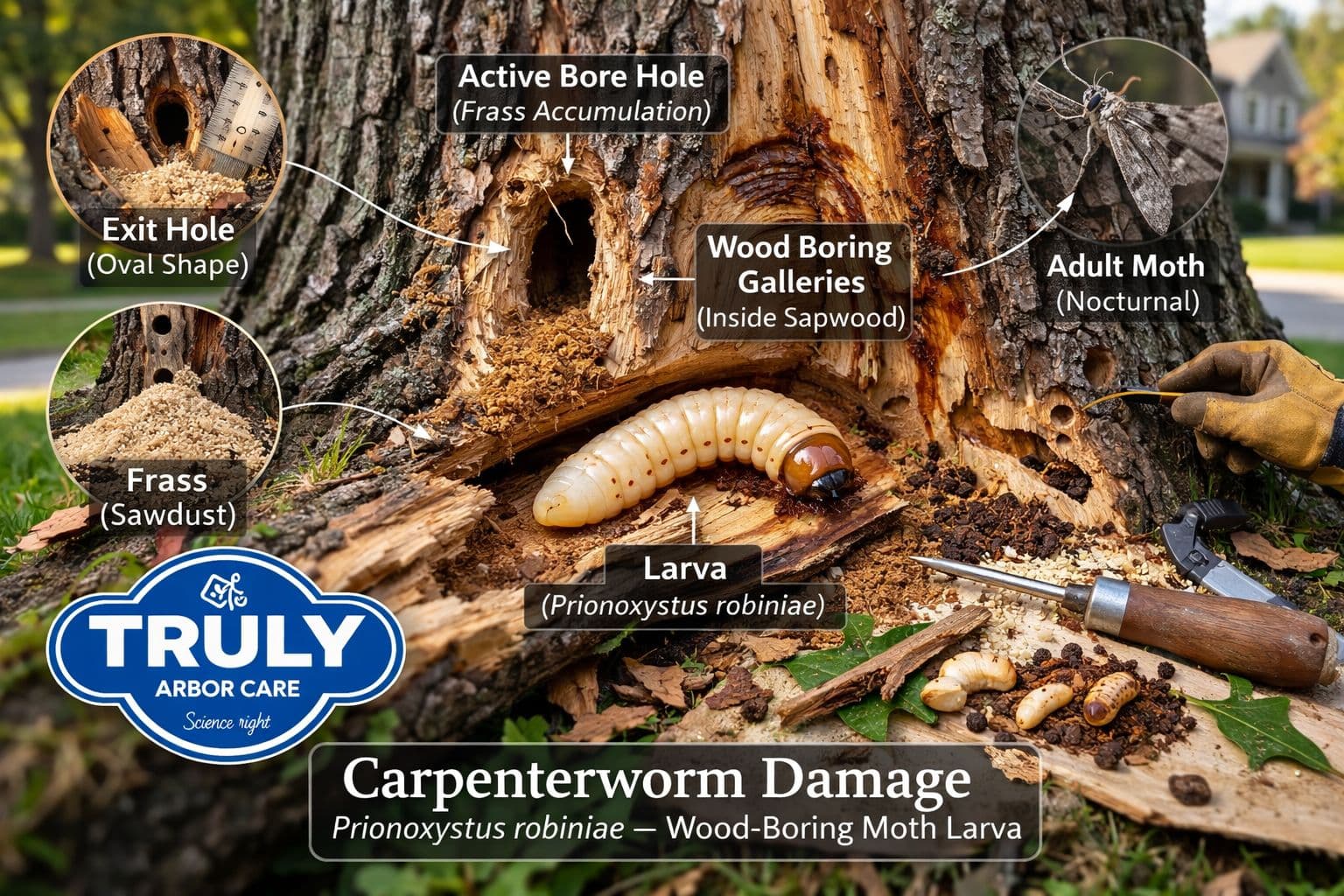
Identification and Morphology
Adult carpenterworms are large gray to mottled brown moths with wingspans reaching approximately 3 inches. Adults are rarely observed because they are nocturnal and short-lived.
The damaging stage is the larval stage. Caterpillars may grow up to 2 inches in length and are cream-colored with dark brown heads. Larvae live within the wood for extended periods, often 2 to 3 years before pupation.
Entry holes are typically found on the trunk or large branches of hardwood trees.
⸻
Distinguishing Signs of Carpenterworm Infestation
Key indicators include:
- Oval or irregular entry holes in trunk or scaffold limbs
- Wet, dark staining around bore holes
- Accumulation of frass and coarse sawdust at the base of the tree
- Audible chewing in severe cases
- Structural weakening over time
Texas A&M publications note that carpenterworm larvae expel frass from entry holes, which may accumulate in bark crevices or on the ground near the base of the tree.
⸻
Host Range in North Texas
Carpenterworms primarily infest hardwood species including:
- Oak
- Elm
- Ash
- Cottonwood
- Willow
- Maple
Mature and over-mature trees are most commonly affected. In North Texas urban landscapes, older shade trees with prior mechanical injury are particularly vulnerable.
⸻
Structural Impact and Risk
Unlike defoliating insects, carpenterworms compromise structural integrity from within. Galleries weaken load-bearing wood fibers and may increase the likelihood of limb failure.
While infestations rarely cause rapid mortality, long-term structural compromise can elevate risk in trees located near homes, walkways, and high-traffic areas.
ISA Tree Risk Assessment principles recommend evaluation when:
- Multiple bore sites are present
- Trunk galleries extend vertically
- Decay fungi are observed in conjunction with larval damage
⸻
Life Cycle in Texas
Carpenterworms typically have a multi-year life cycle.
- Eggs are laid in bark crevices.
- Larvae hatch and begin boring into wood.
- Larval feeding may continue for 2 to 3 years.
- Pupation occurs near the bark surface before adult emergence.
Texas A&M AgriLife notes that adult emergence often occurs in late spring through early summer in Texas.
⸻
Management and Prevention
Texas A&M guidance emphasizes prevention and tree vigor management.
Recommended practices include:
- Avoiding trunk injury
- Maintaining proper irrigation during drought
- Reducing soil compaction
- Monitoring mature hardwood trees for early signs
Chemical treatments are generally limited in effectiveness once larvae are deep within heartwood. Targeted treatment at early larval stages may be considered in high-value trees under professional supervision.
ANSI A300 Plant Health Care standards prioritize structural evaluation and risk mitigation when internal wood-boring insects are present.
⸻
Professional Evaluation in North Texas
As ISA Certified Arborists serving the Dallas–Fort Worth region, Truly Arbor Care evaluates carpenterworm damage within a comprehensive plant health care and structural assessment framework.
Because carpenterworm infestations affect internal wood strength, proper diagnosis is essential before determining preservation versus removal.
For more information, check out the Texas A&M article on carpenterworms here.