
Buck Moth in North Texas
Identification, Life Cycle, and Oak Defoliation Risk | Truly Arbor Care
The buck moth, Hemileuca maia, is a native caterpillar-producing moth found throughout the southeastern and south-central United States, including Texas. According to Texas A&M AgriLife Extension and Texas A&M Forest Service publications, buck moth larvae primarily feed on oak species and may cause noticeable defoliation in localized areas.
In North Texas, populations are typically sporadic but can become significant in residential landscapes where oak trees are concentrated. While healthy trees often recover from a single defoliation event, repeated outbreaks combined with drought stress can reduce vigor.
⸻
Identification and Morphology
Adult buck moths are medium-sized moths with dark brown to black wings marked by a broad pale band and a distinctive eye spot on each hind wing. Wingspan typically ranges from 2 to 3 inches.
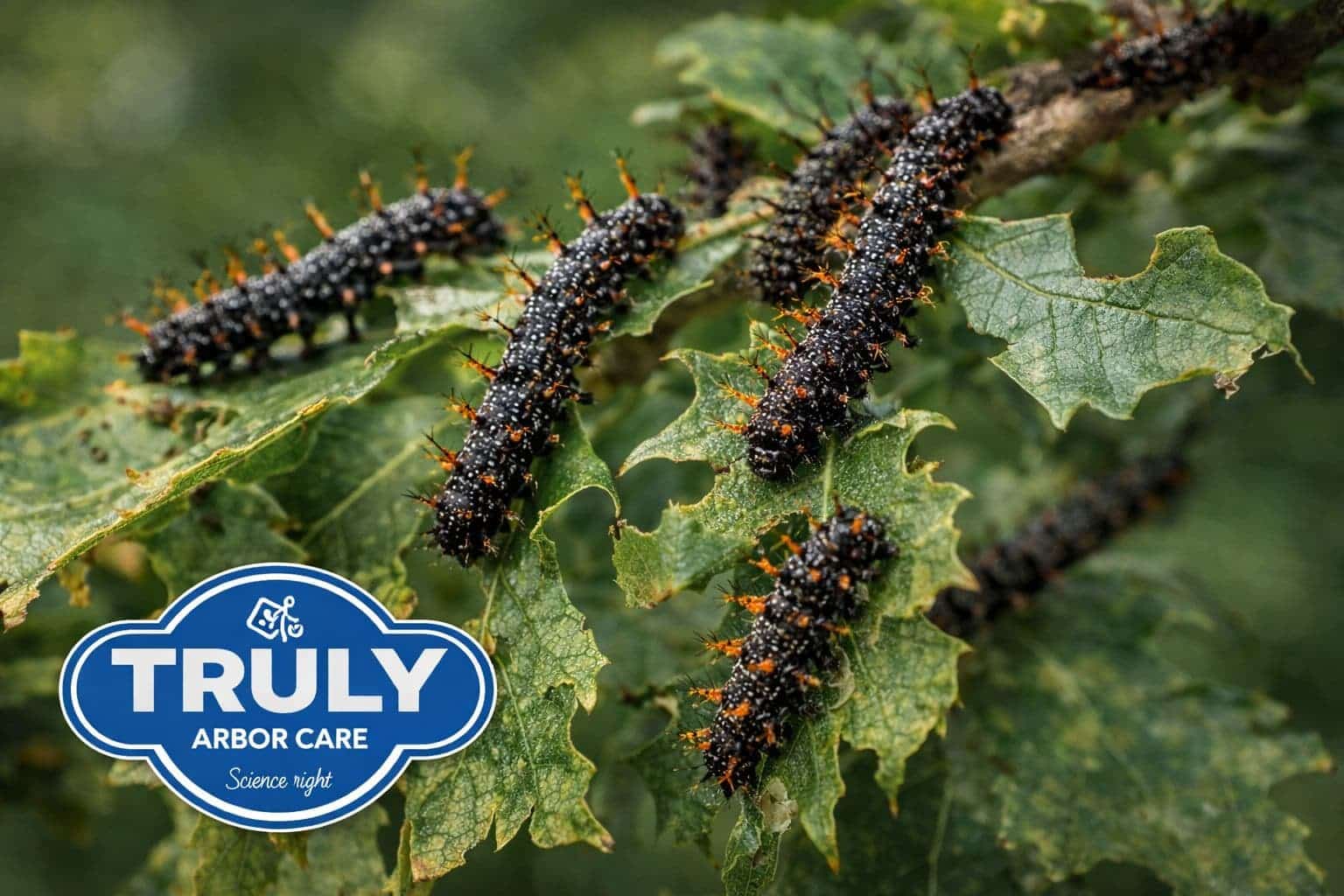
Larvae are more commonly observed than adults. Caterpillars are dark brown to black with rows of branching spines. These spines contain venom glands capable of causing painful skin irritation upon contact.
Texas A&M guidance notes that buck moth caterpillars often appear in groups during early development stages.
⸻
Distinguishing Characteristics
Key identifying features include:
- Dark caterpillars covered in branching spines
- Group feeding behavior on oak foliage
- Painful sting upon contact
- Adults emerging in fall
Unlike many spring defoliators, buck moth adults typically emerge in the fall, and eggs overwinter on host trees.
⸻
Life Cycle in Texas
Buck moths have one generation per year in Texas.
- Fall: Adults emerge, mate, and females deposit eggs on twigs.
- Winter: Eggs remain dormant on host trees.
- Spring: Eggs hatch and larvae begin feeding on new oak foliage.
- Late spring to early summer: Caterpillars mature and pupate in the soil.
Texas A&M research indicates that larval feeding is concentrated in early spring when oak leaves are tender and most vulnerable.
⸻
Host Trees in North Texas
Primary hosts include:
- Post oak
- Live oak
- Water oak
- Other native oak species
In North Texas landscapes, ornamental and native oaks may experience localized defoliation when populations build.
While a single defoliation event rarely causes mortality in established trees, repeated feeding during drought conditions can reduce carbohydrate reserves and increase susceptibility to secondary pests and pathogens.
⸻
Signs and Impact of Infestation
Symptoms include:
- Partial to heavy defoliation of oak canopy
- Visible clusters of spiny caterpillars on branches
- Leaf skeletonization
- Reduced early-season leaf production
Texas A&M notes that healthy trees typically refoliate following a single event. However, repeated defoliation or concurrent stress factors may lead to long-term decline.
The caterpillars pose an additional concern for homeowners due to their venomous spines, which can cause dermatitis upon contact.
⸻
Management and Prevention
Texas A&M AgriLife Extension recommends that management decisions be based on severity and tree health status.
Recommended approaches include:
- Monitoring early-season caterpillar emergence
- Mechanical removal when populations are small
- Targeted insecticide application when defoliation risk is high
- Maintaining overall tree vigor through proper irrigation and soil health
Broad chemical treatment is generally unnecessary unless populations are severe and canopy loss is substantial.
ANSI A300 Plant Health Care standards emphasize maintaining host vigor and monitoring rather than reactive over-application.
⸻
Risk Assessment in North Texas Landscapes
Buck moth outbreaks are typically localized. However, in residential areas with high oak density, aesthetic damage may be significant.
Professional evaluation is recommended when:
- Defoliation exceeds moderate levels
- Repeated annual outbreaks occur
- Trees exhibit additional stress symptoms
As ISA Certified Arborists serving the Dallas–Fort Worth region, Truly Arbor Care evaluates defoliation risk within a comprehensive plant health care framework.
For more information, check out the Texas A&M article on Emerald Ash Borer here.