
Black Twig Borer in North Texas
Biology, Host Impact, and Structural Risk | Truly Arbor Care
The black twig borer, Xylosandrus compactus, is an invasive ambrosia beetle that attacks small diameter branches and twigs of hardwood trees and ornamental species. Originally introduced from Asia, this beetle has expanded across the southeastern United States and is present in Texas. According to Texas A&M Forest Service and university entomology research, black twig borer infestations are most commonly associated with stressed or weakened hosts.
In North Texas landscapes, drought stress, soil compaction, heat stress, and improper pruning practices increase susceptibility.
Unlike larger bark beetles that colonize main stems, black twig borers typically attack small twigs, causing localized dieback and canopy thinning.
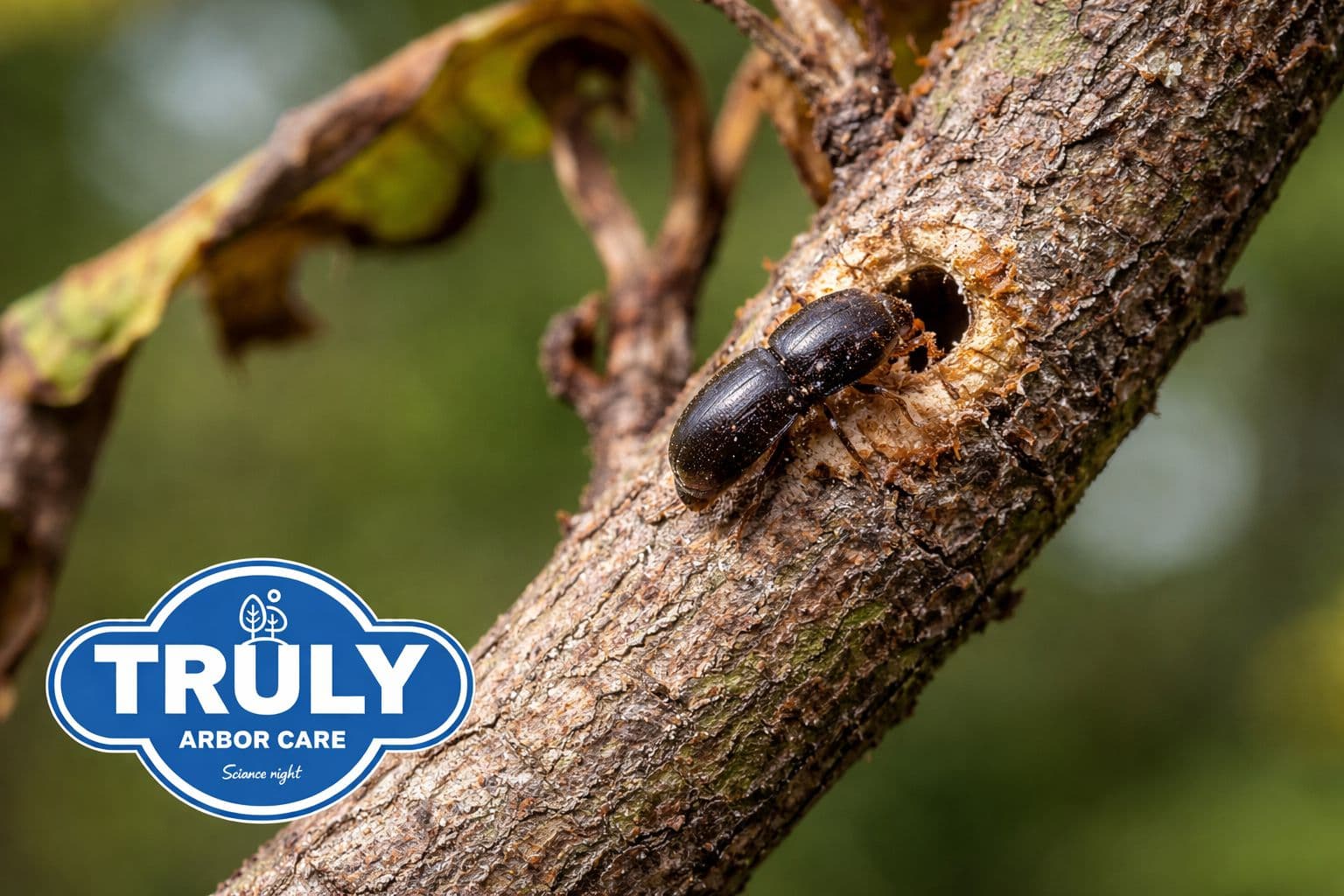
Identification and Morphology
Adult black twig borers are very small, typically 1.5 to 2 mm in length. Females are dark brown to black and cylindrical in shape. Males are rare and rarely observed, as reproduction often occurs through inbreeding within the galleries.
Larvae are legless, white grubs that develop within galleries constructed inside twigs.
Because of their small size, the beetles themselves are rarely seen without magnification. Diagnosis is usually based on damage symptoms rather than visual identification of the adult.
⸻
Gallery Formation and Ambrosia Fungi
Black twig borers are ambrosia beetles, meaning they cultivate symbiotic fungi within the wood. Females bore directly into small twigs and create short tunnels in the pith or xylem tissues. The introduced fungus becomes the primary food source for larvae.
The fungal colonization disrupts vascular tissue and blocks normal water transport, resulting in rapid wilting of the affected twig.
Multiple generations may occur per year in warm climates.
⸻
Signs and Symptoms in North Texas Trees
Common symptoms include:
- Sudden wilting of small twigs
- Flagging or dead branch tips scattered through the canopy
- Tiny circular entry holes in twigs
- Dark staining within cut branches
- Progressive canopy thinning in heavy infestations
Because infestations begin in small diameter wood, early detection can be difficult. Affected twigs often snap easily due to internal tunneling.
Texas A&M research notes that heavy infestations may cause significant aesthetic damage in ornamental plantings and nursery stock.
⸻
Host Range and Environmental Triggers
Black twig borer has a broad host range and may attack:
- Oaks
- Maples
- Redbuds
- Crepe myrtle
- Fruit trees
- Various ornamental hardwoods
Trees under physiological stress release ethanol and other volatile compounds that attract ambrosia beetles. In North Texas, prolonged heat and inconsistent rainfall contribute to stress-induced susceptibility.
While healthy trees can often compartmentalize limited damage, repeated infestations can reduce structural integrity and long-term vigor.
⸻
Management and Prevention
According to Texas A&M Forest Service and university entomology programs, prevention is the most effective management strategy.
Recommended practices include:
- Maintaining proper irrigation during drought
- Avoiding mechanical injury to trunks and roots
- Improving soil aeration and drainage
- Promptly pruning and removing infested twigs
Chemical treatment options are limited once beetles are inside the wood. Preventative trunk sprays may reduce attack pressure during peak activity, but timing is critical and must follow label directions and state regulations.
ANSI A300 Plant Health Care standards emphasize stress reduction and early intervention rather than reactive treatment after widespread colonization.
⸻
Structural and Landscape Risk
Although black twig borer primarily affects small diameter branches, heavy infestations can lead to canopy thinning and long-term decline. In ornamental landscapes, repeated dieback can compromise structural form and increase secondary pest and pathogen pressure.
Professional evaluation is recommended when dieback patterns become widespread.
⸻
Professional Evaluation in North Texas
As ISA Certified Arborists serving the Dallas–Fort Worth region, Truly Arbor Care evaluates black twig borer pressure within a comprehensive plant health care framework. This includes host vitality assessment, environmental stress analysis, and integration of soil health strategies.
Early diagnosis significantly improves preservation outcomes and reduces unnecessary removal.
For more information, check out the Texas A&M article on Black Twig Borer here.