
Black Turpentine Beetle in North Texas
Biology, Identification, and Pine Tree Risk | Truly Arbor Care
The black turpentine beetle, Dendroctonus terebrans, is one of the largest bark beetles affecting pine species in the southern United States, including Texas. According to Texas A&M Forest Service, this beetle is considered a secondary pest that primarily attacks stressed, injured, or weakened pine trees. While not typically as aggressive as the southern pine beetle, localized infestations in North Texas can contribute to decline and mortality when environmental stress is present.
In the Dallas–Fort Worth region, drought stress, soil compaction, construction injury, and root disturbance significantly increase host susceptibility.
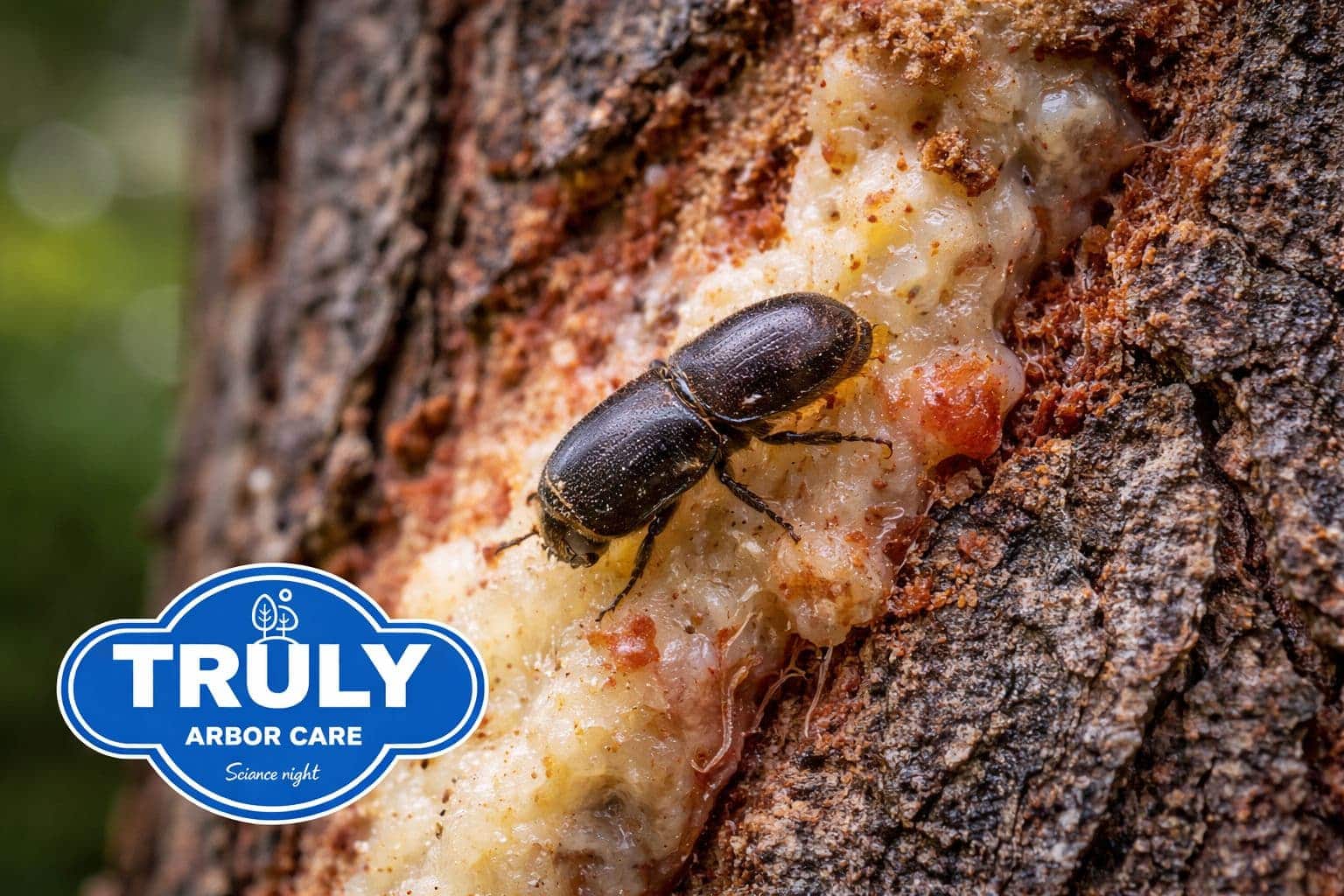
Identification and Morphology
Adult black turpentine beetles are stout, cylindrical insects measuring approximately 5–8 mm in length. Their coloration ranges from dark reddish-brown to black. The pronotum narrows toward the head, and antennae terminate in a club-shaped structure characteristic of bark beetles.
Larvae are creamy white, legless grubs with reddish-brown heads. Pupation occurs beneath the bark within the inner phloem tissues.
Unlike some smaller bark beetles, black turpentine beetle attacks are concentrated primarily at the lower trunk and root collar of pine trees.
⸻
Distinctive Pitch Tubes and Gallery Patterns
One of the most recognizable signs of black turpentine beetle attack is the presence of large pitch tubes on the lower bole of the tree. These pitch tubes form when resin mixes with boring dust as the female initiates gallery construction.
Galleries are irregular and broad within the inner bark. Eggs are laid along one side of the gallery, and larvae feed communally within expanded feeding chambers.
Accumulated boring dust may also be visible at the base of the tree.
⸻
Hosts and North Texas Vulnerability
Primary hosts include southern pine species such as loblolly pine, shortleaf pine, and slash pine. In urban North Texas landscapes, ornamental pines under stress are particularly vulnerable.
Texas A&M Forest Service documentation emphasizes that this species is typically associated with:
- Drought-stressed trees
- Recently injured trees
- Trees impacted by construction damage
- Fresh stumps or logging debris
Because North Texas frequently experiences extended summer heat and variable rainfall, resin production may be insufficient to repel beetle entry in stressed hosts.
⸻
Interaction with Environmental Stress
Research from Texas A&M and USDA Forest Service indicates that bark beetles are attracted to volatile compounds released by stressed trees. Ethanol emissions and altered resin chemistry signal weakened defenses.
When trees are unable to produce adequate resin pressure, successful colonization becomes more likely. While black turpentine beetle infestations alone may not always kill a healthy tree, combined stressors can accelerate decline.
For more information, check out the Texas A&M article on black turpentine beetle here.