
Leafy Mistletoe in North Texas
Understanding Phoradendron tomentosum and Its Impact on Trees in the DFW Metroplex
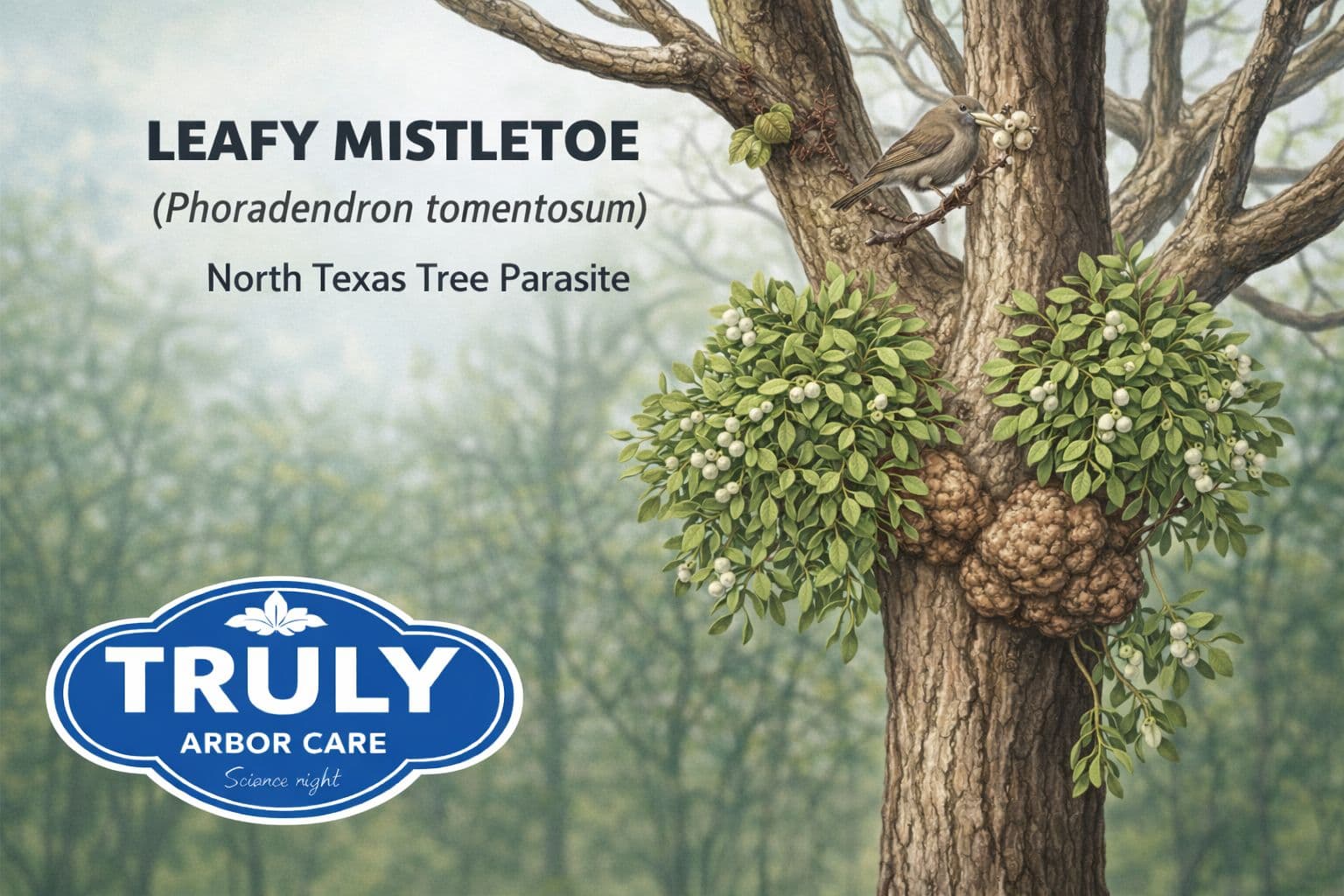
Leafy mistletoe, scientifically known as Phoradendron tomentosum, is a parasitic flowering plant that commonly affects shade trees throughout North Texas and the DFW Metroplex. Although mistletoe is often associated with holiday traditions, in arboriculture it represents a serious plant health concern when infestations become extensive.
According to research from Texas A&M AgriLife Extension and university forestry programs, leafy mistletoe functions as a hemiparasite. This means the plant is capable of performing photosynthesis, but it relies heavily on host trees for water and mineral nutrients. The parasite attaches itself to the host tree’s vascular system using specialized root-like structures called haustoria, which penetrate the bark and connect directly into the tree’s xylem tissues.
While a small amount of mistletoe may not immediately threaten tree health, moderate to heavy infestations can weaken host trees, increase stress, reduce growth, and make trees more vulnerable to drought, insects, and disease. Professional monitoring by an ISA Certified Arborist following ANSI A300 tree care standards and TCIA plant healthcare protocols is essential for managing mistletoe infestations across North Texas landscapes.
Host Trees Commonly Affected by Leafy Mistletoe
Leafy mistletoe has a broad host range and is widely observed in mature hardwood trees throughout North Texas urban forests.
Common host species include:
- Hackberry (Celtis species)
- Elm trees (Ulmus species)
- Pecan trees (Carya illinoinensis)
- Oak trees (Quercus species)
- Cottonwood trees (Populus species)
- Ash trees (Fraxinus species)
- Mesquite trees (Prosopis species)
- Maple trees (Acer species)
Hackberry trees are particularly susceptible in the DFW Metroplex, where mistletoe infestations are commonly observed in older urban canopy trees.
Birds play a major role in spreading the parasite by consuming mistletoe berries and depositing sticky seeds onto nearby tree branches.
Environmental Conditions That Encourage Mistletoe Infestation
Several environmental factors common in North Texas landscapes contribute to mistletoe establishment and spread.
Bird activity is the primary vector for seed dispersal. Birds feed on mistletoe berries during winter months and excrete seeds onto branches where the seeds adhere and germinate.
Other contributing factors include:
- High bird populations in urban environments
- Dense tree canopies that support bird habitat
- Mature tree populations with large branching structures
- Reduced pruning maintenance
- Stress from drought conditions common in North Texas
- Urban heat island effects in the DFW Metroplex
Trees weakened by environmental stress are more susceptible to mistletoe colonization because reduced vigor limits the tree’s ability to compartmentalize parasitic penetration.
How Leafy Mistletoe Infects Trees
The life cycle of leafy mistletoe begins when birds deposit sticky seeds on branches.
The seed germinates and produces a specialized structure called a haustorium. This structure penetrates the bark and grows into the host tree’s vascular tissue.
Once established, the mistletoe plant develops its own stems and leaves while extracting water and dissolved minerals from the host tree’s xylem.
Over time, the parasite produces dense clumps of branching growth, often referred to as “witches brooms.” These clusters can become large and heavy, placing mechanical stress on branches.
The parasite continues to produce berries, which birds consume and spread to additional trees across the landscape.
Symptoms and Identification of Leafy Mistletoe
Leafy mistletoe is relatively easy to identify due to its distinctive appearance.
Common symptoms include:
- Green clumps of leafy growth attached to tree branches
- Rounded clusters often visible during winter when host trees lose leaves
- Branch swelling near the attachment point
- Reduced vigor in affected limbs
- Premature leaf drop in severe infestations
- Branch dieback when infestation becomes extensive
ISA Certified Arborists performing canopy inspections often identify mistletoe infestations during routine tree health evaluations.
In many cases, infestations occur high in the canopy and may go unnoticed until they become widespread.
Consequences if Leafy Mistletoe Is Left Unmanaged
When mistletoe infestations are allowed to expand unchecked, the parasite can significantly weaken host trees.
The parasite continuously removes water and nutrients from the host tree, creating chronic stress.
Potential consequences include:
- Reduced tree vigor
- Increased drought susceptibility
- Branch dieback
- Higher vulnerability to insect attacks
- Greater susceptibility to fungal pathogens
- Structural branch failure due to added weight
In extreme cases, trees with heavy infestations may experience canopy decline severe enough to require removal.
Additionally, mistletoe plants produce large quantities of berries each year, increasing the likelihood of spreading to nearby host trees across the DFW Metroplex.
Managing Mistletoe Through Professional Tree Care
The most effective management strategy for leafy mistletoe involves early detection and targeted pruning.
ISA Certified Arborists operating under ANSI A300 pruning standards can remove infested branches before the parasite becomes well established.
Common management strategies include:
- Pruning infected branches at least 12 to 18 inches below the attachment point
- Monitoring high-value trees annually
- Reducing canopy density to discourage bird habitat
- Improving overall tree vigor through plant healthcare programs
- Managing drought stress through proper irrigation practices
TCIA plant healthcare standards emphasize that maintaining tree health significantly improves a tree’s ability to tolerate and resist parasitic plants such as mistletoe.
Protecting Trees Across North Texas and the DFW Metroplex
Leafy mistletoe is a widespread concern throughout North Texas urban forests. While small infestations may be tolerated, unchecked spread can compromise the long-term health and structural stability of valuable shade trees.
Routine inspections by an ISA Certified Arborist help identify infestations early and allow for proactive management strategies that preserve mature tree canopies throughout the DFW Metroplex.
For more information, check out the Texas A&M article on Leafy mistletoe here.