
Cedar Hawthorn Rust in North Texas Trees
Understanding Gymnosporangium juniperi-virginianae and Its Impact on Junipers and Hawthorns in the DFW Metroplex
Cedar hawthorn rust is a fungal disease that affects both juniper trees and hawthorn species throughout North Texas and the greater DFW Metroplex. The disease is caused by the fungal pathogen Gymnosporangium juniperi-virginianae, a rust fungus that requires two different host plants to complete its life cycle.
According to Texas A&M AgriLife Extension and university plant pathology research, cedar hawthorn rust belongs to a group of rust fungi that alternate between juniper species and plants in the rose family. In North Texas landscapes, eastern red cedar and ornamental junipers commonly serve as the primary host, while hawthorn trees act as the secondary host.
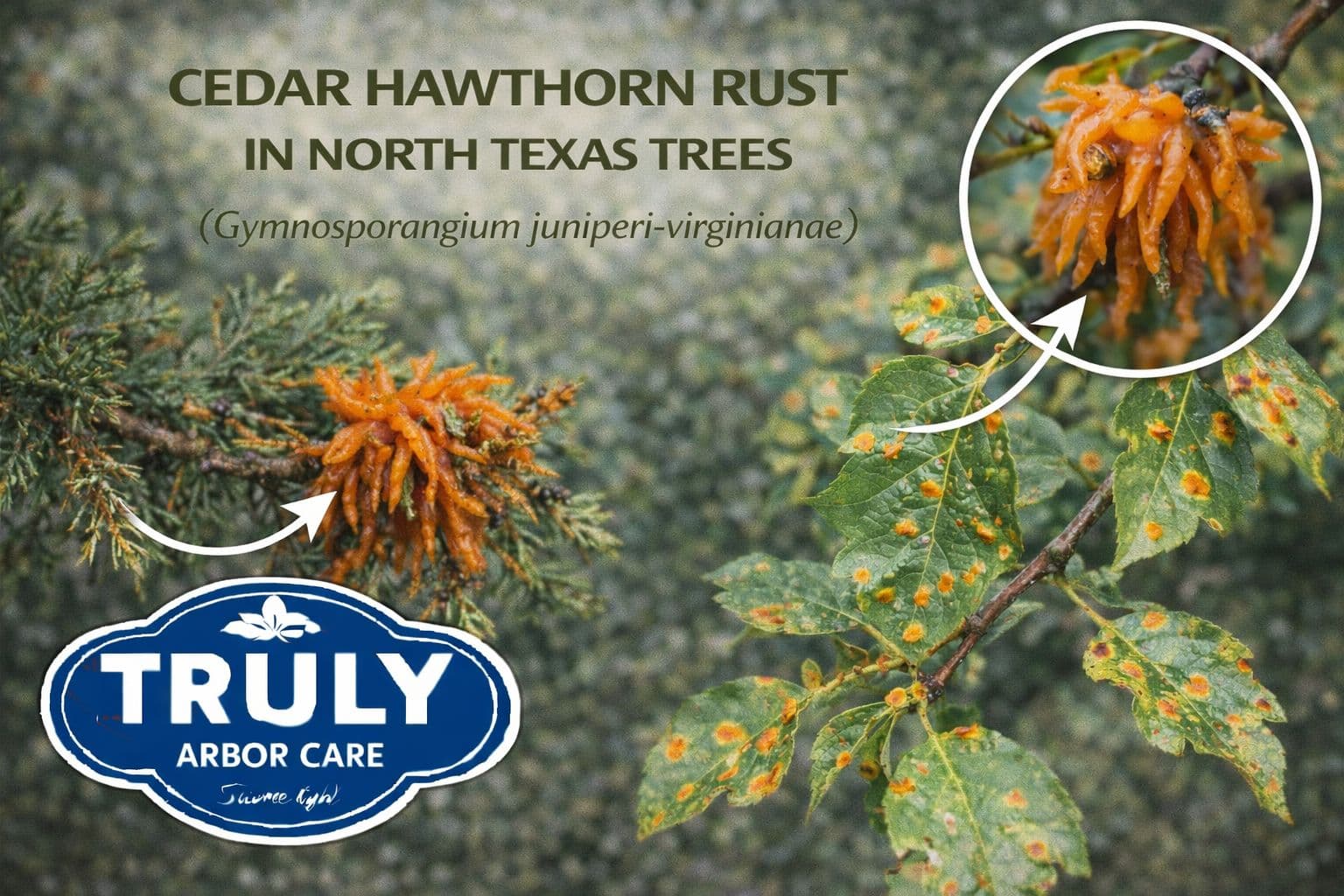
The disease produces distinctive orange fungal structures that appear on infected tissues during spring. While cedar hawthorn rust rarely kills mature trees, repeated infections can weaken plants and reduce ornamental value.
Routine monitoring by an ISA Certified Arborist following ANSI A300 tree care standards and TCIA plant healthcare protocols helps identify rust diseases early and maintain plant health across North Texas landscapes.
Tree Species Involved in the Cedar Hawthorn Rust Cycle
Cedar hawthorn rust requires two different plant hosts to complete its life cycle.
Primary hosts include:
- Eastern Red Cedar (Juniperus virginiana)
- Ornamental Junipers (Juniperus species)
Secondary hosts include:
- Hawthorn (Crataegus species)
- Serviceberry (Amelanchier species)
- Pear species (Pyrus species)
Eastern red cedar is extremely common throughout North Texas and often grows naturally in fields and wooded areas. Because this tree is widespread across the DFW Metroplex, the fungus can easily spread between cedar and susceptible ornamental trees.
Hawthorn trees planted in residential landscapes are the most commonly affected secondary host.
Environmental Conditions That Promote Cedar Hawthorn Rust
Cedar hawthorn rust infections are strongly influenced by seasonal environmental conditions.
Environmental factors common across North Texas that encourage infection include:
- Warm spring temperatures
- Extended rainfall periods
- High humidity levels
- Close proximity of juniper and
- hawthorn hosts
- Dense landscape plantings
Texas A&M research indicates that the disease is most active during spring when fungal spores are released from juniper galls.
Rain and wind disperse spores that infect nearby hawthorn leaves.
Disease Infection and Life Cycle
The life cycle of Gymnosporangium juniperi-virginianae is complex and requires two different hosts.
The fungus overwinters on juniper trees where it forms woody galls on branches. During spring, these galls produce bright orange gelatinous structures known as telial horns.
These structures release spores that are carried by wind to nearby hawthorn trees.
Once spores land on hawthorn leaves, they infect the leaf tissue and produce small orange spots.
Later in the season, the fungus produces spores on hawthorn leaves that infect juniper trees, completing the life cycle.
Symptoms and Identification of Cedar Hawthorn Rust
Cedar hawthorn rust produces distinctive symptoms on both hosts.
Common symptoms on juniper trees include:
Woody galls forming on branches
Orange gelatinous horns emerging during wet spring weather
Symptoms on hawthorn trees include:
- Bright orange spots on leaf surfaces
- Small tubular structures forming on the underside of leaves
- Leaf distortion
- Premature leaf drop
ISA Certified Arborists evaluating tree health across North Texas frequently identify cedar hawthorn rust during spring inspections when telial horns are visible on junipers.
Consequences if Cedar Hawthorn Rust Is Left Unmanaged
Cedar hawthorn rust rarely kills mature trees, but repeated infections can cause long-term stress.
Potential consequences include:
- Premature leaf drop on hawthorn trees
- Reduced photosynthesis
- Decreased ornamental value
- Weakening of young trees
In landscapes across the DFW Metroplex where hawthorn trees are used as ornamental plantings, repeated rust infections can significantly reduce aesthetic quality.
Juniper trees may also develop structural damage if large galls accumulate over time.
Managing Cedar Hawthorn Rust Through Plant Healthcare
Management of cedar hawthorn rust focuses on breaking the fungal life cycle and reducing infection pressure.
ISA Certified Arborists following ANSI A300 standards and TCIA plant healthcare protocols may recommend several management strategies.
These may include:
- Pruning galls from juniper branches
- Increasing spacing between host species
- Monitoring susceptible plants annually
- Applying preventative fungicide treatments when necessary
Removing nearby cedar hosts may reduce infection pressure on hawthorn trees in highly managed landscapes.
Routine monitoring helps arborists detect infections early and implement preventative treatments.
Protecting Landscape Trees Across North Texas and the DFW Metroplex
Rust diseases such as cedar hawthorn rust demonstrate the importance of integrated plant healthcare programs.
Routine inspections by an ISA Certified Arborist ensure trees are maintained according to ANSI A300 standards and modern arboricultural science. Early detection and proper management strategies help preserve healthy ornamental landscapes throughout North Texas.
For more information, check out the Texas A&M article on Cedar hawthorn rust here.