
Ball Moss in North Texas Trees
Understanding Tillandsia recurvata and Its Impact on Trees in the DFW Metroplex
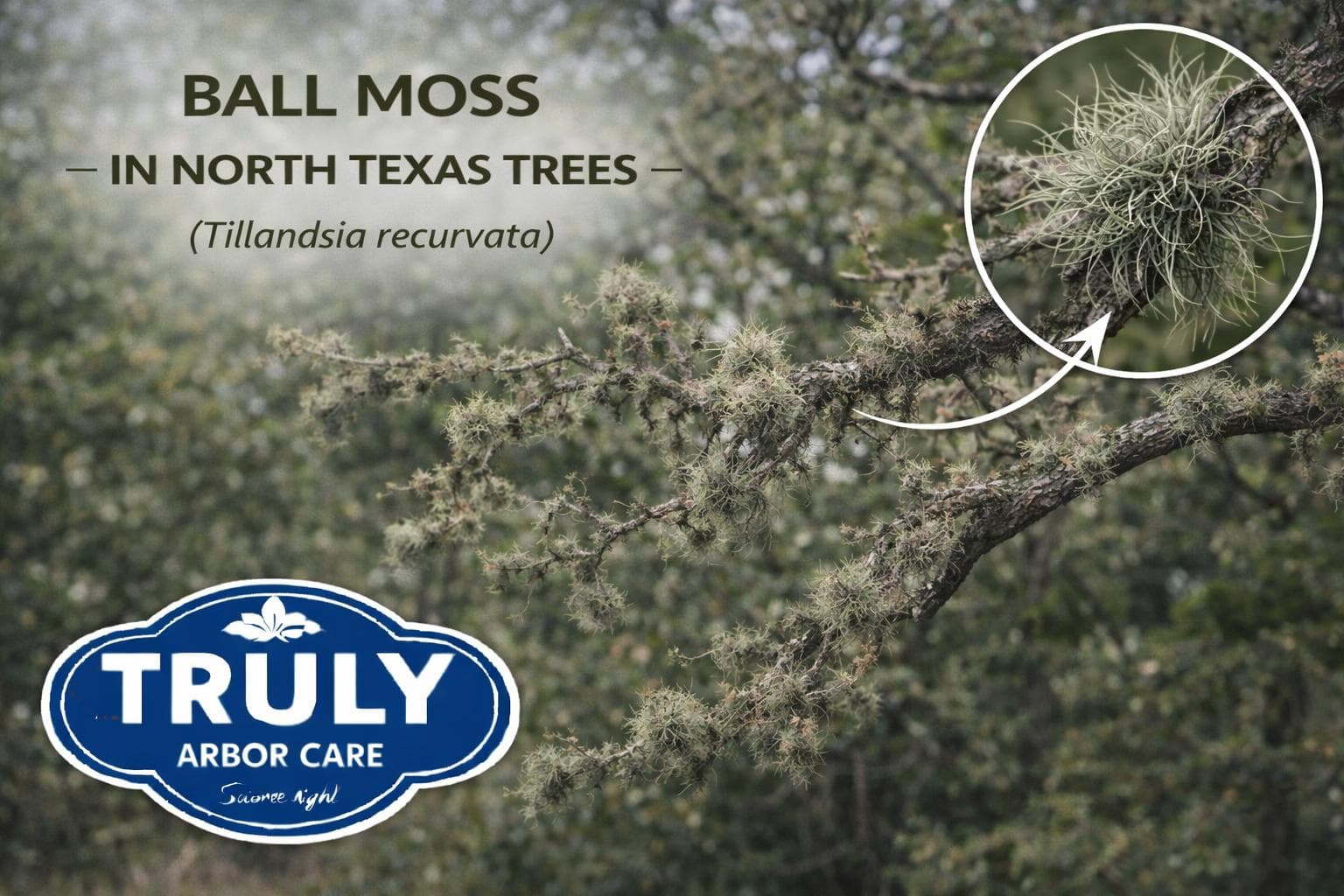
Ball moss is an epiphytic plant commonly found growing on tree branches throughout North Texas and the greater DFW Metroplex. The plant is scientifically known as Tillandsia recurvata and belongs to the bromeliad family, which includes Spanish moss and other air plants. Unlike parasitic plants, ball moss does not directly extract nutrients from its host tree.
According to Texas A&M AgriLife Extension and university plant physiology research, ball moss obtains water and nutrients directly from the air through specialized leaf structures called trichomes. These structures allow the plant to absorb moisture and airborne minerals, allowing it to survive without rooting in soil.
Although ball moss does not parasitize trees, heavy infestations can create secondary stress by shading foliage, increasing branch weight, and restricting air circulation within the canopy. Trees that are already weakened by environmental stress may experience increased decline when ball moss becomes abundant.
Routine inspections by an ISA Certified Arborist following ANSI A300 tree care standards and TCIA plant healthcare protocols help evaluate canopy conditions and determine when ball moss populations may begin affecting tree health across North Texas landscapes.
Tree Species Commonly Hosting Ball Moss
Ball moss can grow on many tree species found throughout the DFW Metroplex. Because the plant attaches to bark surfaces rather than penetrating tissues, it can colonize a wide variety of hosts.
Common host trees include:
- Live Oak (Quercus virginiana)
- Post Oak (Quercus stellata)
- Red Oak (Quercus species)
- Elm species (Ulmus spp.)
- Hackberry (Celtis species)
- Pecan (Carya illinoinensis)
- Crepe Myrtle (Lagerstroemia indica)
- Mesquite (Prosopis species)
Ball moss tends to accumulate most heavily in trees with rough bark or complex branch structures where seeds can easily lodge.
Large mature trees with dense branching patterns often support the highest populations.
Environmental Conditions That Encourage Ball Moss Growth
Ball moss thrives under environmental conditions commonly found throughout North Texas landscapes.
Environmental factors that promote ball moss growth include:
- High humidity levels
- Poor air circulation within tree canopies
- Dense or shaded tree crowns
- Urban heat island effects
- Low canopy maintenance or pruning
Texas A&M research indicates that ball moss populations tend to increase in trees that have reduced vigor or limited airflow within the canopy.
When branches remain shaded and moisture lingers on bark surfaces, ball moss seeds can easily germinate and establish new plants.
Ball Moss Life Cycle and Spread
Ball moss reproduces through seed dispersal. The plant produces small capsules that release thousands of tiny seeds into the air.
Wind currents carry these seeds to nearby tree branches where they attach to bark surfaces.
Once a seed lands in a suitable location, it germinates and develops small root-like structures that anchor the plant to the bark. These structures do not penetrate the tree or draw nutrients from it.
As the plant grows, it forms the familiar spherical clusters that give ball moss its name.
Over time, large colonies may develop throughout the canopy.
Symptoms and Identification of Ball Moss
Ball moss is relatively easy to identify due to its distinctive appearance.
Common characteristics include:
- Small gray-green spherical clusters
- Plants growing directly on tree branches
- Dense clumps that resemble miniature shrubs
- Leaves covered with fine scales that absorb moisture
Individual plants may range from one to several inches in diameter. Large populations can create noticeable clusters throughout the canopy.
ISA Certified Arborists evaluating tree health across North Texas frequently observe ball moss in mature trees, especially in areas with limited pruning maintenance.
Consequences if Ball Moss Populations Become Excessive
Although ball moss is not a parasite, excessive populations can contribute to secondary stress in trees.
Potential consequences include:
- Reduced sunlight reaching tree foliage
- Increased branch weight
- Restricted airflow within the canopy
- Accumulation of moisture on branches
- Increased stress on already weakened trees
Trees experiencing environmental stress, drought damage, or root problems may show accelerated decline when heavy ball moss infestations occur.
In North Texas landscapes where mature shade trees provide important environmental benefits, monitoring ball moss populations can help prevent excessive canopy stress.
Managing Ball Moss Through Plant Healthcare
Management of ball moss typically focuses on improving tree health and increasing canopy airflow.
ISA Certified Arborists following ANSI A300 standards and TCIA plant healthcare protocols may recommend several management strategies.
These may include:
- Selective pruning to increase sunlight penetration
- Improving air circulation within the canopy
- Maintaining overall tree vigor
- Removing excessive infestations when necessary
- Monitoring tree health annually
Healthy trees with strong growth and proper pruning maintenance are generally better able to tolerate ball moss without significant impacts.
Routine plant healthcare programs allow arborists to monitor canopy conditions and recommend management strategies when populations increase.
Protecting Tree Canopies Across North Texas and the DFW Metroplex
Ball moss is a natural component of many ecosystems across North Texas. While small populations are generally harmless, excessive growth can contribute to canopy stress in already weakened trees.
Routine inspections by an ISA Certified Arborist ensure trees are maintained according to ANSI A300 standards and modern arboricultural science. Proper canopy management helps preserve the long-term health and structural integrity of trees throughout the DFW Metroplex.
For more information, check out the Texas A&M article on Ball Moss here.