
Annosum Root Rot in North Texas Trees
Understanding Heterobasidion annosum and Its Impact on DFW Landscapes
Annosum root rot, caused by the fungal pathogen Heterobasidion annosum, is a destructive root and butt rot disease affecting a wide range of conifer species throughout North Texas and the greater DFW Metroplex. According to research from Texas A&M Forest Service and university plant pathology programs, this disease is particularly damaging because it attacks the structural root system and lower stem tissues of trees, gradually weakening the tree’s structural integrity and leading to canopy decline, root decay, and eventual tree failure.
The disease spreads primarily through root-to-root contact between adjacent trees or through airborne spores that infect freshly cut stumps. In landscapes where multiple susceptible host species are present, Annosum root rot can move underground through interconnected root systems, making early diagnosis and professional management critical to preventing tree loss.
ISA Certified Arborists working under ANSI A300 tree care standards and TCIA plant healthcare guidelines routinely monitor for this pathogen throughout North Texas, particularly in conifer plantings found in residential landscapes, parks, golf courses, and managed properties.
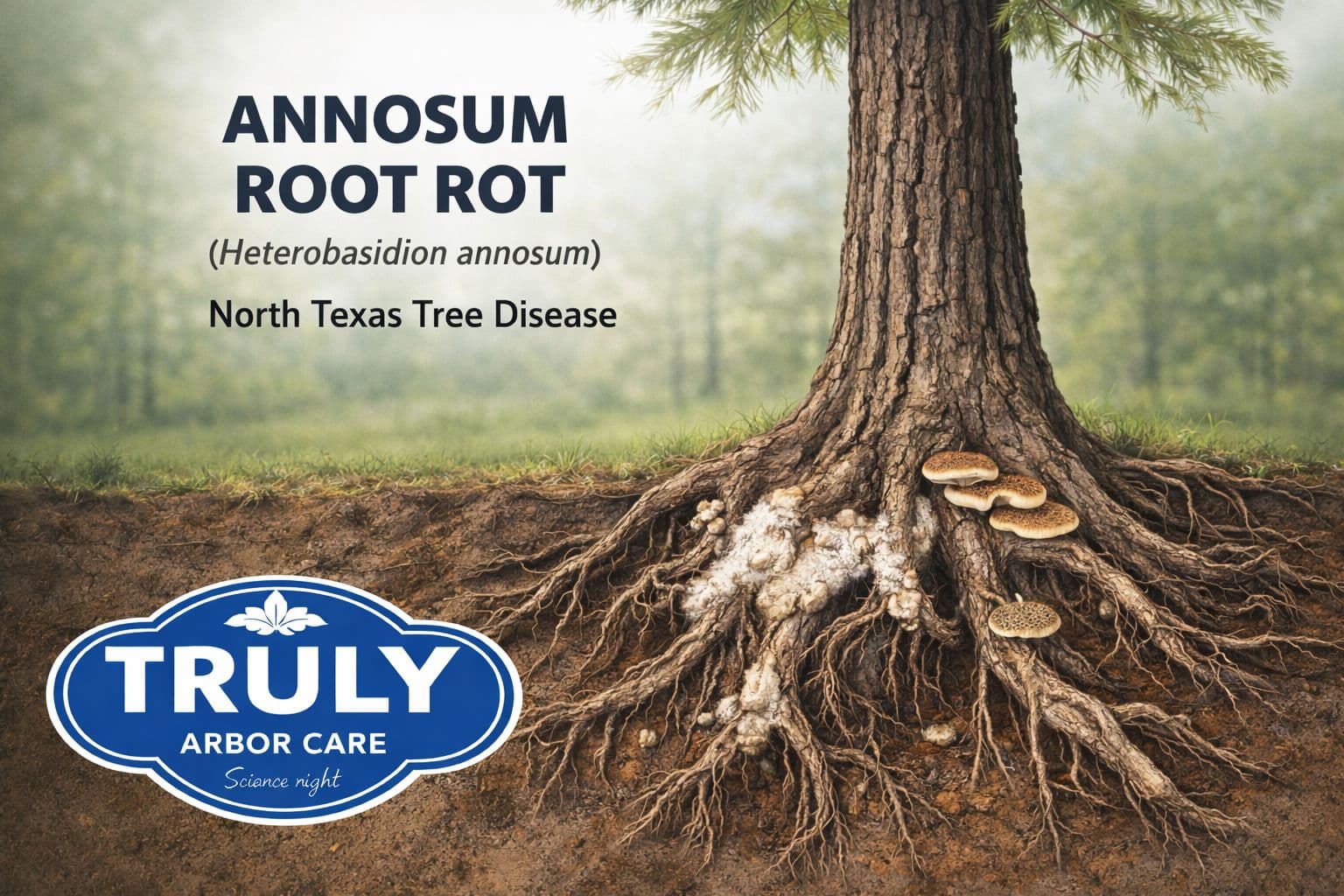
Tree Species and Plant Hosts Susceptible to Annosum Root Rot
The pathogen Heterobasidion annosum primarily affects coniferous tree species. In North Texas landscapes and ornamental plantings, the most commonly affected hosts include:
- Pines (Pinus species)
- Eastern Red Cedar (Juniperus virginiana)
- Junipers (Juniperus species)
- Spruce (Picea species)
- Fir (Abies species)
- Cypress species in managed landscapes
Texas A&M research notes that pines are especially vulnerable because of their root structure and resin chemistry, which can influence fungal colonization. In mixed landscapes where conifers are planted in clusters, the disease can spread through root grafts from one infected tree to neighboring trees.
In some cases, ornamental conifers used in North Texas residential landscapes become infected years before visible symptoms appear above ground.
⸻
Environmental Conditions That Encourage Disease Development
Environmental stress plays a major role in the development and progression of Annosum root rot.
Several environmental conditions common in the North Texas Metroplex can increase susceptibility:
- Compacted soils that restrict root respiration
- Excess moisture or poor soil drainage
- Construction damage to roots
- Improper pruning or stump cutting without treatment
- High-density conifer plantings
- Drought stress followed by irrigation fluctuations
According to Texas A&M Forest Service research, the fungus commonly colonizes freshly cut stumps after tree removal. Airborne spores land on the stump surface and begin colonizing the root system. From there, the fungus spreads through root grafts to adjacent trees.
This mechanism explains why disease centers often expand outward from a single original infection site.
⸻
How Annosum Root Rot Infects Trees
The infection process typically begins in one of two ways.
First, spores of Heterobasidion annosum can infect freshly cut conifer stumps. Once established, the fungus grows through the stump root system and spreads through soil contact to adjacent trees.
Second, the pathogen can move directly through root grafts between neighboring conifers. In clustered plantings common throughout North Texas landscapes, roots frequently intertwine underground, allowing the pathogen to move tree to tree without surface symptoms.
Once the fungus enters the tree’s vascular tissue, it begins decomposing structural wood components such as cellulose and lignin. This results in progressive decay within the root collar and lower trunk.
Over time the tree loses structural stability.
⸻
Symptoms and Structural Damage Caused by Annosum Root Rot
Because Annosum root rot attacks the root system first, early symptoms often appear subtle and gradual.
Common symptoms include:
- Progressive canopy thinning
- Yellowing or chlorosis of needles
- Reduced growth and branch dieback
- Resin flow near the base of the tree
- White fungal decay in root wood
- Conks or fruiting bodies near the root collar
Internally, the fungus produces a white rot decay that degrades the tree’s structural wood fibers. As decay progresses, the base of the tree becomes structurally compromised.
ISA Certified Arborists performing risk assessments under ANSI A300 guidelines often identify these trees as elevated structural risk due to the potential for sudden failure.
⸻
Consequences if Annosum Root Rot is Left Untreated
When Annosum root rot is not addressed, several serious outcomes can occur.
Trees may experience progressive canopy decline, loss of structural roots, and eventual collapse during wind events. Because the decay occurs at the base of the tree, failures can be sudden and catastrophic.
Additionally, infected trees act as reservoirs for the pathogen, allowing the fungus to spread through root contact to other nearby conifers.
In residential areas throughout DFW and North Texas, this can result in expanding disease pockets that gradually eliminate multiple trees within a landscape.
⸻
Preventing Tree Loss Through Professional Plant Healthcare
The most effective strategy for managing Annosum root rot is prevention and early detection through routine plant healthcare monitoring.
ISA Certified Arborists trained in plant pathology and tree risk assessment can evaluate conifer health, identify early signs of root decay, and implement management strategies consistent with TCIA Plant Healthcare standards and ANSI A300 tree care guidelines.
Preventative measures may include:
- Stump treatment with borate fungicides after tree removal
- Improved soil drainage and root aeration
- Proper spacing of conifers
- Monitoring root health through annual inspections
- Targeted plant healthcare programs
In North Texas landscapes where conifers are valuable ornamental features, proactive monitoring by a qualified ISA Certified Arborist can significantly reduce the risk of disease spread and tree failure.
Annual evaluations help detect root pathogens before structural damage becomes irreversible.
⸻
Protecting Trees in the DFW Metroplex
For property owners throughout North Texas, proactive tree health monitoring is one of the most effective ways to preserve mature landscapes and prevent disease outbreaks.
Routine evaluations performed by ISA Certified Arborists ensure trees are maintained according to ANSI A300 standards and modern plant healthcare practices.
Early diagnosis allows property owners to implement targeted treatments before widespread loss occurs.
For more information, check out the Texas A&M article on Annosum root rot here.