
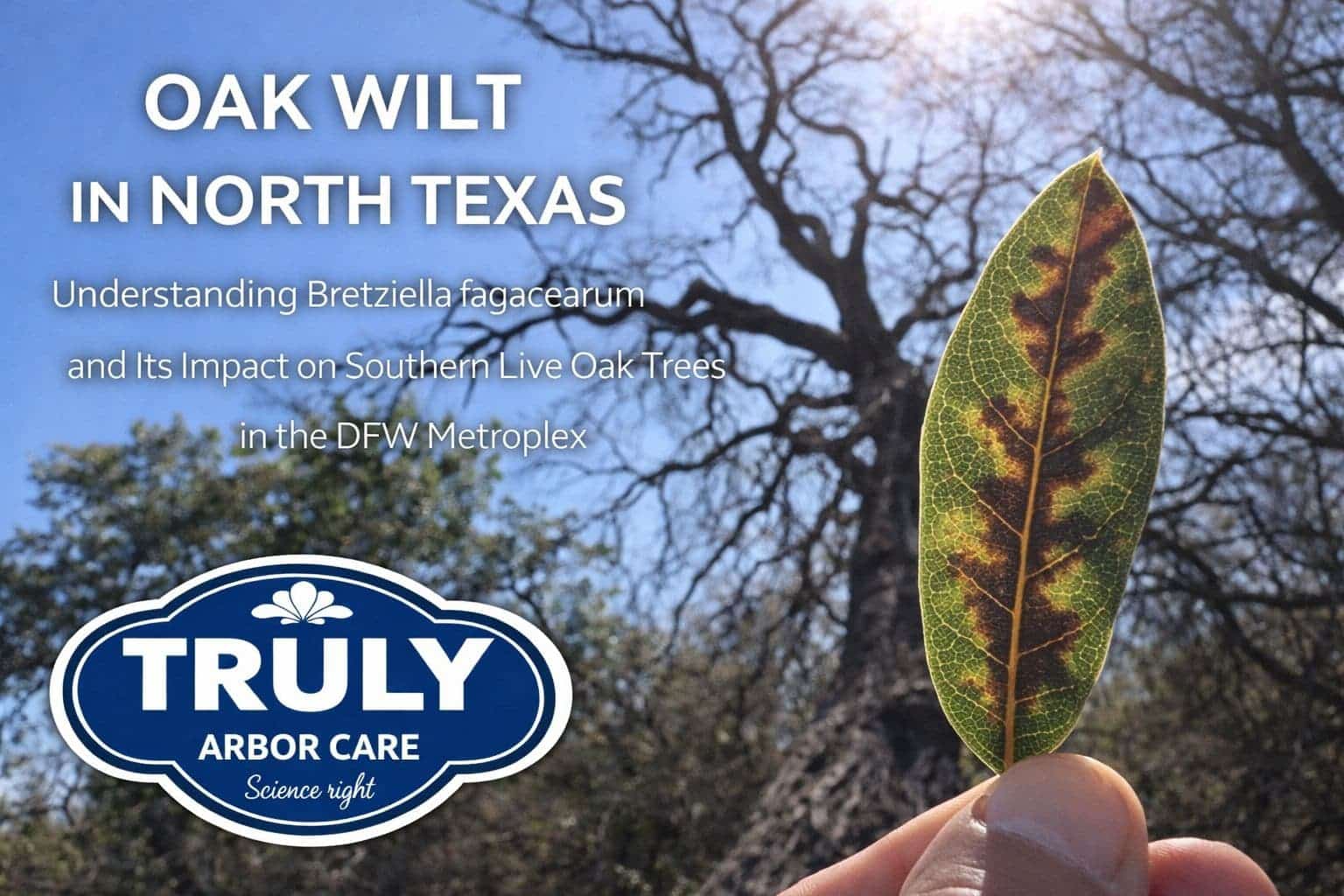
Oak Wilt in North Texas
Understanding Bretziella fagacearum and Its Impact on Oak Trees in the DFW Metroplex
Oak wilt is one of the most serious tree diseases affecting oak trees throughout North Texas and the greater DFW Metroplex. The disease is caused by the fungal pathogen Bretziella fagacearum, which invades the vascular system of oak trees and disrupts the transport of water throughout the canopy.
According to research published by Texas A&M Forest Service and Texas A&M AgriLife Extension, oak wilt is considered one of the most destructive tree diseases in Texas. The pathogen spreads rapidly through interconnected root systems and insect vectors, often resulting in the death of infected trees.
Once the fungus enters the vascular system, the tree responds by producing tyloses—structures that block the xylem vessels in an attempt to prevent the spread of the pathogen. Unfortunately, this defensive response also blocks water movement throughout the tree, leading to rapid leaf wilt and canopy decline.
In North Texas landscapes where mature oak trees provide shade, property value, and ecological benefits, oak wilt represents a significant threat. Early diagnosis and treatment by an ISA Certified Arborist following ANSI A300 tree care standards and TCIA plant healthcare protocols is essential for protecting valuable oak trees across the DFW Metroplex.
Oak Species Susceptible to Oak Wilt
Oak wilt primarily affects species within the genus Quercus. However, susceptibility varies depending on the oak group.
Red Oak Group (Highly Susceptible)
Red oaks are extremely vulnerable to oak wilt and often die within weeks after infection.
Common red oak species in North Texas include:
- Shumard Oak (Quercus shumardii)
- Texas Red Oak (Quercus buckleyi)
- Black Oak (Quercus velutina)
- Pin Oak (Quercus palustris)
Live Oaks and White Oaks (Moderately Susceptible)
Live oaks are less susceptible than red oaks but can still experience severe decline when infection spreads through root systems.
Common species include:
- Live Oak (Quercus virginiana)
- Post Oak (Quercus stellata)
- Bur Oak (Quercus macrocarpa)
Because oak trees are dominant shade species throughout the DFW Metroplex, oak wilt outbreaks can have widespread impacts on urban forests and residential landscapes.
⸻
Environmental Conditions That Promote Oak Wilt Spread
Several environmental factors contribute to oak wilt outbreaks across North Texas.
Texas A&M research indicates that the following conditions increase disease transmission:
- Spring pruning wounds on oak trees
- High populations of sap-feeding beetles
- Dense oak populations with interconnected roots
- Storm damage that exposes fresh wood
- Warm spring temperatures
The fungus spreads most aggressively during the spring months when beetles are active and fresh pruning wounds are present.
For this reason, Texas A&M Forest Service strongly recommends avoiding pruning oak trees during spring when possible.
⸻
How Oak Wilt Spreads
Oak wilt spreads through two primary mechanisms.
Root Graft Transmission
Live oak trees often form interconnected root systems. When one tree becomes infected, the fungus can travel through these root connections to nearby trees.
This underground transmission is responsible for the expanding circular patterns of oak mortality commonly observed in North Texas landscapes.
Insect Transmission
Sap-feeding beetles can carry fungal spores from infected trees to fresh wounds on healthy oaks.
These insects are attracted to the sweet fungal mats that develop on infected red oak trees.
When beetles visit fresh pruning wounds on nearby trees, they can introduce the pathogen and initiate new infections.
⸻
Symptoms and Identification of Oak Wilt
Oak wilt produces several distinctive symptoms that arborists can identify during tree health inspections.
Common symptoms include:
- Sudden leaf wilting and discoloration
- Leaves turning bronze or brown from the edges inward
- Premature leaf drop
- Rapid canopy thinning
- Branch dieback
Red oak species often decline very quickly after infection, sometimes dying within a single growing season.
Live oaks typically decline more slowly but may show progressive canopy thinning and branch death as the disease spreads through root systems.
ISA Certified Arborists evaluating oak health throughout North Texas frequently monitor for these symptoms during seasonal plant healthcare inspections.
⸻
Consequences of Untreated Oak Wilt
If oak wilt is not managed properly, the disease can spread rapidly and cause extensive tree loss.
Potential impacts include:
- Rapid mortality of red oak trees
- Progressive decline of live oak populations
- Expansion of root transmission zones
- Loss of shade canopy in residential neighborhoods
In North Texas landscapes where mature oaks provide significant environmental and economic value, unmanaged oak wilt outbreaks can dramatically alter the character of entire neighborhoods.
⸻
Oak Wilt Treatment and Management
Oak wilt management requires a proactive and science-based plant healthcare approach.
ISA Certified Arborists may implement several strategies including:
- Macro-infusion treatments using propiconazole fungicides
- Root trenching to stop underground transmission
- Immediate removal of infected red oak trees
- Sealing pruning wounds during high-risk seasons
Macro-infusion treatments are often used to protect healthy live oaks located near infected trees.
These treatments are performed using specialized equipment that injects fungicide directly into the tree’s vascular system.
Texas A&M Forest Service research has demonstrated that these treatments can significantly slow disease progression when applied early.
⸻
Plant Healthcare Programs That Protect Oak Trees
Preventive plant healthcare programs are the most effective strategy for protecting oak trees from oak wilt.
Professional arborists may implement:
- Routine oak wilt monitoring
- Seasonal pruning guidelines
- Soil health improvement programs
- Root zone aeration and oxygenation
- Proper watering practices
Healthy trees are better able to resist environmental stress and recover from disease pressure.
These science-based plant healthcare strategies are widely recommended by Texas A&M Forest Service and professional arboriculture organizations.
⸻
Protecting Oak Trees Across North Texas
Oak trees are among the most valuable components of the urban forest throughout North Texas and the DFW Metroplex. Protecting these trees requires proactive monitoring and professional plant healthcare management.
Routine inspections by an ISA Certified Arborist ensure trees are evaluated according to ANSI A300 standards and modern arboricultural science.
Early detection of oak wilt allows property owners to implement treatments that protect valuable trees and prevent the spread of this destructive disease.
For more information, check out the Texas A&M article on Oak wilt here.