
Spring Cankerworm in North Texas
Paleacrita vernata | Early Season Defoliator in North Texas Landscapes
Spring cankerworm, Paleacrita vernata, is a native defoliating caterpillar species found throughout Texas. According to Texas A&M AgriLife Extension and Texas A&M Forest Service publications, spring cankerworms are active in early spring and may cause noticeable defoliation on hardwood trees when populations increase.
In North Texas, spring cankerworm feeding typically occurs in early to mid-spring, coinciding with bud break and new leaf expansion.
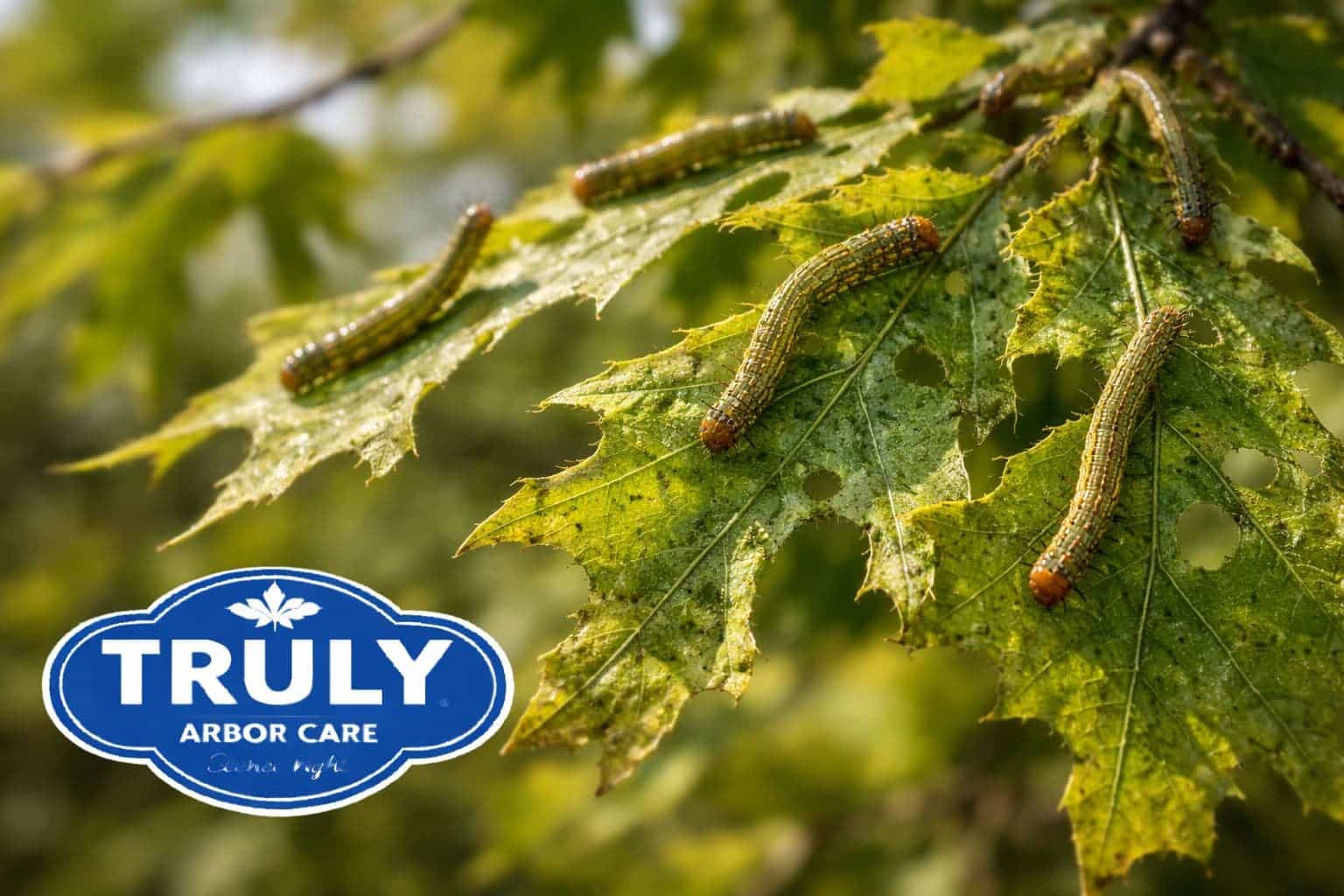
ISA Certified Arborist Evaluation and Texas A&M Research Context in North Texas
As ISA Certified Arborists serving North Texas, Truly Arbor Care evaluates spring cankerworm activity using science-based plant health care standards aligned with Texas A&M AgriLife Extension guidance.
Texas A&M indicates that early-season defoliators can be confused with frost injury, drought stress, or other chewing insects. Accurate identification is critical before treatment decisions are made.
Professional evaluation in North Texas includes assessing canopy density, bud development stage, percentage of leaf loss, and overall tree vigor before determining management recommendations.
—
Identification and Morphology
Spring cankerworm larvae are commonly referred to as inchworms due to their looping movement.
Key identifying characteristics include:
- Slender, smooth-bodied larvae
- Green to light brown coloration
- Few abdominal prolegs (causing the looping motion)
- Approximately 1 inch in length at maturity
Unlike many other caterpillars, spring cankerworms lack multiple mid-body prolegs, giving them a distinctive arching locomotion pattern.
—
Distinguishing Characteristics
In North Texas, spring cankerworm damage often presents as:
- Early-season leaf chewing
- Irregular holes in newly expanded leaves
- Partial defoliation in upper canopy
- Presence of hanging larvae on silk threads
Damage differs from fungal leaf diseases, as chewing removal is clean and irregular rather than spotted or necrotic.
—
Host Trees in North Texas
Spring cankerworm has a broad host range including:
- Oak
- Elm
- Maple
- Hackberry
- Ash
Texas A&M notes that heavy infestations can temporarily thin the canopy, but healthy trees typically recover when environmental stress is minimal.
Trees experiencing drought, compaction, or root disturbance may show increased sensitivity to repeated defoliation events.
—
Life Cycle in North Texas
The life cycle of Paleacrita vernata in North Texas follows a seasonal pattern:
- Eggs overwinter on bark
- Larvae emerge in early spring
- Feeding coincides with leaf emergence
- Pupation occurs in soil
- Adults emerge later in the year
Warm early springs in North Texas can accelerate larval development.
—
Impact on Tree Health in North Texas
According to Texas A&M AgriLife Extension, single-season defoliation from spring cankerworm rarely causes mortality in established trees. However, repeated heavy defoliation may reduce energy reserves.
Potential impacts include:
- Reduced photosynthesis
- Temporary canopy thinning
- Increased vulnerability to secondary pests
In North Texas, maintaining proper irrigation and minimizing environmental stress supports canopy recovery.
—
Environmental Stress and Susceptibility
Trees in North Texas are more vulnerable to significant impact when experiencing:
- Drought conditions
- Compacted soils
- Poor drainage
- Construction-related root damage
Texas A&M emphasizes that environmental stress often determines whether defoliation leads to long-term decline.
—
Management and Professional Guidance in North Texas
Texas A&M AgriLife Extension recommends integrated pest management strategies including:
- Monitoring larval populations
- Assessing percentage of defoliation
- Encouraging natural predators
- Targeted treatment only when thresholds are exceeded
ANSI A300 Plant Health Care standards emphasize threshold-based treatment and overall tree health support rather than routine pesticide application.
In North Texas, professional evaluation ensures treatment decisions are aligned with tree condition and infestation severity.
—
Professional Assessment in North Texas
As ISA Certified Arborists serving North Texas, Truly Arbor Care evaluates spring cankerworm infestations within a comprehensive plant health framework, including canopy inspection, soil assessment, irrigation review, and long-term health planning.