
Southern Pine Sawyer in North Texas
Monochamus titillator | Longhorn Beetle Activity in the DFW Metroplex
The southern pine sawyer, Monochamus titillator, is a native longhorned beetle found throughout Texas and much of the southeastern United States. According to Texas A&M Forest Service and Texas A&M AgriLife Extension publications, this species primarily colonizes stressed, recently cut, or dying pine trees.
In North Texas and across the DFW Metroplex, southern pine sawyer beetles are most commonly observed in association with recently storm-damaged pines or logging debris.
ISA Certified Arborist Evaluation and Texas A&M Research Context
As ISA Certified Arborists serving North Texas, Truly Arbor Care evaluates southern pine sawyer activity using science-based diagnostic standards aligned with Texas A&M research. Accurate identification is essential because this species is often confused with other longhorn beetles or bark beetles.
Texas A&M documentation emphasizes that southern pine sawyer is generally considered a secondary colonizer rather than a primary tree-killing pest.
⸻
Identification and Morphology
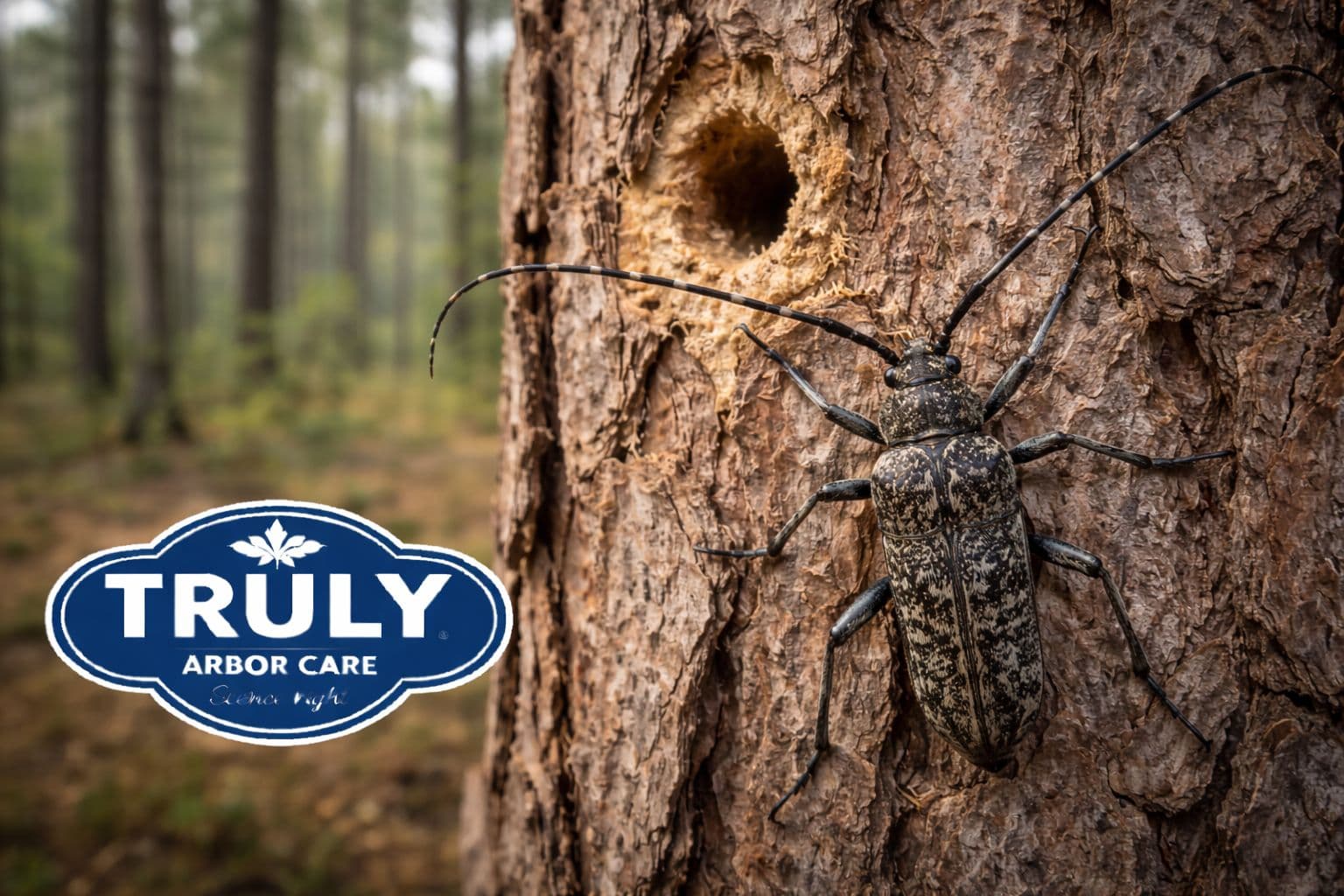
Adult southern pine sawyers are large longhorn beetles measuring up to 1 inch or more in length. They are characterized by:
- Long antennae often exceeding body length
- Mottled gray and brown coloration
- Robust cylindrical body
Larvae are large, cream-colored wood-boring grubs that tunnel deep into the sapwood and heartwood.
⸻
Distinguishing Characteristics
Key identifying features include:
- Large round exit holes
- Coarse frass accumulation
- Larval tunnels extending deep into wood
- Adult beetles visible on pine bark
Unlike southern pine beetle, which attacks healthy trees during outbreaks, southern pine sawyer typically infests weakened or recently cut material.
⸻
Host Trees in North Texas
Primary hosts include:
- Loblolly pine
- Shortleaf pine
- Slash pine
Other southern pine species
Texas A&M Forest Service notes that infestations are most common in freshly cut timber, storm-damaged trees, or drought-stressed pines.
In the DFW Metroplex, ornamental pines affected by environmental stress are occasionally colonized.
⸻
Life Cycle in Texas
Southern pine sawyers typically produce one generation per year.
- Adults emerge in late spring and summer
- Eggs are laid in bark crevices
- Larvae bore deeply into wood
- Pupation occurs within the trunk
- Adults emerge through large round exit holes
Development timing may vary with temperature in North Texas.
⸻
Impact on Tree Health
Southern pine sawyer is generally considered a secondary pest. Texas A&M guidance indicates that healthy trees are rarely killed solely by this species.
However, larval tunneling may:
- Weaken structural wood
- Reduce lumber quality
- Increase susceptibility to decay organisms
In the DFW Metroplex, structural concerns are most relevant when infestations occur in already weakened trees.
⸻
Environmental Stress and Susceptibility
Trees experiencing:
- Storm damage
- Drought
- Compacted soils
- Mechanical injury
are more likely to be colonized.
Maintaining tree vigor reduces colonization risk.
⸻
Management and Professional Guidance in North Texas
Texas A&M recommends:
- Prompt removal of storm-damaged trees
- Avoiding accumulation of pine slash
- Monitoring stressed pines
- Maintaining overall tree health
ANSI A300 Plant Health Care standards emphasize stress reduction and structural assessment.
⸻
Professional Assessment in the DFW Metroplex
As ISA Certified Arborists serving North Texas and the DFW Metroplex, Truly Arbor Care evaluates southern pine sawyer infestations within a comprehensive plant health and structural risk framework to determine appropriate action.
For more information, check out the Texas A&M article on the southern pine sawyer here.