
Lesser Peachtree Borer in North Texas
Synanthedon pictipes | Trunk and Scaffold Limb Infestation in the DFW Metroplex
The lesser peachtree borer, Synanthedon pictipes, is a clearwing moth whose larvae bore into the bark and cambial tissue of stone fruit trees and certain ornamental hardwoods. According to Texas A&M AgriLife Extension and Texas A&M Forest Service publications, this species is commonly associated with peach, plum, and other Prunus species.
In North Texas and throughout the DFW Metroplex, infestations are frequently observed in orchards and residential fruit plantings, particularly in trees with existing wounds or bark injury.
ISA Certified Arborist Evaluation and Texas A&M Research Context
As ISA Certified Arborists serving North Texas, Truly Arbor Care evaluates lesser peachtree borer infestations using science-based plant health care standards aligned with Texas A&M research. Accurate identification is critical because symptoms may resemble fungal canker, mechanical injury, or other trunk-boring insects.
Texas A&M guidance emphasizes monitoring bark wounds and scaffold limbs for early signs of infestation.
⸻
Identification and Morphology
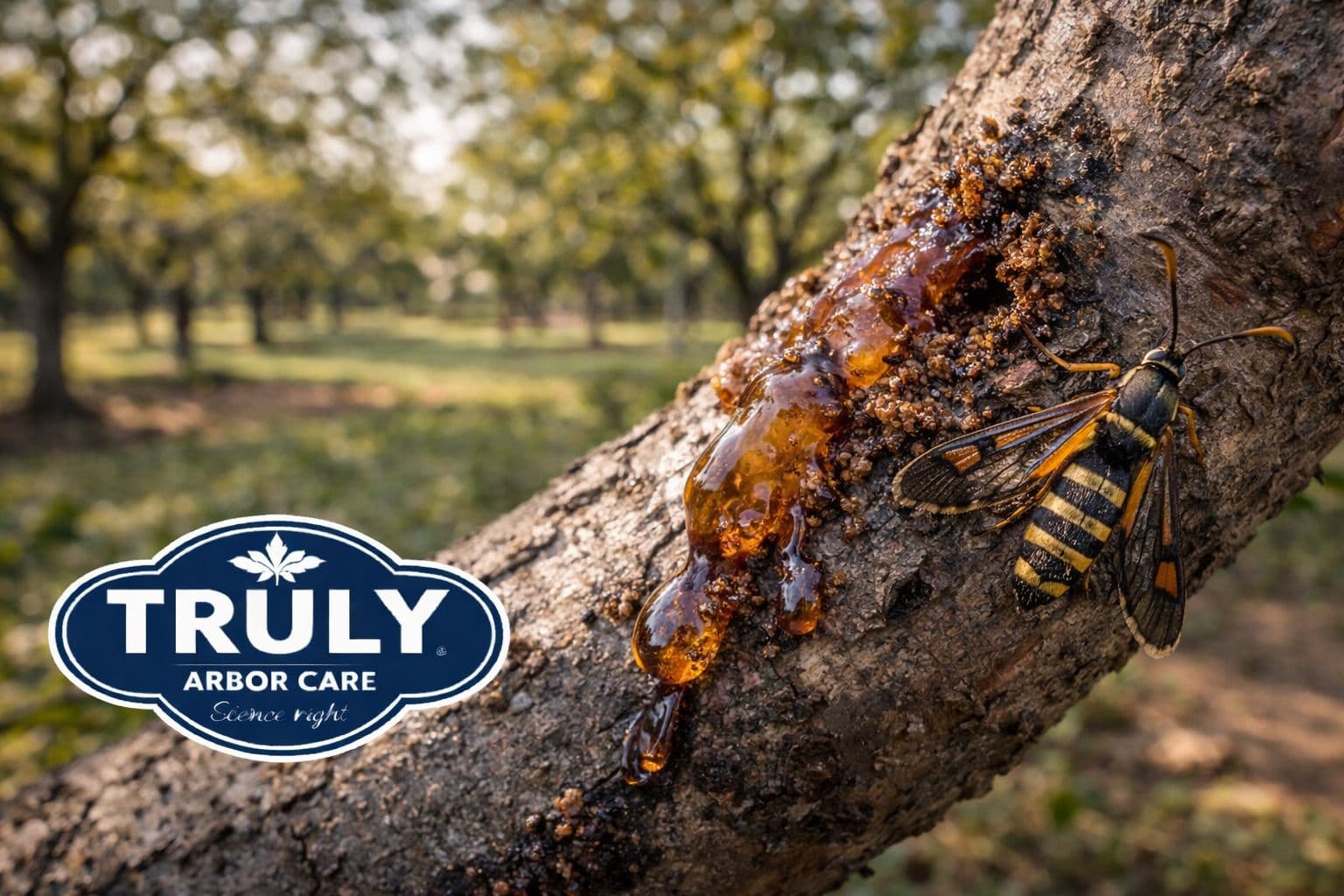
Adult lesser peachtree borers resemble small wasps, with clear wings and dark bodies marked with yellow or orange bands.
The larval stage is the damaging stage. Larvae are cream-colored and bore into bark and cambial tissues, often at branch unions or trunk wounds.
Unlike the peachtree borer, which concentrates at the soil line, lesser peachtree borer typically infests higher on the trunk or scaffold limbs.
⸻
Distinguishing Characteristics
Key identifying features include:
- Gummosis on scaffold limbs
- Amber sap mixed with frass
- Entry holes near pruning wounds
- Swollen or callused bark around infestation site
Damage is often localized but may weaken branch unions over time.
⸻
Host Trees in North Texas
Primary hosts include:
- Peach
- Plum
- Cherry
- Nectarine
- Other Prunus species
Texas A&M documentation notes that trees with mechanical injury, sunscald, or previous bark damage are more susceptible.
In the DFW Metroplex, residential fruit trees are most commonly affected.
⸻
Life Cycle in Texas
Lesser peachtree borer typically produces one generation per year in Texas.
- Adults emerge in spring and summer
- Eggs are laid near bark wounds
- Larvae bore into cambium and feed
- Pupation occurs within the tree
- Adults emerge through small exit holes
Infestations may persist across multiple seasons if untreated.
⸻
Impact on Tree Health
Larval feeding disrupts cambial tissue and may:
- Reduce nutrient transport
- Weaken scaffold limbs
- Increase susceptibility to secondary pathogens
- Contribute to structural instability
Texas A&M AgriLife notes that young or stressed trees are more vulnerable to significant decline.
In North Texas, drought stress may compound damage severity.
⸻
Environmental Stress and Susceptibility
Trees experiencing:
- Drought
- Improper pruning
- Mechanical injury
- Compacted soils
are more likely to attract egg-laying adults.
Maintaining proper irrigation and careful pruning reduces risk.
⸻
Management and Professional Guidance in the DFW Metroplex
Texas A&M recommends preventative practices including:
- Avoiding trunk and scaffold limb injury
- Monitoring bark wounds
- Timed insecticide applications during adult flight periods
ANSI A300 Plant Health Care standards emphasize preserving tree vigor and minimizing stress factors.
⸻
Professional Assessment in North Texas
As ISA Certified Arborists serving North Texas and the DFW Metroplex, Truly Arbor Care evaluates lesser peachtree borer infestations within a comprehensive plant health and structural risk framework to determine appropriate management strategies.
For more information, check out the Texas A&M article on lesser peachtree borer here.