
Elm Leaf Beetle in North Texas
Pyrrhalta luteola | Elm Defoliation in the DFW Metroplex
The elm leaf beetle, Pyrrhalta luteola, is a defoliating insect found throughout Texas and much of the United States. According to Texas A&M AgriLife Extension and Texas A&M Forest Service publications, this species feeds primarily on elm foliage and can cause significant defoliation during peak population cycles.
In North Texas and across the DFW Metroplex, infestations are most commonly observed in ornamental elm plantings and mature shade trees.
ISA Certified Arborist Evaluation and Texas A&M Research Context
As ISA Certified Arborists serving North Texas, Truly Arbor Care evaluates elm leaf beetle activity using science-based diagnostic standards aligned with Texas A&M research. Accurate identification is critical because defoliation symptoms may resemble drought stress or fungal leaf diseases.
Texas A&M AgriLife Extension notes that repeated heavy infestations can weaken elm trees, particularly when combined with environmental stress.
⸻
Identification and Morphology
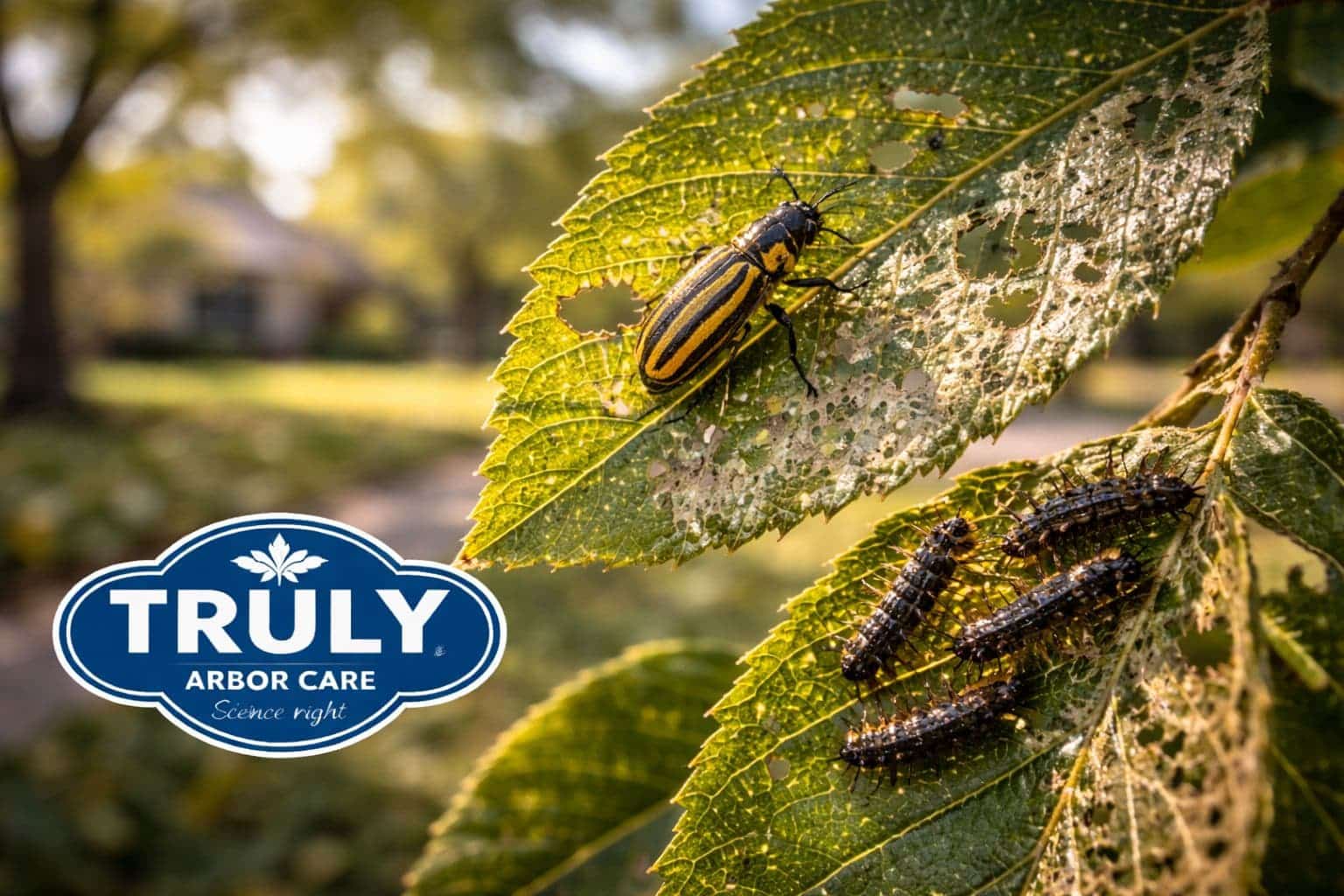
Adult elm leaf beetles are small, oval-shaped insects measuring approximately 1/4 inch in length. They are typically yellow-green with dark longitudinal stripes along the wing covers.
Larvae are dark, slug-like, and spiny in appearance. Both larvae and adults feed on leaf tissue.
⸻
Distinguishing Characteristics
Key identifying features include:
- Skeletonized leaf surfaces
- Windowpane feeding damage
- Yellow-green striped adult beetles
- Dark larvae feeding on leaf undersides
Unlike caterpillars, elm leaf beetles chew irregular holes rather than consuming entire leaf margins.
⸻
Host Trees in North Texas
Primary hosts include:
- American elm
- Cedar elm
- Other ornamental elm species
Texas A&M Forest Service documentation indicates that elms in urban environments are especially vulnerable due to stress factors.
In the DFW Metroplex, cedar elm is frequently impacted.
⸻
Life Cycle in Texas
Elm leaf beetles may produce multiple generations per year in Texas.
- Adults overwinter in protected locations
- Eggs are laid on leaf undersides
- Larvae feed for several weeks
- Pupation occurs in bark crevices or soil
- New adults emerge and continue feeding
Warm North Texas temperatures support multiple reproductive cycles.
⸻
Impact on Tree Health
Repeated defoliation may lead to:
- Reduced canopy density
- Decreased growth
- Increased vulnerability to drought stress
- Aesthetic decline
Texas A&M AgriLife notes that while mature trees may survive occasional defoliation, repeated heavy feeding combined with environmental stress may reduce long-term vigor.
In the DFW Metroplex, urban heat stress may intensify impacts.
⸻
Environmental Stress and Susceptibility
Trees experiencing:
- Drought
- Compacted soils
- Root disturbance
- Urban heat exposure
may recover more slowly from defoliation.
Maintaining irrigation consistency and soil health improves resilience.
⸻
Management and Professional Guidance in North Texas
Texas A&M recommends monitoring population levels before treatment.
Management strategies may include:
- Mechanical removal in small infestations
- Targeted insecticide application during early larval stages
- Maintaining overall tree vigor
ANSI A300 Plant Health Care standards emphasize integrated pest management and proper diagnosis.
⸻
Professional Assessment in the DFW Metroplex
As ISA Certified Arborists serving North Texas and the DFW Metroplex, Truly Arbor Care evaluates elm leaf beetle infestations within a comprehensive plant health framework to determine appropriate intervention strategies.
For more information, check out the Texas A&M article on Elm Leaf Beetle here.