
Dogwood Borer in North Texas
Synanthedon scitula | Trunk and Root Collar Damage in the DFW Metroplex
The dogwood borer, Synanthedon scitula, is a clearwing moth whose larvae bore into the bark and cambial tissues of hardwood trees. According to Texas A&M AgriLife Extension and Texas A&M Forest Service resources, dogwood borer is most commonly associated with flowering dogwood, but it may also infest other ornamental and fruit trees.
In North Texas and across the DFW Metroplex, infestations are most frequently observed in stressed or mechanically injured trees, particularly in urban landscapes where trunk damage is common.
ISA Certified Arborist Evaluation and Texas A&M Research Context
As ISA Certified Arborists serving North Texas, Truly Arbor Care evaluates dogwood borer infestations using science-based plant health care standards aligned with Texas A&M research. Proper diagnosis is critical because symptoms may resemble fungal canker, mechanical injury, or other borer species.
Texas A&M guidance emphasizes that stress reduction and early detection significantly improve long-term outcomes in affected trees.
⸻
Identification and Morphology
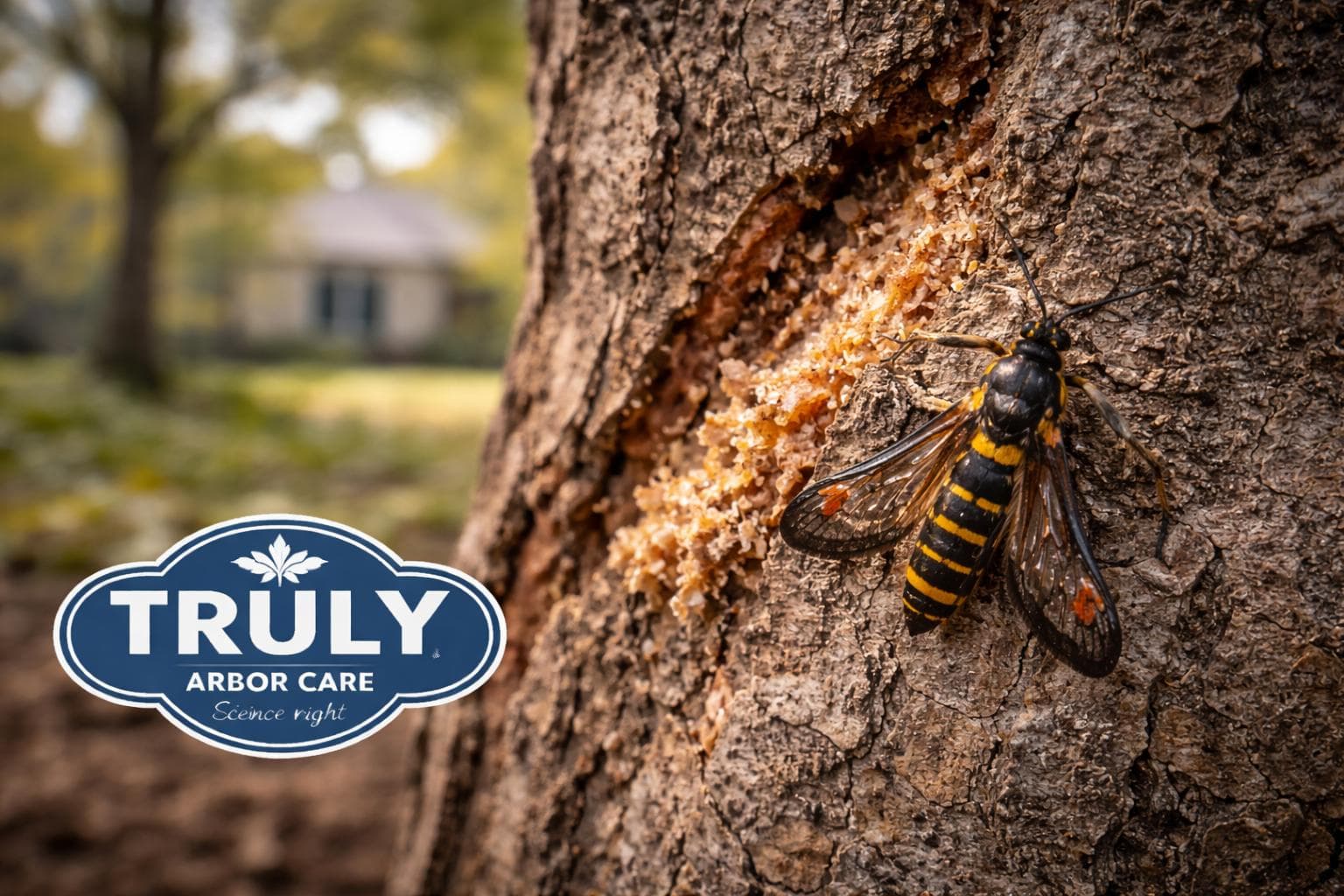
Adult dogwood borers resemble small wasps, with clear wings and dark metallic bodies marked with yellow bands. This mimicry helps deter predators.
The damaging stage is the larval stage. Larvae are cream-colored, cylindrical grubs that tunnel beneath the bark and feed within cambial tissue.
Infestations often occur near:
- Branch crotches
- Trunk wounds
- Root collars
- Grafted unions in ornamental plantings
⸻
Distinguishing Characteristics
Key identifying features include:
- Loose bark near injury sites
- Sawdust-like frass at base of trunk
- Swollen or callused bark tissue
- Entry holes near wounds
Unlike peachtree borer, which typically concentrates at the soil line, dogwood borer may infest higher on the trunk at pruning or injury sites.
⸻
Host Trees in North Texas
Primary hosts include:
- Flowering dogwood
- Apple
- Peach
- Oak (occasionally)
- Other ornamental hardwoods
Texas A&M documentation notes that trees with mechanical wounds or sunscald damage are especially susceptible.
In the DFW Metroplex, infestations are most common in residential ornamental plantings.
⸻
Life Cycle in Texas
Dogwood borer typically produces one generation per year in Texas.
- Adults emerge in late spring to summer
- Eggs are laid near bark injuries
- Larvae bore into cambium and feed
- Overwintering occurs within the tree
- Adults emerge the following season
Damage may persist over multiple growing seasons if untreated.
⸻
Impact on Tree Health
Larval feeding disrupts vascular tissue and may weaken structural integrity over time.
Symptoms may include:
- Branch dieback
- Reduced vigor
- Increased susceptibility to secondary decay
- Structural weakness at trunk unions
Texas A&M AgriLife notes that while mature trees may tolerate limited feeding, repeated infestations can compromise structural stability.
In North Texas, drought stress may compound decline.
⸻
Environmental Stress and Susceptibility
Trees experiencing:
- Drought
- Mechanical injury
- Improper pruning
- Sunscald
- Compacted soils
are more likely to attract egg-laying adults.
Maintaining trunk protection and proper pruning techniques reduces risk.
⸻
Management and Professional Evaluation in the DFW Metroplex
Texas A&M recommends preventative practices including:
- Avoiding trunk injury
- Proper pruning cuts
- Maintaining irrigation
- Monitoring graft unions and wound sites
Targeted insecticide applications may be considered when timed with adult flight periods.
ANSI A300 Plant Health Care standards emphasize structural assessment and vigor maintenance.
⸻
Professional Assessment in North Texas
As ISA Certified Arborists serving North Texas and the DFW Metroplex, Truly Arbor Care evaluates dogwood borer infestations within a comprehensive plant health and structural risk framework to determine appropriate management strategies.
For more information, check out the Texas A&M article on Dogwood borer here.