
What Homeowners Are Seeing
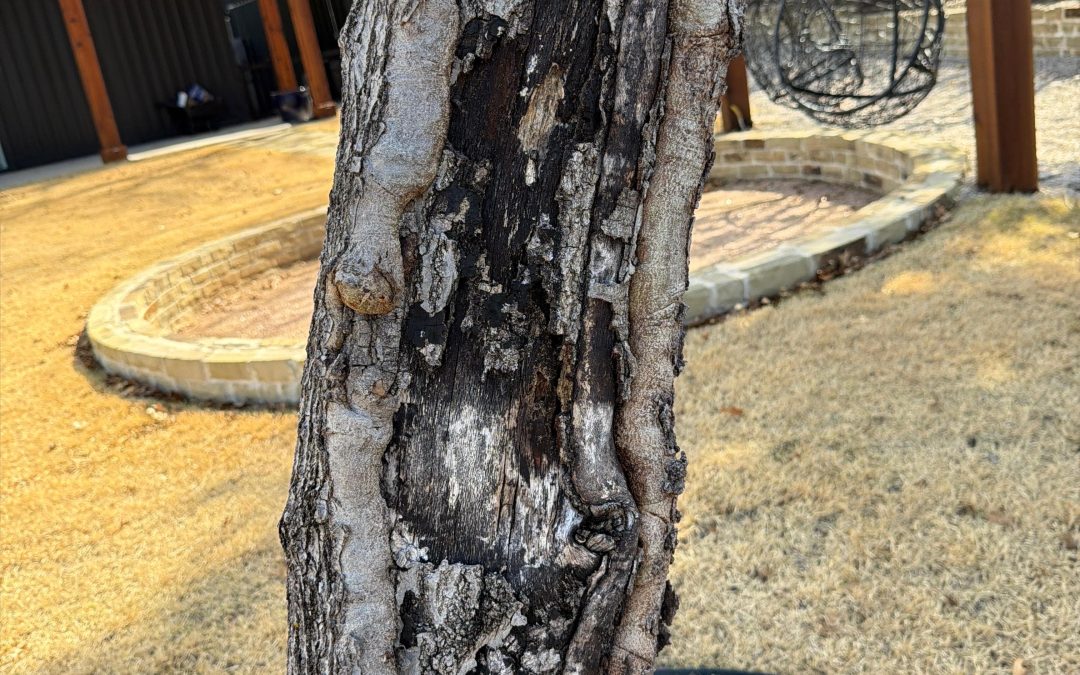
Hypoxylon canker on Shumard Red Oak in Weatherford, Texas. When bark begins peeling from the trunk of a Shumard red oak, and gray or charcoal-colored patches appear beneath it, concern is understandable. In Weatherford and throughout North Texas, this pattern is often associated with what is commonly called Hypoxylon canker.
This condition is caused by fungi in the genus Biscogniauxia, commonly present in oak ecosystems. Under normal circumstances, these fungi exist quietly in the environment without harming healthy trees. However, when a red oak experiences prolonged stress, its internal defense systems weaken. At that point, the fungus can colonize internal tissues.
In many cases, visible trunk involvement means the tree has already undergone significant physiological stress. The fungus is not typically the original cause of decline — it is usually a secondary organism responding to a stressed host.
Common stress triggers in Weatherford and surrounding Parker County include:
- Prolonged drought cycles
- Root disturbance from construction
- Soil compaction from equipment or traffic
- Chronic irrigation imbalance
- Urban environmental stress
Understanding this sequence — stress first, fungus second — is critical to making informed decisions.
Diagnostic Assessment (Biology-First Interpretation)
From an arboricultural standpoint, Hypoxylon colonization is a symptom of compromised vascular function.
As outlined in ISA-aligned tree biology principles , trees rely on living tissues (cambium, phloem, parenchyma) and stored carbohydrates to defend against opportunistic organisms. When drought or root damage reduces water transport and carbohydrate production, defense capacity declines.
Red oaks (section Lobatae) are particularly vulnerable during prolonged water deficits. When vascular tissues desiccate:
- Cambial activity slows
- Carbohydrate reserves decline
- CODIT response weakens
- Defense boundaries become less effective
The fungus then colonizes weakened xylem tissues. As stromatic tissue develops beneath bark, the outer bark separates and sloughs off, exposing silver-gray fungal mats that later darken to a charcoal appearance.
It is important to state clearly:
- Diagnosis of the specific fungal species requires laboratory confirmation.
- Visual identification alone cannot determine internal decay extent.
- Ground-level inspection does not reveal full structural condition.
However, trunk colonization in red oaks generally indicates advanced physiological compromise.
Soil & Root-Zone Context in Weatherford, Texas
Tree decline rarely begins in the canopy. It begins below grade.
The soils in Weatherford and Parker County are commonly clay-based or shallow limestone-derived profiles. These soils are prone to:
- Seasonal shrink–swell cycles
- Oxygen limitation when compacted
- Reduced infiltration during drought
According to ISA- and TCIA-aligned Plant Healthcare frameworks , root systems drive canopy performance. Fine absorbing roots require oxygen as much as water. When soil becomes compacted or chronically dry:
- Root regeneration slows
- Nutrient uptake declines
- Carbohydrate production decreases
- Defense chemistry weakens
Hypoxylon colonization frequently follows extended drought periods when root systems cannot support canopy demand.
Mulch depth, irrigation frequency, turf competition, and grade changes around the trunk all influence long-term viability.
Basal & Structural Observations
Hypoxylon affects wood integrity over time. The key structural concern is not cosmetic bark loss — it is internal drying and decay progression.
Trees do not “heal.” They compartmentalize.
Under CODIT principles :
- Wall 1 limits vertical spread
- Wall 2 limits inward spread
- Wall 3 limits lateral spread
- Wall 4 forms new barrier tissue
When carbohydrate reserves are low, Wall 4 formation is reduced. In stressed red oaks, compartmentalization may be incomplete, allowing decay columns to expand.
Important distinctions:
- Historic colonization with stable compartmentalization may remain structurally acceptable.
- Active, expanding decay with canopy thinning increases concern.
- Bark sloughing alone does not confirm structural failure.
Advanced assessment tools (resistance drilling, sonic tomography, aerial inspection) may be warranted when targets are present.
Ground-based inspection has inherent limitations and cannot fully assess upper canopy unions or internal decay.
Risk Perspective (ISA TRAQ–Aligned)
Tree risk assessment evaluates three components :
- Likelihood of Failure
- Likelihood of Impact
- Consequences of Failure
In Hypoxylon-affected red oaks, risk increases when:
- Decay involves the main trunk
- Scaffold unions show cracking or movement
- The tree is located over homes, driveways, or pedestrian areas
- Canopy dieback is extensive
Red oaks can become brittle as internal moisture declines. Stem failures during wind events are not uncommon in advanced cases.
However, risk is dynamic and site-specific.
A tree in an open pasture with no targets may present low overall risk despite internal decay. The same tree over a residence may represent an elevated or high risk rating.
It is essential to communicate:
- Pruning reduces risk but does not eliminate it
- Cabling reduces movement but does not guarantee prevention
- No mitigation method provides certainty
When trunk decay exceeds acceptable thresholds, removal becomes the most responsible mitigation option.
Plant Healthcare Interpretation
There is no curative fungicide treatment for Hypoxylon once trunk colonization is visible.
Plant Healthcare (PHC) focuses on stress reduction rather than pathogen eradication .
If structural integrity remains acceptable, supportive PHC may include:
- Deep root fertilization within the Critical Root Zone
- Balanced macro- and micronutrient application
- Soil conditioning to improve oxygen diffusion
- Organic matter incorporation where appropriate
- Deep, infrequent irrigation correction
- Proper mulch application (2–3 inches, no trunk contact)
- ANSI A300-compliant deadwood removal
Objective: Improve carbohydrate economy and strengthen residual defense response.
Limitations must be clear:
- PHC does not reverse structural decay.
- PHC does not eliminate fungal presence.
- PHC cannot restore postmortem tissues.
It is most effective when implemented before extensive canopy loss occurs.
Professional Recommendations
- Conduct a formal ISA TRAQ-style risk assessment if the tree is within falling distance of a structure or high-occupancy area.
- Evaluate canopy density and dieback progression. Greater than 30–40% canopy loss in red oaks often indicates limited recovery potential.
- Inspect the root collar and buttress roots for additional decay or soil grade issues.
- Improve root-zone conditions through mulch correction and irrigation management.
- Avoid flush cuts, topping, or excessive thinning. All pruning should comply with ANSI A300 intent .
- Consider advanced decay detection tools when structural uncertainty exists over targets.
- Remove the tree when trunk structural integrity declines beyond acceptable risk thresholds.
No arborist can guarantee retention once advanced trunk colonization is present.
Key Takeaway for Homeowners
Hypoxylon canker is not typically the original problem. It is a signal that the tree has experienced prolonged stress.
The most important question is not, “Can we kill the fungus?”
The correct question is, “Is the tree structurally safe, and can stress be reduced enough to support stability?”
In some cases, supportive care is reasonable.
In others, removal is the most responsible long-term decision.
Tree risk can be reduced, but it cannot be eliminated.
Standards & Framework Alignment
This assessment framework aligns with:
- ISA Tree Biology & CODIT principles
- ANSI A300 pruning intent
- ISA TRAQ risk logic
- TCIA Plant Healthcare methodology
- Structural support system limitations
- For general tree-care best practices, homeowners can also reference guidance from the Texas A&M Forest Service, https://tfsweb.tamu.edu/trees/, a trusted authority on Texas tree health.
This article does not reproduce proprietary ISA or ANSI standards verbatim. It reflects biology-based interpretation for public education and professional clarity.
Inspection limitations apply. Internal decay cannot be fully assessed without advanced testing. Environmental forces and hidden defects can lead to unpredictable outcomes. No guarantee of retention or prevention of failure is expressed or implied.
If you’d like to speak to an arborist, please call us at 817-697-2884 or visit our website https://www.trulyarborcare.com/contact-us/ to schedule a consultation. Serving Granbury, Texas, and the DFW Metroplex area.
Hello community, In this video, ISA Certified Arborist Josh Friar evaluates Hypoxylon canker development on a Shumard red oak (Quercus shumardii) in Weatherford, Texas, and explains what trunk colonization actually means from a tree biology and risk perspective. This discussion addresses the stress-induced nature of Hypoxylon (Biscogniauxia species) and why visible bark sloughing and charcoal-like fungal tissue are typically indicators of prolonged physiological stress rather than the original cause of decline. This video is biology-first and inspection-based—not product-driven. The focus is on how drought cycles, root-zone compaction, irrigation imbalance, and carbohydrate depletion reduce vascular defense capacity in red oaks, allowing opportunistic fungi to colonize weakened wood.